Prove that the difference of x^3+y and y^3+x is a always a multiple of 6

  • Context: Undergrad 
  • Thread starter Thread starter willr12
  • Start date Start date
  • Tags Tags
    Difference Multiple
Click For Summary
SUMMARY

The difference of x^3 + y and y^3 + x is always a multiple of 6 for any integers x and y. The proof involves rewriting the expression as x(x - 1)(x + 1) - y(y - 1)(y + 1), which represents the difference of two products of three consecutive integers. Since the product of three consecutive integers is divisible by 6, the difference of such products is also divisible by 6. This can be established through mathematical induction or by analyzing the properties of consecutive integers.

PREREQUISITES
  • Understanding of polynomial expressions and factorizations
  • Knowledge of properties of integers and divisibility
  • Familiarity with mathematical induction
  • Basic concepts of triangular numbers
NEXT STEPS
  • Study the principles of mathematical induction in depth
  • Explore the properties of triangular numbers and their applications
  • Learn about divisibility rules for integers, particularly for products
  • Investigate proofs involving consecutive integers and their properties
USEFUL FOR

Mathematicians, educators, students studying number theory, and anyone interested in proofs involving integer properties and divisibility.
willr12
Messages
17
Reaction score
2
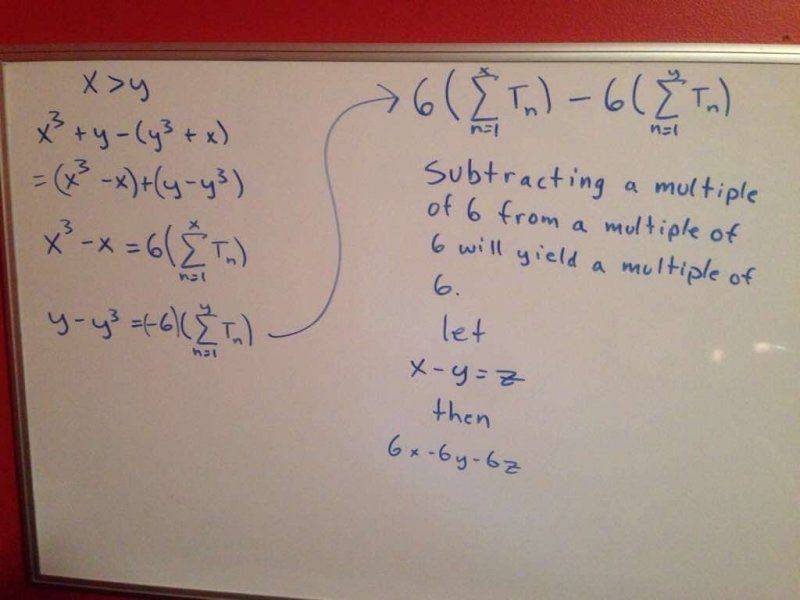
I recently came across a problem that said 'prove that the difference of x^3+y and y^3+x is a always a multiple of 6, given that x and y are integers'. I tried it, but I'm not sure if this is a valid proof.
ImageUploadedByPhysics Forums1419985517.717480.jpg
this is with the first triangular number being 0 and Tsubn being the nth triangular number.
 
Mathematics news on Phys.org
If you can use or prove the formula for the triangular numbers, sure.
 
Or you can do this:
x3 + y - (y3 + x) = x3 - x - (y3 - y)
= x(x2 - 1) - y(y2 - 1)
= x(x - 1)(x + 1) - y(y - 1)(y+ 1)

In a more suggestive form, the last expression is
(x - 1)(x)(x + 1) - (y - 1)(y)(y + 1), with each group being the product of three successive integers.

It's not too hard to show that the product of three integers in succession is divisible by 6 (can do this by induction), so the difference of two such products is also divisible by 6.
 
Mark44 said:
(can do this by induction)
Or splitting it into 5 to 6 cases.
That is the more elementary approach if the triangle formula is not available.
 
No need to consider different cases . Given 3 consecutive integers, exactly one is a multiple of 3 and at least one is even. Therefore the product is divisible by both 2 and 3.
 

Similar threads

Replies
1
Views
2K
  • · Replies 1 ·
Replies
1
Views
1K
  • · Replies 4 ·
Replies
4
Views
2K
  • · Replies 4 ·
Replies
4
Views
3K
  • · Replies 2 ·
Replies
2
Views
2K
Replies
3
Views
2K
  • · Replies 12 ·
Replies
12
Views
3K
  • · Replies 2 ·
Replies
2
Views
2K
  • · Replies 2 ·
Replies
2
Views
2K
  • · Replies 8 ·
Replies
8
Views
2K