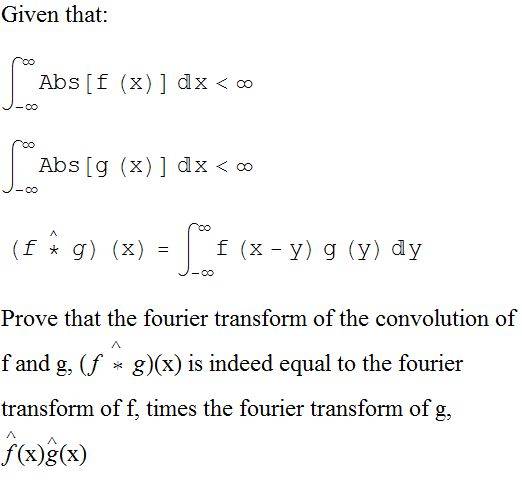
Prove the convolution of f and g

  • Thread starter Thread starter abstracted6
  • Start date Start date
  • Tags Tags
    Convolution
Click For Summary
SUMMARY

The discussion centers on proving the convolution of two functions, f and g, through the application of the Fourier transform. The integral to evaluate is $$\int_{-\infty}^{\infty}f(x-y)g(y)dy$$, which requires transforming it into a double integral. A change of variables is essential to separate the integrals effectively, facilitating the proof of the convolution theorem.

PREREQUISITES
  • Understanding of Fourier transforms
  • Knowledge of convolution operations
  • Familiarity with integral calculus
  • Experience with change of variables in integrals
NEXT STEPS
  • Study the properties of Fourier transforms
  • Learn about convolution in the context of signal processing
  • Explore techniques for changing variables in integrals
  • Investigate applications of convolution in differential equations
USEFUL FOR

Students in mathematics, engineers working with signal processing, and anyone interested in understanding the convolution of functions through Fourier analysis.

abstracted6
Messages
37
Reaction score
0
This was the bonus question on my test, I couldn't really figure out how to begin.

prob2.jpg
 
Physics news on Phys.org
Start by writing the Fourier transform of$$
\int_{-\infty}^{\infty}f(x-y)g(y)dy$$
It will be an integral of that, so it will be a double integral. See if you can find a change of variables that allows you to separate the integrals.
 

Similar threads

  • · Replies 10 ·
Replies
10
Views
3K
  • · Replies 13 ·
Replies
13
Views
2K
  • · Replies 2 ·
Replies
2
Views
3K
  • · Replies 2 ·
Replies
2
Views
2K
  • · Replies 1 ·
Replies
1
Views
1K
  • · Replies 17 ·
Replies
17
Views
5K
  • · Replies 12 ·
Replies
12
Views
2K
  • · Replies 11 ·
Replies
11
Views
7K
Replies
1
Views
2K
  • · Replies 23 ·
Replies
23
Views
2K