Proving 1/n! ≤ 1/(2·3^(n-2)) for n ≥ 3

  • Topic:
  • Thread starter Math Amateur
  • Start date
2 replies · 2K views · last reply
Math Amateur
Gold Member
MHB
Messages
3,920
Reaction score
48
I am reading Houshang H. Sohrab's book: "Basic Real Analysis" (Second Edition).

I am focused on Chapter 2: Sequences and Series of Real Numbers ... ...

I need help with an aspect of the proof of Proposition 2.3.15 ...

Proposition 2.3.15 and its proof read as follows:
View attachment 9052
In the above proof by Sohrab we read the following:

" ... ...Since $$1 / n! \leq 1 / (2 \cdot 3^{ n - 2 } )$$ for all $$n \geq 3$$ ... ... "My question is ... how do we know this is true ... ?

Can someone please demonstrate how to prove that $$1 / n! \leq 1 / (2 \cdot 3^{ n - 2 } )$$ for all $$n \geq 3$$ ... ...

Help will be much appreciated ...

Peter
 
Attachments
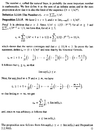
  • Printed page of a real analysis text covering the number e: its definition as the series sum of 1/n!, Proposition 2.3.15 that 2 < e < 3 and e equals the limit of (1 + 1/n)^n, and the proof with binomial expansions and inequalities.
    Sohrab - Proposition 2.3.15 ... .png
    26.9 KB · Views: 165
Hi Peter,

$n!=1\cdot2\cdot3\cdots n$ is the product of $n$ factors. As each of the $n-2$ factors after $2$ is at least equal to $3$, we have:
$$
n!\ge1\cdot2\cdot3^{n-2}=2\cdot3^{n-2}
$$
and the result follows by taking the inverse.
 
castor28 said:
Hi Peter,

$n!=1\cdot2\cdot3\cdots n$ is the product of $n$ factors. As each of the $n-2$ factors after $2$ is at least equal to $3$, we have:
$$
n!\ge1\cdot2\cdot3^{n-2}=2\cdot3^{n-2}
$$
and the result follows by taking the inverse.

Hmmm ... easy when you see how ... :) ...

Thanks for the help castor28 ...

Peter