Math Amateur
Gold Member
MHB
- 3,920
- 48
I am reading Houshang H. Sohrab's book: "Basic Real Analysis" (Second Edition).
I am focused on Chapter 2: Sequences and Series of Real Numbers ... ...
I need help with an aspect of Example 2.3.52 ...
The start of Example 2.3.52 reads as follows ... ...
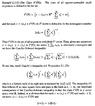
View attachment 9109
In the above Example from Sohrab we read the following:
" ... ... Then, given any sequences $$x = (x_n), \ y = (y_n) \in l^2 ( \mathbb{N} )$$, the series $$\sum_{ n = 1 }^{ \infty } x_n y_n $$ is absolutely convergent ... ..."
My question is as follows:
How/why, exactly, given any sequences $$x = (x_n), \ y = (y_n) \in l^2 ( \mathbb{N} )$$ ...
... does it follow that the series $$\sum_{ n = 1 }^{ \infty } x_n y_n $$ is absolutely convergent ... ...?
Help will be much appreciated ... ...
Peter
I am focused on Chapter 2: Sequences and Series of Real Numbers ... ...
I need help with an aspect of Example 2.3.52 ...
The start of Example 2.3.52 reads as follows ... ...
View attachment 9109
In the above Example from Sohrab we read the following:
" ... ... Then, given any sequences $$x = (x_n), \ y = (y_n) \in l^2 ( \mathbb{N} )$$, the series $$\sum_{ n = 1 }^{ \infty } x_n y_n $$ is absolutely convergent ... ..."
My question is as follows:
How/why, exactly, given any sequences $$x = (x_n), \ y = (y_n) \in l^2 ( \mathbb{N} )$$ ...
... does it follow that the series $$\sum_{ n = 1 }^{ \infty } x_n y_n $$ is absolutely convergent ... ...?
Help will be much appreciated ... ...
Peter
Attachments