Proving A=B ∪ (A ∩ B) with Distributive Law

  • Thread starter Thread starter senobim
  • Start date Start date
  • Tags Tags
    Law
Click For Summary
SUMMARY

The discussion focuses on proving the identity A = B ∪ (A ∩ B') under the condition that B ⊂ A, utilizing the Distributive Law of set theory. Participants express confusion regarding the solution provided in the manual, which incorrectly states that B ∪ (A ∩ B) = A without considering the complement sets. The correct approach involves recognizing that A ∩ B = B when B is a subset of A, and applying the correct distributive laws to derive the identity accurately. The conversation highlights the importance of clarity in set notation and the proper application of set theory laws.

PREREQUISITES
  • Understanding of set theory concepts, particularly unions and intersections.
  • Familiarity with Distributive Laws in set theory.
  • Knowledge of complement sets and their notation.
  • Ability to interpret Venn diagrams in the context of set operations.
NEXT STEPS
  • Study the Distributive Laws of set theory in detail.
  • Learn about De Morgan's Laws and their applications in set operations.
  • Practice drawing and interpreting Venn diagrams for various set identities.
  • Review the properties of subsets and their implications in set theory proofs.
USEFUL FOR

Students of mathematics, particularly those studying set theory, educators teaching algebra of sets, and anyone involved in mathematical proofs and logic.

senobim
Messages
34
Reaction score
1
<Moderator's note: Moved from a technical forum and thus no template.>

Greetings! I've been working on basic algebra of sets.

Refer to Exercise 2.4. Use the identities A = A ∩ S and S = B ∪ B and a distributive law to prove that If B ⊂ A then A = B ∪ (A ∩ B). Exercise 2.4 asked to draw Venn's diagram of this case. So I did. (posted from solution manual)

I had really hard time to prove that identity so I've checked solution manual for this part and found this:
B ∪( A ∩ B ) = (B ∩ A) ∪ (B ∩ B ) = (B ∩ A) = A

The only case where this solution could work is when A = B (the only case that I could think of) Or am I missing something? Is there any way to prove it without A = B assumption? (I think, I could prove it using associative law, but clearly exercise only permits distributive. I am confused.)
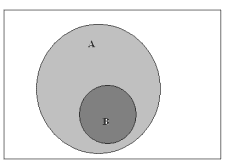
1.png
 

Attachments

  • 1.png
    1.png
    1.3 KB · Views: 1,524
Last edited by a moderator:
Physics news on Phys.org
senobim said:
<Moderator's note: Moved from a technical forum and thus no template.>

Greetings! I've been working on basic algebra of sets.

Refer to Exercise 2.4. Use the identities A = A ∩ S and S = B ∪ B
How are these identities? A ∩ S = A only if A ⊂ S. What is S? How is S equal to B ∪ B? And B ∪ B is just B.

senobim said:
and a distributive law to prove that If B ⊂ A then A = B ∪ (A ∩ B).
This doesn't make sense to me. If B ⊂ A, then A ∩ B = B, so B ∪ (A ∩ B) = B ∪ B = B, not A.
senobim said:
Exercise 2.4 asked to draw Venn's diagram of this case. So I did. (posted from solution manual)

I had really hard time to prove that identity so I've checked solution manual for this part and found this:
B ∪( A ∩ B ) = (B ∩ A) ∪ (B ∩ B ) = (B ∩ A) = A

The only case where this solution could work is when A = B (the only case that I could think of) Or am I missing something? Is there any way to prove it without A = B assumption? (I think, I could prove it using associative law, but clearly exercise only permits distributive. I am confused.)
View attachment 228441
Yes, the problem confuses me as well.
What book is this from? Are you sure you have written the problem exactly as stated in the book?
 
Last edited:
Ohh, after copying the problem, somehow, I've lost complement sets. Excuse me!

The book is Mathematical statistics with application by D.Wackerly et al.

A = A ∩ S , S = B ∪ B'

If B ⊂ A then A = B ∪ (A ∩ B')

Ok, If A = A ∪ B and A = A ∩ B it's possible to prove that identity, although I am still a little confused how is A = A ∩ B if B ⊂ A

By definition the intersection A ∩ B of two sets A and B is the set that contains all elements of A that also belong to B, so that implies A ∩ B = B if B ⊂ A.
 
Last edited:
senobim said:
Ohh, after copying the problem, somehow, I've lost complement sets. Excuse me!

The book is Mathematical statistics with application by D.Wackerly et al.

A = A ∩ S , S = B ∪ B'
Is S the universal set? You don't mention this anywhere, and it's not labelled as such in the image you attached. Many textbooks use U for the universal set, at least those written in English.
senobim said:
If B ⊂ A then A = B ∪ (A ∩ B')

Ok, If A = A ∪ B and A = A ∩ B it's possible to prove that identity, although I am still a little confused how is A = A ∩ B if B ⊂ A
If B ⊂ A, then it's not true that A = A ∩ B. It is true that B = A ∩ B in this case.

Edit: I mislabeled the properties I meant, but it's now fixed.
This implication, If B ⊂ A then A = B ∪ (A ∩ B'), is easy to prove using DeMorgan's Laws the Distributive Laws, which is what they have used in the solution you posted (with corrections for complements).

The two forms of this law are:
  • A ∪ (B ∩ C) = (A ∪ B) ∩ (A ∪ C) and
  • A ∩ (B ∪ C) = (A ∩ B) ∪ (A ∩ C)
senobim said:
By definition the intersection A ∩ B of two sets A and B is the set that contains all elements of A that also belong to B, so that implies A ∩ B = B if B ⊂ A.

You wrote this in post #1:
senobim said:
I had really hard time to prove that identity so I've checked solution manual for this part and found this:
B ∪( A ∩ B ) = (B ∩ A) ∪ (B ∩ B ) = (B ∩ A) = A
I haven't really looked at this. You said you had omitted the complement marks, so possibly they are missing in this, as well.
 
Last edited:
S - is a universal set.
Mark44 said:
If B ⊂ A, then it's not true that A = A ∩ B. It is true that B = A ∩ B in this case.

In that case answer posted in a solution manual of this book, doesn't make any sense at all (compliment marks added)

B ∪( A ∩ B' ) = (B ∩ A) ∪ ( B ∩ B' ) = (B ∩ A) = A

Mark44 said:
  • A ∪ (B ∩ C) = (A ∪ B) ∩ (A ∪ C) and
  • A ∩ (B ∪ C) = (A ∩ B) ∪ (A ∩ C)

I fail to see how they are using these law to prove that implication.
 
My attemp to prove it:

B ∪ (A ∩ B') = [distributive law] = (B ∪ A) ∩ (B ∪ B') = (B' ∩ A) = A
 
senobim said:
S - is a universal set.

In that case answer posted in a solution manual of this book, doesn't make any sense at all (compliment marks added)

B ∪( A ∩ B' ) = (B ∩ A) ∪ ( B ∩ B' ) = (B ∩ A) = A
You wrote something similar in post #1. The first equality is wrong. Either the work posted in your book (or wherever) has a typo, or you mistyped what was there.

It should be
B ∪ (A ∩ B' ) = (B ∪ A) ∩ ( B ∪ B' )
Earlier I referred to this as one of De Morgan's Laws, which is incorrect. This is one of the distributive laws of set theory.

Continuing from the above, since B ⊂ A, then B ∪ A = A, and B ∪ B' = S.
So B ∪ (A ∩ B' ) = (B ∪ A) ∩ ( B ∪ B' ) = A ∩ S = ?
senobim said:
I fail to see how they are using these law to prove that implication.
The work shown in the solution uses a distributive law of set theory, not De Morgan's Law as I called it.
 
Mark44 said:
Continuing from the above, since B ⊂ A, then B ∪ A = A, and B ∪ B' = S.
So B ∪ (A ∩ B' ) = (B ∪ A) ∩ ( B ∪ B' ) = A ∩ S = ?

= A

Solution manual is wrong, I posted exactly as it is. Thank you for your time!
 

Similar threads

  • · Replies 7 ·
Replies
7
Views
2K
Replies
16
Views
3K
  • · Replies 10 ·
Replies
10
Views
2K
  • · Replies 5 ·
Replies
5
Views
2K
  • · Replies 1 ·
Replies
1
Views
2K
Replies
7
Views
2K
  • · Replies 10 ·
Replies
10
Views
3K
Replies
2
Views
1K
  • · Replies 2 ·
Replies
2
Views
2K
  • · Replies 10 ·
Replies
10
Views
2K