Proving Acute Angles from Two Equations

  • Thread starter Thread starter Saptarshi Sarkar
  • Start date Start date
  • Tags Tags
    Angles
Click For Summary
SUMMARY

The discussion centers on proving that the angles resulting from two equations related to a collision are acute. The equations provided are 2mv = 2mv_aCos(a) + mv_bCos(b) and 0 = 2mv_aSin(a) - mv_bSin(b). It is established that the collision is not inelastic, as the particles remain separate post-collision. The conversation highlights that if the collision is elastic, the angles can be derived using the ZMF (Zero Momentum Frame) approach, leading to the conclusion that both angles are acute based on the maximum angle of deflection formula arcsin(m/M).

PREREQUISITES
  • Understanding of elastic and inelastic collisions
  • Familiarity with momentum conservation principles
  • Knowledge of trigonometric functions and their applications in physics
  • Ability to work with equations involving angles and velocities
NEXT STEPS
  • Study the concept of Zero Momentum Frame (ZMF) in collision analysis
  • Learn about the maximum angle of deflection in elastic collisions
  • Explore the implications of kinetic energy conservation in elastic vs. inelastic collisions
  • Investigate the mathematical derivation of angles in collision scenarios
USEFUL FOR

Physics students, educators, and professionals interested in collision mechanics, particularly those focusing on elastic and inelastic collision analysis and angle determination.

Saptarshi Sarkar
Messages
98
Reaction score
13
Homework Statement
A body 'A' of mass 2m collides with a body 'B' of mass m initially at rest in the Laboratory frame. The two bodies are seen to fly off at angles 'a' and 'b' respectively with respect to the incident direction. Find whether the angles a and b acute or obtuse.
Relevant Equations
##p_{x_{initial}} = p_{x_{final}}##
##p_{y_{initial}} = p_{y_{final}}##
From the above two equations, I get :
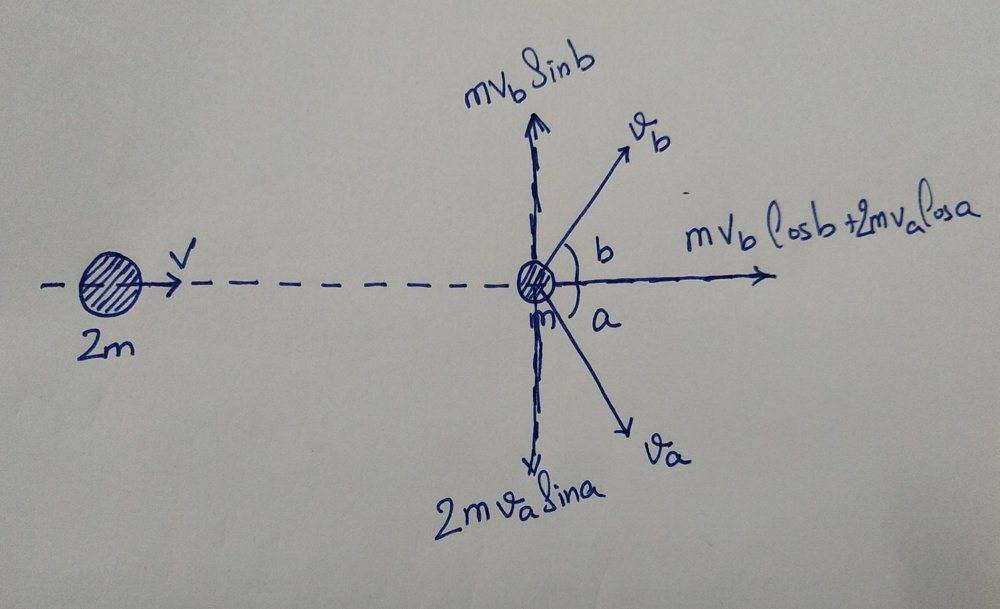
IMG_20200108_200419.jpg


##2mv = 2mv_aCos(a) + mv_bCos(b)##
##0 = 2mv_aSin(a) - mv_bSin(b)##

But, I can't figure out how to prove how the angles should be. I think both the angles should be acute, but don't know how to show it.
 
Physics news on Phys.org
Do we know if the collision is elastic?
 
etotheipi said:
Do we know if the collision is elastic?

The question does not specify it. But it's not inelastic as we can see that after the collision, both the particles remain separate.
 
Saptarshi Sarkar said:
The question does not specify it, but it's not inelastic as we can see that after the collision, both the particles remain separate.

It can still be inelastic if the particles remain separate, it just won't be totally inelastic.

If the collision is elastic, we can transform into the ZMF (by, in this case, subtracting ##\frac{2v}{3}## from all of our velocities before the collision). This would allow us to easily see that after the collision, in the ZMF, the particle of mass ##2m## moves away at some angle at ##\frac{v}{3}## and the particle of mass ##m## moves in exactly the opposite direction at ##\frac{2v}{3}##. From this point, we can add on the ZMF velocity vector of magnitude ##\frac{2v}{3}## again and see if we can solve for the angles.
 
Last edited by a moderator:
  • Like
Likes   Reactions: Saptarshi Sarkar
Without info on elasticity, what can you say about KE before and after?
What inequality can you write?
 
etotheipi said:
It can still be inelastic if the particles remain separate, it just won't be totally inelastic.
Even if the particles do not stay together, a glancing blow can be completely inelastic. Complete inelasticity just means there is a maximal loss of KE subject to other constraints. If there's no glue or friction then the momentum of the incoming particle in a direction parallel to the plane of contact is unaffected.

I think it is reasonably obvious that maximal deflection of the incoming particle occurs when the collision is perfectly elastic.
 
  • Like
Likes   Reactions: etotheipi
haruspex said:
Even if the particles do not stay together, a glancing blow can be completely inelastic. Complete inelasticity just means there is a maximal loss of KE subject to other constraints. If there's no glue or friction then the momentum of the incoming particle in a direction parallel to the plane of contact is unaffected.

I didn't know this, thanks for enlightening me!
haruspex said:
I think it is reasonably obvious that maximal deflection of the incoming particle occurs when the collision is perfectly elastic.

I believe that when I scribbled down the elastic version a few days ago both angles were necessarily acute. So the inequality follows...
 

Similar threads

Replies
3
Views
1K
Replies
1
Views
1K
  • · Replies 15 ·
Replies
15
Views
1K
  • · Replies 20 ·
Replies
20
Views
3K
  • · Replies 8 ·
Replies
8
Views
2K
  • · Replies 21 ·
Replies
21
Views
3K
Replies
14
Views
946
  • · Replies 9 ·
Replies
9
Views
1K
  • · Replies 4 ·
Replies
4
Views
2K
  • · Replies 3 ·
Replies
3
Views
757