Proving Probability of Union with Indicator Variables in Three Events

Click For Summary

Discussion Overview

The discussion revolves around proving Theorem 7.1 regarding the probability of a union of three events using indicator variables, specifically referencing a proof from section 12.2. Participants express challenges in understanding the proof and seek assistance in working through examples and variations of the proof for different numbers of events.

Discussion Character

  • Homework-related
  • Technical explanation
  • Debate/contested

Main Points Raised

  • One participant expresses frustration with their professor's teaching style and the lack of examples, indicating that the entire class struggles with the proof.
  • Another participant mentions the inclusion-exclusion principle and suggests that the proof may be more accessible in a free textbook by Blitzstein and Hwang.
  • A participant seeks help in writing their own version of the proof for three events, indicating a desire to extend this to more events.
  • One suggestion is to start with the proof for two events using a Venn diagram to understand double counting before progressing to three events.
  • Another participant clarifies the requirement to explicitly write out the proof for three events without using product notation, emphasizing the need for detailed steps.

Areas of Agreement / Disagreement

Participants generally agree on the difficulty of the proof and the need for clearer examples. However, there are differing opinions on the best approach to understanding and proving the theorem, with some advocating for starting with simpler cases while others focus on the specific requirements of the proof.

Contextual Notes

Participants mention various approaches and resources, but there is no consensus on a single method for proving the theorem. The discussion reflects a range of understanding and strategies for tackling the proof, highlighting the complexity involved.

Brooklyn
Messages
2
Reaction score
0
TL;DR
Probability of a Union using Indicator Functions
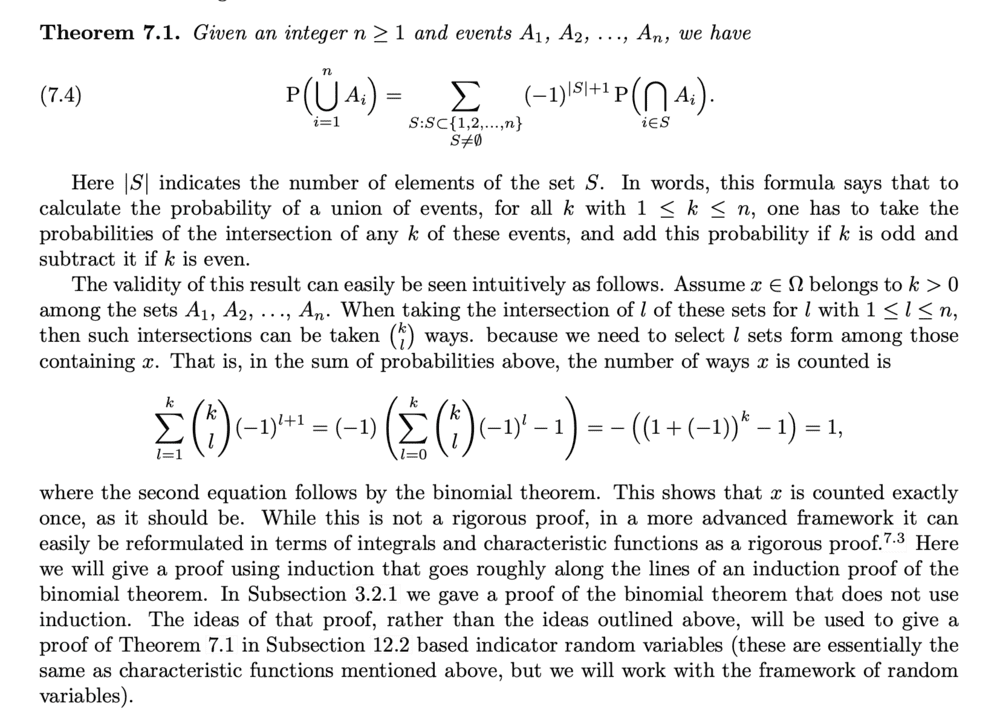
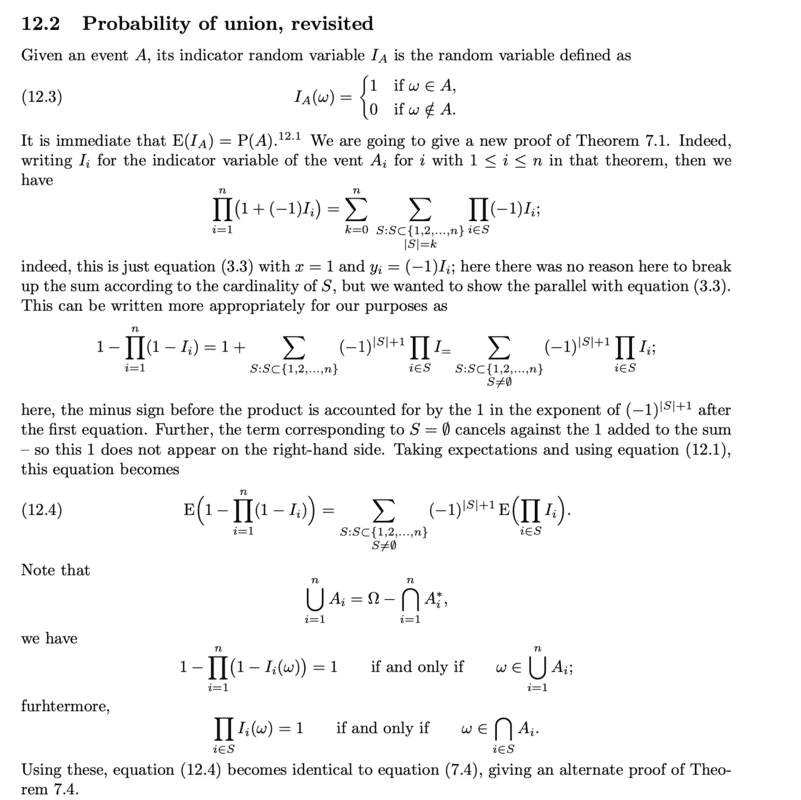
"Prove Theorem 7.1 about the probability of a union, using the 12.3 proof (see section 12.2) that involves indicator variables. Do not write the proof in full generality, only for three events. You should not use the product notation; you should write out all factors of the product."

I'm taking a calculus-based intro to probability and stats course that's not intended for math majors. I have a professor who is terrible at teaching and expects that students should easily be able to do the proof. I asked for help and he told me that it'd make sense if I worked out an example. I'm not sure how to work out an example if I don't understand the proof. None of the students in the class understand the proof.

During class, he reads from his notes (excerpts below) and doesn't work out examples. A month into the course, he says we need more theory before he supposedly gets to examples. I found nothing on the net to explain the proof. Any help would be greatly appreciated and I'd pass it on to the rest of the class which is also lost.
Screen Shot 2020-09-24 at 9.14.56 PM.png

Screen Shot 2020-09-24 at 9.13.53 PM.png
 
Physics news on Phys.org
they're doing inclusion-exclusion... what exactly is your question? I think this is worked out in a more friendly way in the free book by Blitzstein and Hwang https://projects.iq.harvard.edu/stat110/home

For the second approach with indicators: it helps to know what an elementary symmetric function is and how to factor or expand a polynomial
 
I'm trying to figure out how to write my own version of the 12.3 proof for "two, three, four, or five events." I tried to ask if someone could help write a proof for 3 events, then I could work out the other cases. I think the notes provide the general proof and we're supposed to translate that.

Thanks for the link, I'll lookup inclusion-exclusion in the book.
 
why don't you do the proof for ##n=2## items? Draw a venn diagram and pay attention to what you are double counting...

Once you've mastered ##n=2##, try ##n=3## which is very doable. ##n=4## may be workable but it starts to get a bit tedious around ##n\geq 4## and some abstraction is needed.
 
Brooklyn said:


"Prove Theorem 7.1 about the probability of a union, using the 12.3 proof (see section 12.2) that involves indicator variables. Do not write the proof in full generality, only for three events. You should not use the product notation; you should write out all factors of the product."

I interpret that to mean that your write-out the proof of Theorem 7.1 for the special case ##n = 3##.

For example, instead of ##\Pi _{i=1}^{n} (1 + (-1)I_i)##, you write ##\Pi_{i=1}^{3} (1 + (-1)I_i)) = (1 - I_1)(1-I_2)(1-I_3) = ## whatever eq. 3.3 says in this case.
 

Similar threads

  • · Replies 3 ·
Replies
3
Views
2K
  • · Replies 11 ·
Replies
11
Views
4K
  • · Replies 17 ·
Replies
17
Views
3K
  • · Replies 14 ·
Replies
14
Views
5K
  • · Replies 93 ·
4
Replies
93
Views
21K
  • · Replies 3 ·
Replies
3
Views
2K
  • · Replies 45 ·
2
Replies
45
Views
16K
  • · Replies 7 ·
Replies
7
Views
2K
  • · Replies 7 ·
Replies
7
Views
2K
  • · Replies 11 ·
Replies
11
Views
4K