Proving the result of the following limit

  • Thread starter Thread starter Rikudo
  • Start date Start date
  • Tags Tags
    Limit
Click For Summary
SUMMARY

The discussion centers on proving the limit of the function \( f(x) = (1+x)^{1/x} \) as \( x \) approaches 0. Participants explore various methods including L'Hôpital's rule and logarithmic differentiation to resolve the indeterminate form \( \frac{0}{0} \). The limit is ultimately shown to converge to \( e \) through Taylor series expansion and careful analysis of the derivatives. Key insights include the importance of recognizing the differentiability of \( f \) and the application of the Maclaurin series for \( \ln(1+x) \).

PREREQUISITES
  • Understanding of limits and continuity in calculus
  • Familiarity with L'Hôpital's rule for resolving indeterminate forms
  • Knowledge of Taylor series and Maclaurin expansion
  • Basic principles of logarithmic differentiation
NEXT STEPS
  • Study the application of L'Hôpital's rule in various indeterminate forms
  • Learn about Taylor series and how to derive them for common functions
  • Explore logarithmic differentiation techniques in calculus
  • Investigate the properties of exponential functions and their limits
USEFUL FOR

Students and professionals in mathematics, particularly those focusing on calculus, limit evaluation, and function analysis. This discussion is beneficial for anyone looking to deepen their understanding of limits involving exponential functions.

Rikudo
Messages
120
Reaction score
26
Homework Statement
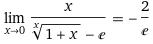
Proving value of this limit. (see the picture below)
Relevant Equations
euler's limit identity
Right now, I am trying to prove this :
lim_(x->0) x/((1 + x)^(1/x) - e) = -2/e

I tried to use this identity to solve it:
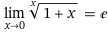
lim_(x->0) (1 + x)^(1/x) = e

Then, the limit will become ##\frac {x}{e-e}##
However, the result is still ##\frac 0 0 ##

Could you please give me hints to solve this problem?
 
Physics news on Phys.org
We are effectively computing derivative at ##t=0## by definition for ## f(x) := (1+x)^{1/x} ##
<br /> \lim _{x\to 0} \frac{f(x)-f(0)}{x} = \lim _{x\to 0} \frac{(1+x)^{1/x} - e}{x}<br />
The map ##f## is differentiable since it's a composition of differentiable maps (i.e the above limit exists). Expressions of the form ## \frac{d}{dx}a(x)^{b(x)}## can be tackled with logarithmic differentiation.

Seems like a fancy way of saying "use L'Hopital's rule".
 
nuuskur said:
We are effectively computing derivative at ##t=0## by definition for ## f(x) := (1+x)^{1/x} ##
<br /> \lim _{x\to 0} \frac{f(x)-f(0)}{x} = \lim _{x\to 0} \frac{(1+x)^{1/x} - e}{x}<br />
The map ##f## is differentiable since it's a composition of differentiable maps (i.e the above limit exists). Expressions of the form ## \frac{d}{dx}a(x)^{b(x)}## can be tackled with logarithmic differentiation.

Seems like a fancy way of saying "use L'Hopital's rule".
Ok. so, I tried to differentiate the ##(1+x)^{1/x}##, and using the rule, I get:

$$\lim _{x\to 0} \frac{x}{(1+x)^{1/x} - e} = \frac{1}{\frac{x(1+x)^{-1+\frac{1}{x}}\,\,-\,\,(1+x)^{\frac 1 x}\,\,ln(1+x)}{x^2}}$$

Then, all I need to do is to substitute the value of ##x## as zero, right?
The answer is quite strange...The denominator will be ##\frac 0 0##
 
Your denominator is
\lim_{x \rightarrow 0}(1+x)^{\frac{1}{x}}[\frac{1}{x}(1- \ln (1+x)^{\frac{1}{x}})-\frac{1}{1+x}]
=e \lim_{x \rightarrow 0}[\frac{1}{x}(1- \ln (1+x)^{\frac{1}{x}})-1]
Maclaulin expansion formula of log (1+x) seems helpful for investigation of this limit.
 
Last edited:
anuttarasammyak said:
Maclaulin expansion formula of log (1+x) seems helpful for investigation of this limit.
Ah. I see.. Now I managed to prove it.

There are some things that is bothering me,though..
1. Why my method in post 1 does not work?

2. I tried a different way to transform the term ##ln(1+x)##, but I only get the first term of the maclaurin series.
Here is what I did:
let ##y= ln(1+x)##

Then, we can rewrite this equation as $$e^y=(1+x)$$
Now, since x->0, we can use the identity of euler number
$$e^{\frac y x}= (1+x)^{\frac 1 x} $$
$$e^{\frac y x} = e$$
$$y = ln(1+x) = x $$
As we can see, this result slightly different from the maclaurin's (##x-\frac {x^2}{2}##)
 
1.\frac{x^2}{x},\frac{x}{x},\frac{x}{x^2}
are all 0/0. We need to investigate orders to zero in denominator and numerator to get the limit value. L'Hopital rule is a popular one to do it.
2.y(x)=\ln (1+x)
y(0)=0
y^{(1)}(x)=\frac{1}{1+x}
y^{(1)}(0)=1
y^{(2)}(x)=-\frac{1}{(1+x)^2}
y^{(2)}(0)=-1
Thus we get Taylor series of
y(x)=\ln (1+x)=x-\frac{x^2}{2}+...
 
Last edited:
I would write ##f(x) = \exp (\ln(1+x)/x)##. Then
<br /> f&#039;(x) = (1+x)^{1/x}\left (\frac{1}{x^2+x} - \frac{1}{x^2}\ln (1+x) \right ) \xrightarrow[x\to 0]{} - \frac{e}{2}<br />
The right term converges to ##-\frac{1}{2}## so the result follows.

Rikudo said:
Ok. so, I tried to differentiate the ##(1+x)^{1/x}##, and using the rule, I get:

$$
\lim _{x\to 0} \frac{x}{(1+x)^{1/x} - e} = \frac{1}{\frac{x(1+x)^{-1+\frac{1}{x}}\,\,-\,\,(1+x)^{\frac 1 x}\,\,ln(1+x)}{x^2}}
$$

Then, all I need to do is to substitute the value of ##x## as zero, right?
The answer is quite strange...The denominator will be ##\frac 0 0##
Write ##\lim_ {x\to 0}## on the RHS as well (the derivative is incorrect, though). Substitution might work, but doesn't have to. In the event of "##\frac{0}{0}##", apply L'Hopital.
 
Last edited:
nuuskur said:
We are effectively computing derivative at ##t=0## by definition for ## f(x) := (1+x)^{1/x} ##
<br /> \lim _{x\to 0} \frac{f(x)-f(0)}{x} = \lim _{x\to 0} \frac{(1+x)^{1/x} - e}{x}<br />
Why can't we just substitute ##(1+x)^{1/x}## as ##e?##

then, this equation will become:
$$\lim _{x\to 0} \frac{f(x)-f(0)}{x} = \lim _{x\to 0} \frac {e- e}{x}$$
Since x is near zero, then we can make it like this:
$$\lim _{x\to 0} \frac{f(x)-f(0)}{x} = \lim _{x\to 0} \frac{0}{x}$$
So, the answer to this limit equation which I have quoted from your reply is ##0##
 
You can assume |x| &lt; 1 and expand (1 + x)^{1/x} as a binomial expansion:
\begin{split}<br /> \frac{(1 + x)^{1/x} - e}{x} &amp;= \frac{1}{x}\left( 1 - e + \sum_{n=1}^\infty \frac{x^n}{n!} \prod_{k=0}^{n-1}<br /> \left( \frac 1x - k \right) \right) \\<br /> &amp;= \frac{1}{x} \left(2 - e + \sum_{n=2}^\infty \frac{1}{n!} \prod_{k=1}^{n-1} (1 - kx) \right) \end{split}. The only terms you need from \prod_{k=1}^{n-1} (1 - kx) are the O(1) and O(x) terms; everything else will vanish in the limit x \to 0.
 
  • #10
Rikudo said:
Why can't we just substitute ##(1+x)^{1/x}## as ##e?##

then, this equation will become:
$$\lim _{x\to 0} \frac{f(x)-f(0)}{x} = \lim _{x\to 0} \frac {e- e}{x}$$
Since x is near zero, then we can make it like this:
$$\lim _{x\to 0} \frac{f(x)-f(0)}{x} = \lim _{x\to 0} \frac{0}{x}$$
So, the answer to this limit equation which I have quoted from your reply is ##0##
Alright, I'll bite. You claim that the derivative of every differentiable function at ##0## is equal to ##0##. That's obviously false.

You can't just limit the expression piece by piece. It's not valid in general. While it is true that ##\lim _{x\to 0} f(x)-e =0##, the quantity ##\frac{1}{x}## is not bounded as ##x\to 0##. So you can't claim the limit of the whole thing is zero.

Your argument is akin to claiming something like
<br /> \lim _{x\to\infty} \left ( 1+\frac{1}{x} \right )^x = \lim _{x\to\infty} 1^x = 1 .. \quad\text{(this is false!)}<br />
it doesn't work like that.
 
  • #11
Rikudo said:
Why can't we just substitute ##(1+x)^{1/x}## as ##e?##
Because they're not equal. The limit of the first expression, as x approaches zero, is the number e.
nuuskur said:
Your argument is akin to claiming something like $$\lim _{x\to\infty} \left ( 1+\frac{1}{x} \right )^x = \lim _{x\to\infty} 1^x = 1 .. \quad\text{(this is false!)}$$
What he said.
The limit above is another indeterminate form; namely ##[1^\infty]##. It's indeterminate because limits of this form can have arbitrary values.
 

Similar threads

  • · Replies 10 ·
Replies
10
Views
2K
  • · Replies 14 ·
Replies
14
Views
4K
  • · Replies 25 ·
Replies
25
Views
1K
  • · Replies 9 ·
Replies
9
Views
3K
  • · Replies 8 ·
Replies
8
Views
2K
  • · Replies 23 ·
Replies
23
Views
2K
  • · Replies 5 ·
Replies
5
Views
684
Replies
24
Views
4K
Replies
5
Views
2K
  • · Replies 10 ·
Replies
10
Views
2K