Pulley system for cardboard pulp shredder/mixer

Click For Summary

Discussion Overview

The discussion revolves around the design and feasibility of a human-powered cardboard pulp shredder/mixer intended for performance art. Participants explore the mechanics of pulleys, power requirements, and safety considerations in creating a machine that can effectively shred cardboard using human effort.

Discussion Character

  • Exploratory
  • Technical explanation
  • Debate/contested
  • Experimental/applied

Main Points Raised

  • One participant describes a machine design involving pulleys and a blade system to shred cardboard, expressing uncertainty about the required RPM and safety.
  • Another participant questions the initial claim of the drill's RPM, suggesting that a typical drill operates at a maximum of 2500 RPM, and provides calculations for the expected RPM of the proposed system.
  • A participant corrects their earlier mistake regarding the drill's RPM, clarifying it to be 3000 RPM and providing details about the DIY blade design.
  • Discussion includes the importance of understanding power requirements, with one participant explaining the energy needed to pulp cardboard and the limitations of human power compared to electric systems.
  • Suggestions are made to consider pedal power and the use of bicycle components for efficiency, with a focus on the challenges of converting vertical to horizontal motion.
  • Participants discuss the potential for using bevel gears to transmit power, while others seek simpler, more DIY solutions.
  • Questions are raised about the specific requirements for pulp production, including the amount of pulp needed per hour and the number of people involved in the process.
  • Concerns are expressed about the practicality of competing with electric-powered systems, even in contexts where labor is inexpensive.

Areas of Agreement / Disagreement

Participants express various viewpoints on the feasibility and design of the proposed machine, with no consensus reached on the best approach or the effectiveness of human power compared to electric systems. Multiple competing ideas about power transmission and design remain unresolved.

Contextual Notes

Participants highlight the need for specific numerical requirements (e.g., pulp per hour, number of performers) to better assess the design's feasibility. There are also unresolved questions about the efficiency of the proposed system compared to existing electric solutions.

lucaszito
Messages
4
Reaction score
0
TL;DR
Human powered cardboard pulp maker
Hi everybody, first message on this forum !

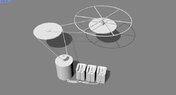
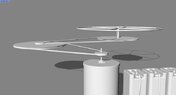
I am building a machine for a friend who works with cardboard pulp, he is also a performance artist and would like a machine where 2 or 3 performers can activate the machine by hand with pulleys and wheels, and shred the pieces of cardboard that are soaking in a container filled with water. There is 4 pulleys in total and the last driven pulley is attached to a shaft with blades on it, this whole assembly constitutes the shredding mechanism.

Currently the artist is shredding the cardboard with a hand drill on which is attached some very small DIY blades. The drill runs for about 30 minutes at 8000 RPM and he manages to get the consistency he wants.
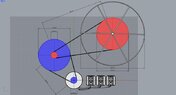
In my idea of his machine 2 performers would spin a horizontal wheel bar of 2 meter(6.56168 feet) diameter at about 5 to 15 RPM and that wheel bar is attached to a pulley which is driving a 1:5 pulley, that 1:5 pulley is attached to a 1:1 pulley which drives another 1:5 pulley. Since the blade that will be made for this machine is about 12 times bigger than the original blade he was using, I am not sure that we need as many RPM as the drill gives. But I am not very sure either. Anyhow, I thought that just a little less RPM than the drill would do the trick, maybe 5000 if that is even doable. All pulleys will be made of wood and the wheel bar will be in steel tubes.However it is my very first time working with pulleys and ratio and I lack experience in safety, in feasibility and in physics.

I do not know how to obtain the RPM I want for the rotating blade while having a decent of size for the whole machine. Here are a few links to some pictures that give you guys dimensions and other drawings to see the machine better.

https://res.cloudinary.com/engineer...v1621112118/tips/dimensions_fltygf_rpbgnw.jpg
https://res.cloudinary.com/engineering-com/image/upload/v1620749269/tips/1_uf3o60.jpg
https://res.cloudinary.com/engineering-com/image/upload/v1620749310/tips/2_ooh7c9.jpg

Obviously the pulleys will not be floating, I just haven't thought about the structure yet, I wanted to have your opinion first.I am wondering if such a system will output the results I want, if it is durable and safe.

Thank you very much for your help !

Lucas
 
Physics news on Phys.org
We need more information to help you determine if the human power system will work as desired.

Are you sure about that 8000 RPM drill? How powerful is the drill? Because the fastest drill I have ever seen ran 2500 RPM. If the hand wheel turns 5 to 15 RPM, and you have two 5:1 drive ratios in series, the rotating blade will turn 125 to 375 RPM. A sketch or photo, with some dimensions, of the existing rotating blade would be helpful.

It will be as durable as you make it. It will be as safe as you make it. Human powered machines are easy to stop if something goes wrong, but you do need to design it so as to avoid pinch points.

BTW, if you are interested in how the big companies make waste paper into pulp, search paper pulper. A typical pulper will pulp over 100 tons per day, and is driven by a motor of several hundred horsepower.
 
  • Like
Likes   Reactions: lucaszito
Oops sorry I made many mistakes ! So I meant to type 3000RPM for the drill, it consumes about 550W when running full speed.

The blade is also something we will DIY, we'll take 8b200mm circular saw blades cut them in half and bend a quarter a few degrees. And then arrange them so that they look the same way I've attached in the pictures. There are some teeth on the curved part of the blade just as there are on wood circular saw blades.

The sketch I've already drawn is really a mock up, and even the gear system is something I tried to come up with but it is definitely okay to change it completely.

Hope you have enough info
 

Attachments

  • dimensions_fltygf.jpg
    dimensions_fltygf.jpg
    28.8 KB · Views: 231
  • 1_uf3o60.jpg
    1_uf3o60.jpg
    13.9 KB · Views: 214
  • 2_ooh7c9.jpg
    2_ooh7c9.jpg
    14.7 KB · Views: 233
  • Screenshot 2021-05-16 021209.png
    Screenshot 2021-05-16 021209.png
    31.8 KB · Views: 196
  • Screenshot 2021-05-16 021233.png
    Screenshot 2021-05-16 021233.png
    14 KB · Views: 210
You need to look at power requirements before designing a drive system. Pulping a given amount of paper requires a certain amount of energy. Energy is power times time. The drill system uses 550 watts times 0.5 hour, or 275 watt-hour of energy to pulp that amount of paper. If you want to pulp a larger amount of paper, the energy will scale accordingly. Pulping twice as much paper will need about 550 watt-hours of energy.

A normal physically fit human can produce about 100 watts of power using their legs on bicycle pedals, and maintain this for several hours. Arms are much less strong, so can produce only a fraction of that amount of power. A pedal power system will work best at about 80 RPM. Drive train efficiency is very important in low power systems, and bicycle sprockets and chains are both extremely efficient and readily available.

The energy requirements decrease if the paper is presoaked long enough to soften it. The energy requirements increase or decrease depending on the efficiency of the impeller. And the total time to convert paper into pulp is the energy required divided by the amount of paper to pulp. There are enough differences between the drill system and the proposed performance art system that it is difficult to calculate if the proposed system will do what you want. In that case, the suggested approach is to build something and find out. But make it easy to change gear ratios and impellers because you will be changing those.

This is definitely an interesting project, so don't get discouraged.
 
  • Like
Likes   Reactions: russ_watters, lucaszito and Lnewqban
Thanks a lot jrmichler for your answer.
I've been advised earlier to think about pedal power, but I don't know how I could transmit the vertical spin of the sprocket into a horizontal spin for the shaft with available means.
 
Search bevel gears to find how to transmit power around a 90 degree corner. Lots of good hits on the first page of results.
Bevel Gears.jpg
 
Would there be something easier to find ? A more DIY way for instance ?
 
lucaszito said:
Would there be something easier to find ? A more DIY way for instance ?
What are your requirements? How much pulp per hour? How many people?

This video illustrates the basic steps at an industrial scale.

I could visualize a big drum that people spin by walking like a treadmill. But it might take N people, H hours, to pulp K kilos of cardboard. Obviously numbers are needed for , N, H and K.

You're going to have a hard job competing with electric power. Even third world countries where hand labor is nearly free, they use electric pulpers.