Pulleys and Gravity: Solving Acceleration for m1 & m2

  • Thread starter Thread starter ace214
  • Start date Start date
  • Tags Tags
    Gravity Pulleys
Click For Summary

Homework Help Overview

The discussion revolves around a physics problem involving two masses connected by a pulley system, where one mass is on a horizontal surface and the other is hanging. The problem explores the effects of static and kinetic friction on the acceleration of the system when released from rest and when in motion.

Discussion Character

  • Exploratory, Assumption checking, Problem interpretation

Approaches and Questions Raised

  • Participants discuss the equations of motion for both masses, questioning the treatment of static versus kinetic friction. There is a focus on whether the equations should yield zero acceleration in certain scenarios and the implications of negative acceleration results.

Discussion Status

Participants are actively engaging with the problem, with some suggesting that the equations may need to be treated separately for different friction scenarios. There is a recognition of the need to consider whether the forces involved can overcome static friction, and hints have been provided regarding the nature of static friction.

Contextual Notes

There is an emphasis on the maximum value of static friction and the conditions under which the system may or may not accelerate. Participants are also navigating the constraints of homework rules regarding the use of feedback and attempts.

ace214
Messages
28
Reaction score
0
In Figure P4.30, m1 = 9.5 kg and m2 = 3.5 kg. The coefficient of static friction between m1 and the horizontal surface is 0.60 while the coefficient of kinetic friction is 0.30.
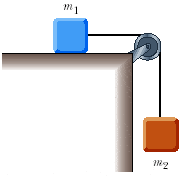
p4-30.gif
(Why can't I post this image in the message?)
In case you don't feel like looking at the picture, there are two masses connected by a frictionless pulley- m1 is on the table, m2 is hanging off the table.

(a) If the system is released from rest, what will its acceleration be?
(b) If the system is set in motion with m2 moving downward, what will be the acceleration of the system?

=========================================

I assume that the basic equation is the same for both parts just with different coefficients of friction. (Is this correct?) So I start with

m1a1 = T - forceFriction
m2a1 = T - m2g

Then I plug in -a1 for a2 in the second problem giving me -m2a1 = T - m2g => m2a1 = -T +m2g

Then add these two equations together, canceling out the tension.

m1a1 + m2a1 = m2g - Ff => a1(m1 + m2) = m2g - Ff


Then I solve for a using +9.8 for g in all cases. I eventually get -1.66 but this is not the answer. WebAssign says it differs by order of magnitude...

==========================================

I think something may be wrong with my signs in one way or another but I have tried multiple ways. Thanks for any help.
 

Attachments

  • p4-30.gif
    p4-30.gif
    2.2 KB · Views: 697
Physics news on Phys.org
Are you combining the two questions? You should treat them separately. The equations will be the same except that the frictional force will be different.
 
Yes, that's what I said. No, I have just tried one (using the static friction) to see if I've got it right, because feedback is given immediately. I didn't want to use up all my chances in both.

Any help as to the answer?
 
static case

Realize that static friction can have any value up to the maximum of [itex]\mu N[/itex]; you can't just say that it equals that maximum value. The first thing you have to answer is: Can the hanging mass exert enough force to overcome the static friction?
 
Have you considered for case (a) that the block would not accelerate (i.e. zero acceleration)?

Hint: Does m2 generate enough force to overcome the static friction force of m1?
 
Ahhh.. Ok. But shouldn't the equations have worked anyway and just gotten 0?
Also, I got it to work for kinetic friction.
 
ace214 said:
But shouldn't the equations have worked anyway and just gotten 0?
No, because your equation had friction = [itex]\mu N[/itex], which isn't true for static friction. (Static friction is less than or equal to that maximum value, as needed.)

Also, I got it to work for kinetic friction.
Sure, since kinetic friction does equal [itex]\mu N[/itex].
 
So is there a way to plug it into such an equation or will it always be "is this force greater than friction?"
 
The fact that you got a negative acceleration should have been a tip-off. You should know that the only way this thing could accelerate is in the + direction (to the right and down).

But there's no substitute for reasoning it out.
 
  • #10
Ok, thanks a lot.
 

Similar threads

  • · Replies 5 ·
Replies
5
Views
2K
  • · Replies 2 ·
Replies
2
Views
1K
  • · Replies 3 ·
Replies
3
Views
2K
  • · Replies 1 ·
Replies
1
Views
3K
  • · Replies 3 ·
Replies
3
Views
2K
  • · Replies 10 ·
Replies
10
Views
3K
  • · Replies 4 ·
Replies
4
Views
2K
  • · Replies 2 ·
Replies
2
Views
2K
  • · Replies 4 ·
Replies
4
Views
3K
  • · Replies 34 ·
2
Replies
34
Views
4K