How Does Torque Affect the Motion of a Disc Pulled Across a Table?

  • Thread starter Thread starter ago01
  • Start date Start date
  • Tags Tags
    Disc Table
Click For Summary
SUMMARY

This discussion focuses on the relationship between torque and the motion of a disc being pulled across a table, specifically addressing the equations governing rotational and translational motion. The user initially struggles with the correct application of torque and acceleration, ultimately realizing that static friction plays a crucial role in forward motion. Key equations discussed include the torque equation ##T_1R = \frac{Mr^2}{2}\alpha## and the relationship between angular acceleration and tangential acceleration ##\alpha = \frac{a_t}{r}##. The final understanding emphasizes that the tangential acceleration is indeed related to the acceleration of the center of mass (CM) of the object.

PREREQUISITES
  • Understanding of Newton's laws of motion
  • Familiarity with rotational dynamics and torque equations
  • Knowledge of static friction and its role in motion
  • Basic grasp of angular acceleration and its relationship to linear acceleration
NEXT STEPS
  • Study the relationship between static friction and torque in rolling motion
  • Learn about the moment of inertia and its impact on rotational motion
  • Explore the derivation of equations relating angular and linear acceleration
  • Investigate common mechanics textbooks that cover rotational dynamics in detail
USEFUL FOR

This discussion is beneficial for physics students, mechanical engineers, and anyone interested in understanding the principles of rotational motion and the effects of torque on moving objects.

ago01
Messages
46
Reaction score
8
Homework Statement
A uniform cylindrical spool of string has radius R=3 cm, and mass M=500g. You accelerate the spool along a table by applying a constant force F=2N to the string. The spool rolls along the table without slipping and you can ignore the mass of the string. What is the acceleration of the center of mass of the spool? What is the magnitude of the static friction?
Relevant Equations
Torque, angular acceleration, force
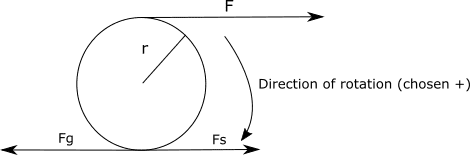
I started out by drawing a diagram:
bitmap.png


So I thought I would try torque with the axis of rotation in the center:

##T_1R = \frac{Mr^2}{2}\alpha##

and given that ##T_1## is equal to ##F## in the positive direction.

##\alpha = 266.6 \frac{rad}{s^2}##

Then knowing the relationship between angular acceleration and tangential acceleration:

##\alpha = \frac{a_t}{r}##
##a_t = \alpha*r##
##a_t = 7.998 \frac{m}{s^2}##

But this is not correct. The center of mass is translating and the rest of the object is rotating around it. ##a_t## would be the acceleration of a particle on the edge of the spool. Without this I cannot solve the second part so I am stuck.

So what if instead I just consider the translational portion?

##F_x = Ma##
##T_1 = Ma##
##T_1/M = a##
## a = 4 \frac{m}{s^2}##

But this is also incorrect. This would be like dragging the cylinder with slipping. It seems I am missing the connecting equations for rotational and translational motion.
 
Physics news on Phys.org
What does Fg represent?

Your first equation does not consider all the torques on the cylinder. Look again at your diagram.
 
haruspex said:
What does Fg represent?

Your first equation does not consider all the torques on the cylinder. Look again at your diagram.

I finally got it with that hint.

For some reason I remember the professor in the video saying that in rolling motion static friction is the reason the object moves forward. Reviewing my book, the diagrams of a bicycle wheel only show a vector for static friction (like normal) opposite the direction of the force. I guess I manufactured a vector for no reason to represent the forward motion... it makes sense "static friction is the reason it moves" because the static friction applies additional torque:

##\sum{F_x} = T_1 - F_s##

##\sum{\unicode{x03A4}} = T_1R + F_sR = I\alpha##

Solving for ##F_s## in the first equation and plugging it into the second equation I get the answer.

But where I am confused still is - this is the tangential acceleration right (since we have ##\alpha = \frac{a_t}{R}##)? How is this also the acceleration of the CM moving forward?
 
ago01 said:
But where I am confused still is - this is the tangential acceleration right (since we have ##\alpha = \frac{a_t}{R}##)? How is this also the acceleration of the CM moving forward?
It can be seen from a combination of Newton's second and third laws. Internal forces cancel leaving the acceleration of the centre of mass to obey ##F_{ext} = ma_{com}##.

Most mechanics textbooks should go through this calculation.
 
The book claims the answer is that all the magnitudes are the same because "the gravitational force on the penguin is the same". I'm having trouble understanding this. I thought the buoyant force was equal to the weight of the fluid displaced. Weight depends on mass which depends on density. Therefore, due to the differing densities the buoyant force will be different in each case? Is this incorrect?

Similar threads

  • · Replies 13 ·
Replies
13
Views
2K
Replies
2
Views
1K
  • · Replies 97 ·
4
Replies
97
Views
6K
  • · Replies 6 ·
Replies
6
Views
933
  • · Replies 9 ·
Replies
9
Views
3K
Replies
7
Views
2K
Replies
26
Views
1K
Replies
4
Views
1K
  • · Replies 17 ·
Replies
17
Views
909
  • · Replies 12 ·
Replies
12
Views
3K