Pulling a sled across snow with a rope at an angle

  • Thread starter Thread starter Purpleshinyrock
  • Start date Start date
  • Tags Tags
    Angle Rope
Click For Summary
SUMMARY

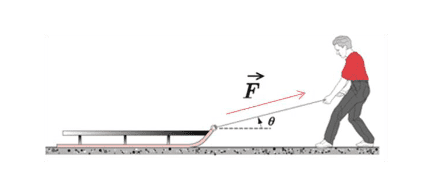
The discussion focuses on solving a physics problem involving a sled being pulled with a force of 50.0 N at an angle of 30º while overcoming a frictional force of 15 N. Key concepts include drawing a Free Body Diagram (FBD) and applying classical mechanics principles to determine the normal force, resulting horizontal force, acceleration, and final speed of the sled after 10 seconds. The problem emphasizes the importance of understanding dynamics and friction in this context.

PREREQUISITES
  • Classical mechanics principles
  • Understanding of Free Body Diagrams (FBD)
  • Basic trigonometry
  • Friction force concepts
NEXT STEPS
  • Study the principles of Dynamics in classical mechanics
  • Learn how to draw and analyze Free Body Diagrams (FBD)
  • Explore friction force calculations and their implications in motion
  • Practice solving problems involving forces at angles
USEFUL FOR

Students of physics, educators teaching classical mechanics, and anyone interested in understanding the dynamics of forces acting on objects in motion.

Purpleshinyrock
Messages
27
Reaction score
6
Poster has been reminded to show their work on schoolwork problems
Homework Statement
I need help understanding this exercise
Relevant Equations
dont know
Hello. Can someone tell me what area of phisics should I study to better understand this exercise and also what should I do to solve this exercise please?
A man pulls a small sledge with a force F ⃗ of intensity equal to 50.0 N and that makes an angle with the horizontal θ = 30º (see figure). The sled moves horizontally and the resistance that the snow offers to the movement of the sled results in a frictional force of intensity F a = 15 N. the sled has a mass of 20 kg. Determine:
Screenshot_2021-04-03 M23 - Fis_Qui_Aluno_int_ProvaModelo_vfinal pdf.png
a) the normal reaction to which the sled is subjected;

b) the resulting horizontal force on the sled;

c) the acceleration acquired by the sled;

d) the speed acquired by the sled after 10 s, assuming it started from rest.

(Use g = 10.0 m ∙ s -2 ).
 
Last edited by a moderator:
Physics news on Phys.org
Purpleshinyrock said:
Can someone tell me what area of phisics should I study to better understand this exercise and also what should I do to solve this exercise please?
Assuming you know trig, you just need classical mechanics.
 
Purpleshinyrock said:
also what should I do to solve this exercise please?
With this type of problem, it is usually best to start by drawing a Free Body Diagram (FBD). So show us your FBD for the sled, and show us the equations that you write for it given the problem description and the questions...
 
  • Like
Likes   Reactions: Purpleshinyrock and Vinh Nguyen
Last edited:
  • Like
Likes   Reactions: Purpleshinyrock
Thank You all for the answers and advice I used them to learn about the topic and solve the problem,
heres my answer:
 

Attachments

  • Screenshot_2021-04-04 2020-11-11 18 32 Office Lens(1) pdf.png
    Screenshot_2021-04-04 2020-11-11 18 32 Office Lens(1) pdf.png
    54.3 KB · Views: 316
  • Like
Likes   Reactions: Lnewqban
Purpleshinyrock said:
heres my answer:
Illegible
 
phinds said:
Illegible
Is this better sir/maam?
 

Attachments

  • Like
Likes   Reactions: phinds
Purpleshinyrock said:
Is this better sir/maam?
It looks right. But, did you know that ##14m/s## is about ##50km/h##? That's pretty fast for running backwards on snow.
 
  • Haha
Likes   Reactions: Purpleshinyrock
woahh He must be very motivated (and maybe superhuman)
 

Similar threads

  • · Replies 2 ·
Replies
2
Views
2K
Replies
3
Views
2K
  • · Replies 3 ·
Replies
3
Views
6K
Replies
6
Views
4K
  • · Replies 3 ·
Replies
3
Views
2K
  • · Replies 2 ·
Replies
2
Views
2K
  • · Replies 15 ·
Replies
15
Views
2K
  • · Replies 4 ·
Replies
4
Views
2K
  • · Replies 5 ·
Replies
5
Views
2K
  • · Replies 5 ·
Replies
5
Views
2K