PVD Vaccum Chamber -- How to clean up after Water leakage?

Click For Summary

Discussion Overview

The discussion revolves around the issue of cleaning a PVD (Physical Vapor Deposition) vacuum chamber after experiencing water leakage. Participants explore methods to remove residual water without the option of a bake-out, focusing on alternative cleaning techniques and the implications for achieving stable base pressure.

Discussion Character

  • Exploratory
  • Technical explanation
  • Debate/contested

Main Points Raised

  • Jane describes the water leakage from the crucible revolver area and expresses concern about residual water affecting the chamber's base pressure.
  • One participant suggests that applying a vacuum could chill the water, potentially freezing it, but maintaining the vacuum long enough for evaporation should be manageable.
  • Another participant supports the idea of repeated dry nitrogen flushing and emphasizes the importance of removing screws and other components where water might be trapped.
  • There is a suggestion that heating the nitrogen could expedite the drying process, and using acetone might help dislodge water from difficult areas.
  • Concerns are raised about the possibility of compromised seals during the clean-up, with some participants suspecting faulty seals as a root cause of the issues.
  • Jane later confirms that the suggestions provided, including heating the chamber walls, were effective and that there are no leaks present.

Areas of Agreement / Disagreement

Participants generally agree on the effectiveness of nitrogen flushing and the importance of addressing potential water traps. However, there is uncertainty regarding the condition of the seals and whether they may have been compromised during the clean-up process.

Contextual Notes

Participants express various assumptions about the effectiveness of different cleaning methods and the potential for residual water to affect vacuum performance. The discussion does not resolve the uncertainty surrounding the seals' condition.

lamejane
Messages
11
Reaction score
2
TL;DR
Solution to get rid of water in a vacuum chamber
Hello all ,

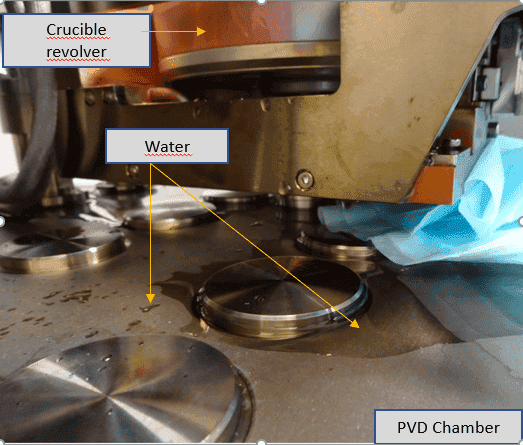
our PVD chamber experienced a water leakage from the cruible revoler area and unfortunately we are no longer able to achieve a stable Base pressure ( ~10e-6 mbar)

We do not have the option of a bake out. Is there any other way to get rid of water in the chamber ?
Ofcourse the water has been wiped out dry using clean room wipes, but i suspect there is still some monolayers of water adhering strongly to the chamber surface. Would repeated Nitrogen flusing help in getting rid of the water molecules? ?
1603207330088.png
Thanks !
Rgds
Jane
 
Engineering news on Phys.org
Applying a vacuum will chill the water - potentially causing it to freeze. But maintaining the vacuum long enough for any traces of water to remelt and evaporate should not be difficult. Likely just a few minutes.

Is it possible that something else happened during the clean-up that is compromising the seals?
 
Yes, repeated dry nitrogen flushing and pump down should do it. Removing screws and other things where water could be trapped will also help a lot. I see lots of nooks and crannies where there could be water trapped. I don't think you have to worry at all about the surfaces you have wiped down. What kind of pressure are you able to achieve? If you are getting to a few mtorr, you might look for a leak. Usually, water in screw threads and other nooks and crannies will manifest itself as a sort of "popping" on the vacuum gauge.
 
Last edited:
  • Like
Likes   Reactions: lamejane
If you can heat the Nitrogen, things will go even quicker. If you have a 'nooks and crannies' problem, Acetone can help to get the water out in the open.
 
  • Like
Likes   Reactions: lamejane
.Scott said:
Is it possible that something else happened during the clean-up that is compromising the seals?

the root cause is unkown but we suspect that the seals were faulty.
 
bobob said:
Yes, repeated dry nitrogen flushing and pump down should do it. Removing screws and other things where water could be trapped will also help a lot. I see lots of nooks and crannies where there could be water trapped. I don't think you have to worry at all about the surfaces you have wiped down. What kind of pressure are you able to achieve? If you are getting to a few mtorr, you might look for a leak. Usually, water in screw threads and other nooks and crannies will manifest itself as a sort of "popping" on the vacuum gauge.

Thank you, This suggestion along with heating the chamber walls with a hot blowdryer (industry grade) prior to chamber evacuation helped.
We have no Leaks.
 
  • Like
Likes   Reactions: .Scott and berkeman