MHB Can Plugging in (x/2) or (x - 1/2) Determine Real Zeros in a Quadratic Equation?

  • Thread starter Thread starter mathland
  • Start date Start date
  • Tags Tags
    Quadratic
Click For Summary
SUMMARY

The discussion focuses on determining real zeros in the quadratic function defined as f(x) = x - x^2. Participants explore the implications of substituting (x/2) and (x - 1/2) into f(x) and analyze the effects of vertical and horizontal shifts on the graph. It is concluded that the function y = x - x^2 - 1/2 does not intersect the x-axis, indicating no real zeros. The importance of the discriminant, D = b^2 - 4ac, in assessing the nature of zeros is emphasized.

PREREQUISITES
  • Understanding of quadratic functions and their standard form, ax^2 + bx + c
  • Knowledge of the discriminant and its role in determining the nature of zeros
  • Familiarity with vertical and horizontal shifts in graph transformations
  • Basic calculus concepts, particularly concavity and its implications
NEXT STEPS
  • Study the properties of the discriminant in depth, focusing on its implications for real zeros
  • Learn about graph transformations, specifically vertical and horizontal shifts
  • Explore concavity and its effects on the behavior of quadratic functions
  • Practice rewriting quadratic functions in standard form and analyzing their graphs
USEFUL FOR

Mathematics students, educators, and anyone interested in understanding quadratic equations and their graphical representations.

mathland
Messages
33
Reaction score
0
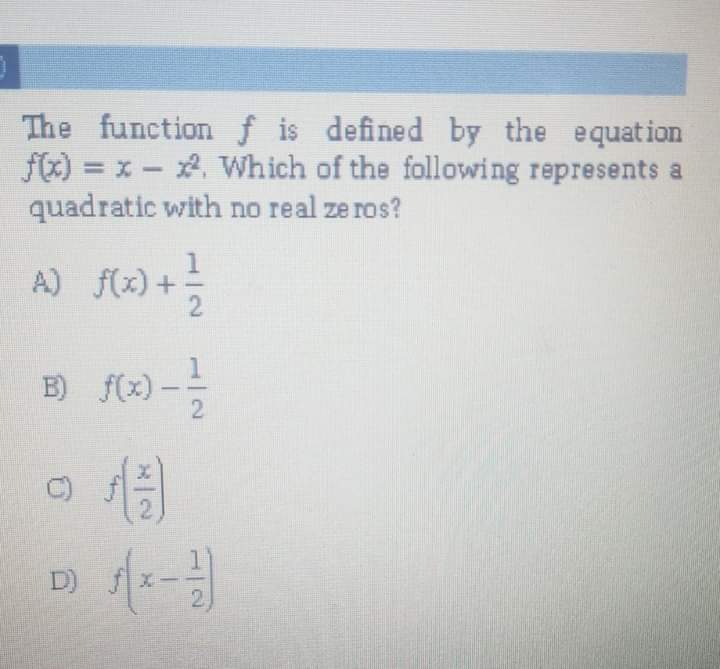
I can replace f(x) with x - x^2. Should I plug (x/2) into f(x)? How about (x - 1/2) into f(x)? I need the set up.
FB_IMG_1612321220546.jpg
 
Mathematics news on Phys.org
Note the range of $f(x)$. A and B are vertical shifts, C and D are horizontal shifts. Which one of the given shifts would result in the graph of $f(x)$ not crossing the $x-\text{axis}$?
 
Greg said:
Note the range of $f(x)$. A and B are vertical shifts, C and D are horizontal shifts. Which one of the given shifts would result in the graph of $f(x)$ not crossing the $x-\text{axis}$?

Let y = the function.

y = x - x^2 - 1/2 does not cross the line y = 0.
 
Note the concavity of $f(x)$. What does that tell you about lowering the graph of $f(x)$? (the line $y=0$ does not concern us presently).
 
write each quadratic in standard form, $ax^2+bx+c$ ... check each discriminant, $D = b^2-4ac$

you know what the discriminant can tell you about the nature of zeros, right?
 

Similar threads

  • · Replies 6 ·
Replies
6
Views
2K
  • · Replies 3 ·
Replies
3
Views
1K
  • · Replies 3 ·
Replies
3
Views
2K
Replies
1
Views
1K
  • · Replies 2 ·
Replies
2
Views
1K
  • · Replies 6 ·
Replies
6
Views
2K
  • · Replies 6 ·
Replies
6
Views
2K
  • · Replies 4 ·
Replies
4
Views
1K
Replies
4
Views
2K
  • · Replies 3 ·
Replies
3
Views
1K