Quatron quad pixel technology - From Sharp

Click For Summary

Discussion Overview

The discussion revolves around Sharp's introduction of a new LCD pixel design that incorporates a yellow pixel alongside the traditional RGB (red, green, blue) configuration. Participants explore the implications of this technology on color representation, particularly for shades of yellow, gold, and brass, and whether it signifies a genuine advancement in display technology or is merely a marketing gimmick.

Discussion Character

  • Exploratory
  • Technical explanation
  • Debate/contested
  • Conceptual clarification

Main Points Raised

  • Some participants express skepticism about the necessity and effectiveness of adding a yellow pixel, questioning whether it truly enhances visual quality.
  • Others suggest that the addition of a yellow pixel could allow for a broader color gamut, potentially enabling the display of colors that were previously unattainable with the RGB model alone.
  • A participant mentions the concept of "Deep Color," speculating that this technology might be a step towards using a 48-bit color scheme instead of the standard 32-bit.
  • Some contributions discuss the limitations of current video production standards, which are based on RGB, and whether the new technology can be effectively utilized without corresponding advancements in camera technology.
  • There is a debate about the perceptual differences between colors produced by the new RGBY model compared to traditional RGB, with questions about whether viewers can discern these differences.
  • Participants discuss the mathematical representation of color spaces and how adding a new primary color could expand the range of colors that can be represented.
  • Some express curiosity about the historical reasons for the RGB model's adoption and whether it was optimized for human color perception.

Areas of Agreement / Disagreement

Participants do not reach a consensus on whether the addition of a yellow pixel is beneficial or merely a marketing strategy. Multiple competing views exist regarding the implications of this technology for color representation and visual quality.

Contextual Notes

There are unresolved questions regarding the effectiveness of the yellow pixel in enhancing color reproduction and the potential need for corresponding advancements in video production technology to fully utilize this new display capability.

  • #31
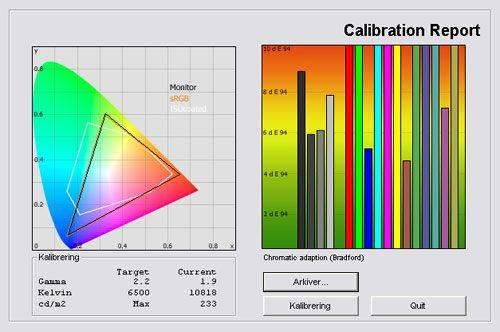
Here's an interesting review for a European model of the Quattron, notice the calibration test:
sharple925-foer-1.jpg

http://www.flatpanelshd.com/review.php?subaction=showfull&id=1287569264

...and a quote from AVSForum regarding the review linked:

BobearQSI at AVSForum said:
The review measures delta E, which is deviation from the correct color. A value greater than 2 is a visible deviation for the correct color. 4-5 means the color is wrong. After the best calibration of the Sharp, the values are still mostly greater than 6. The yellow value is almost 8! This means if you put a calibrated Quattron next to a TV showing the correct yellow, you will easily see a difference in the color. And that's calibrated. The uncalibrated out-of-the-box chart was greater than 10, off the chart.
http://www.avsforum.com/avs-vb/showthread.php?t=1237271&page=6
 
Computer science news on Phys.org
  • #32
Wow. Nice find on that TV pic. I had no idea.
 
  • #34
Hi everyone,,
I see this video,,, It is really amazing and give a lot of information...
SO i recommended to see this video...
 
  • #35
Albern said:
Hi everyone,,
I see this video,,, It is really amazing and give a lot of information...
SO i recommended to see this video...

What video?
 
  • #36
nismaratwork said:
What video?

You know... just whatever video... really any video will do.
:rolleyes:
 
  • #37
FlexGunship said:
You know... just whatever video... really any video will do.
:rolleyes:

Right? I have no idea what he's talking about, or if this was some spam attempt gone terribly awry. If not, I want to see the damned video! :smile:
 
  • #38
nismaratwork said:
Right? I have no idea what he's talking about, or if this was some spam attempt gone terribly awry. If not, I want to see the damned video! :smile:

Obviously the video can only be appreciated on a TV with Quatron technology.
 
  • #39
FlexGunship said:
Obviously the video can only be appreciated on a TV with Quatron technology.

ahhh c'mon, you're telling me I got to downgrade my pentatron tv?
 
  • #40
FlexGunship said:
Just give Gillette a few months and they'll come out with a TV that has five. Schick will follow with one that has six. Then Gillette will add a pixel color to the back of the screen for watching very small shows.

FlexGunship said:
Oh man. I forgot I wrote this. I read it, and was like "LMAO, who the hell wrote that?" And it was Flex! I'm losing my freakin' mind. :bugeye:

EDIT: By the way, I do some work in the printing industry, and additional colors outside of CMYK are only useful in subtractive coloring (i.e. mixing ink or paint), but not in additive coloring (i.e. light).

http://www.printingforless.com/color.html

I seriously just did this again. I was re-reading the thread and I read the Gillette comment and laughed. Nismar... I hope it's just us in this thread, because my brain must be runny oatmeal by now or something.

EDIT: Crap. Greg's here.
 
  • #41
FlexGunship said:
EDIT: Crap. Greg's here.

what!? I come with beer!
 
  • #42
Greg Bernhardt said:
what!? I come with beer!

And I come with your choice of fries or coleslaw!

I was hoping no one would see my embarrassing post. But... since you have beer. It's just a matter of time before the embarrass-o-meter levels out for all of us.

Eat, drink, and be merry!

images?q=tbn:ANd9GcTPFq2nbxilH7T7BV_QdUAsf-YufnQ1GaLIxYRT7xsIKoJYvQgZ&t=1.jpg
 
  • #43
Mmmmm... I'll bring Brats, some Polish mustard and German Sauerkraut (the good stuff, ingredients: Cabbage, Salt.)
 
  • #44
nismaratwork said:
Mmmmm... I'll bring Brats, some Polish mustard and German Sauerkraut (the good stuff, ingredients: Cabbage, Salt.)

Bratz?!

[PLAIN]http://saseykassy14.webs.com/bratz_poster-12304%5B1%5D.jpg
 
Last edited by a moderator:
  • #45
FlexGunship said:
Bratz?!

[PLAIN]http://saseykassy14.webs.com/bratz_poster-12304%5B1%5D.jpg[/QUOTE]

...and just like that, I die a little inside. :-p
 
Last edited by a moderator:
  • #46
Albern said:
Hi everyone,,
I see this video,,, It is really amazing and give a lot of information...
SO i recommended to see this video...
nismaratwork said:
What video?
FlexGunship said:
You know... just whatever video... really any video will do.
:rolleyes:
nismaratwork said:
Right? I have no idea what he's talking about, or if this was some spam attempt gone terribly awry. If not, I want to see the damned video! :smile:
Ah, you know, the video,,, the amazing video,,, much you will learn...
you should really watch the video,,, you you know,,, watch it,,, the video
FlexGunship said:
Obviously the video can only be appreciated on a TV with Quatron technology.
Greg Bernhardt said:
ahhh c'mon, you're telling me I got to downgrade my pentatron tv?
What!? Pentatron is ancient!
I have the next-generation state-of-the-art Googolplexatron TV. :biggrin:
I ordered the Grahamplexatron, but it hasn't arrived yet.

FlexGunship said:
I seriously just did this again. I was re-reading the thread and I read the Gillette comment and laughed. Nismar... I hope it's just us in this thread, because my brain must be runny oatmeal by now or something.
I'm here. :biggrin:
And don't forget that everyone on the Internet can read what you posted.

FlexGunship said:
EDIT: Crap. Greg's here.
What about me?

Greg Bernhardt said:
what!? I come with beer!
nismaratwork said:
...and just like that, I die a little inside. :-p
Don't die, Nismar! Don't die!
 
  • #47
Only a little DA, only a teensy tiny bit. Eventually I'll be a gray husk of a man, shuffling listesly... until then I'm just my happy-go-luck self. :wink:
 
  • #48
Like Moonbear, it seems reasonable to me that there could be a valid effect here, just from the point of view of signal processing.

The eye has three types of color receptors, each of which responds to a fairly broad spectrum of frequencies, with a considerable amount of overlap.

So if you view monochromatic yellow light (e.g. a sodum lamp) you are exciting all three receptors with a single frequency, your brain is somehow combining the three responses, and you see "yellow".

On the other hand, if you view a computer screen, you are viewing three different frequencies of light (RGB) at different amplitudes, and again you see "yellow". Clearly the amplitude output from the three sensors is enough to do a reasonable job of fooling your brain, but who knows what information is getting lost because of the change in frequencies.

Colored ink is fundamentally different from a CRT or LED screen, because the reflected light does contain the complete frequency spectrum. AFAIK the reason for using more than three inks in high quality color printing is to give better control over the whole spectrum. "Metallic" colors are particularly hard to reproduce with only three inks.

If you mess around with the color palette in Photoshop etc, you soon discover that it is quite hard to control "dark yellow" colors, including browns. A separate yellow frequency might improve that - but without actually seeing the display live, thre is no way to tell.

But I think there is a big practical problem with all this, because the standards for transmission of color video are all based on a 3-color model, so without a new standard there is no independent "yellow" data to be displayed. This seems like a re-run of how to fake "surround sound" from a standard 2-channel recording.
 
  • #49
mgb_phys said:
240px-CIExy1931_srgb_gamut.png
Looking at this diagram my guess would be a 6-color setup with the colors set at the very edge would have the greatest range. It seems that it leaves out a lot of the visible spectrum.

Though for it work the best, the original image/video displayed would need to be in those colors.One type (adobeRGB, I think) has its red outside the visual range, which allows it more colors within the triangle.