Andrew Mason said:
I think one would have to first understand how the MRI scan detects the virus before comparing it to other tests. Even if MRI can detect the presence of the virus that would not be enough. A useful test has to be able to determine that the virus is NOT present, which means the MRI would have to carefully examine all the virus-size regions in the sample. That strikes me as being a big challenge.
AM
going back to their website
"
Scanning diamond magnetometry
A disadvantage of MRFM is that it only performs well at cryogenic temperatures and in vacuum, which is not compatible with many biological (and other) applications. Therefore we are trying to come up with other ideas that might allow us doing the same experiments under ambient conditions.
In “scanning diamond magnetometry”, we use quantum optics to sense minute magnetic signals from samples via the fluorescent light emitted by a diamond defect (the so-called nitrogen-vacancy color center). Diamond defects carry a spin that is very sensitive to magnetic fields, owing to the Zeeman effect, and as the optical rate of emission depends on the defect’s spin state, we can measure small fields simply by looking at the fluorescence intensity [1].
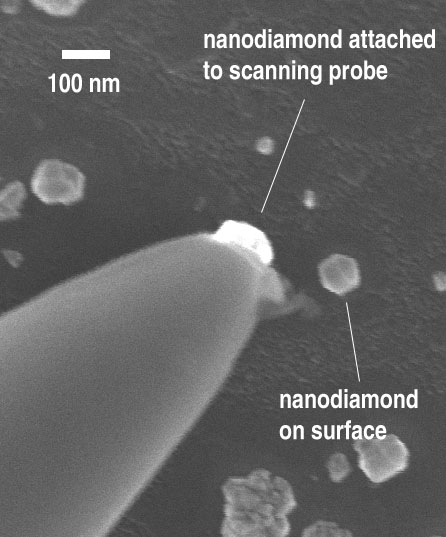
Our goal is to place a diamond defect in a nanocrystal and attach to a scanning probe - in this way we can perform nanoscale imaging. Our scanning diamond magnetometer will have the capability to measure the dipole field of single electron spins, or monolayers of organic materials containing proton spins, at room temperature. Combination of diamond sensors with magnetic resonance spectroscopy will then allow us to perform nanometer-resolution chemical analysis of a wide variety of organic surfaces and other materials.
For our diamond experiments we are currently assembling a dual confocal – atomic force microscope with optical access from both sides. The apparatus also incorporates a permanent magnet with precisely adjustable field orientation to access large bias fields for doing spectroscopy. This instrument will allow us to study individual diamond NV centers and to perform magnetic imaging and spectroscopy experiments on a range of transparent and opaque samples. A second important part of our experimental work is also to find efficient ways to fabricate, purify and chemically modify high quality diamond probes.
Further reading:
[1] C. L. Degen, "Scanning magnetic field microscope with a diamond single-spin sensor", Appl. Phys. Lett. 92, 243111 (2008). (
link)" i should make a note that my main question is their other materials can be used to preform this measurements , i may indicate that i read this information long time ago maybe few years and re read them few months ago in a hope to have a chance in doing an R&D in relation to Coronavirus
but things not very good , and their is little chance for me to do that so i posted this few things here to raise attention to it and its applications that will save good few months in advance if it is useful of courses regards
hagop