kostoglotov
- 231
- 6
MIT OCW 18.06 using Intro to Linear Algebra by Strang
So I was working through some stuff about Cyclic Matrices, and the text was talking about how the column vectors that make up this cyclic matrix, shown here,
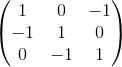
are coplanar, and that is the reason that Ax = b will have either infinite solutions or no solutions depending on what b is; specifically whether or not b1 + b2 + b3 = 0.
I also noticed that the scalar triple product using the three vectors constructed from the columns of the matrix is of course 0, this is to be expected, but if you construct the vectors from the rows of the matrix, the scalar triple product of those vectors is also zero...
Is this just coincidence, or will sets of vectors constructed from both the columns and the rows of a cyclic matrix always be coplanar, or rather, linearly dependent?
So I was working through some stuff about Cyclic Matrices, and the text was talking about how the column vectors that make up this cyclic matrix, shown here,
are coplanar, and that is the reason that Ax = b will have either infinite solutions or no solutions depending on what b is; specifically whether or not b1 + b2 + b3 = 0.
I also noticed that the scalar triple product using the three vectors constructed from the columns of the matrix is of course 0, this is to be expected, but if you construct the vectors from the rows of the matrix, the scalar triple product of those vectors is also zero...
Is this just coincidence, or will sets of vectors constructed from both the columns and the rows of a cyclic matrix always be coplanar, or rather, linearly dependent?