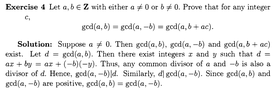
Question about problem involving gcd
- Context: MHB
- Thread starter issacnewton
- Start date
-
- Tags
- Gcd
Click For Summary
SUMMARY
The discussion centers on the mathematical property that if \( d = \gcd(a, b) \), then it follows that \( d | \gcd(a, -b) \). This conclusion is derived from the fundamental definition of the greatest common divisor (gcd), which remains unchanged when one of the arguments is negated. Participants confirm this property as a standard result in number theory, emphasizing its importance in understanding gcd relationships.
PREREQUISITES
- Understanding of the greatest common divisor (gcd)
- Basic knowledge of number theory
- Familiarity with mathematical notation and properties
- Concept of divisibility in integers
NEXT STEPS
- Study the properties of gcd in detail, including proofs and examples
- Explore the Euclidean algorithm for calculating gcd
- Learn about the implications of gcd in modular arithmetic
- Investigate applications of gcd in solving Diophantine equations
USEFUL FOR
Students of mathematics, educators teaching number theory, and anyone interested in the properties of divisibility and gcd in integer arithmetic.
Similar threads
- · Replies 23 ·
Undergrad
Understanding the Results of gcd(x,n)
- · Replies 8 ·
- · Replies 3 ·
- · Replies 2 ·
- · Replies 1 ·
- · Replies 12 ·
- · Replies 1 ·
- · Replies 2 ·
- · Replies 2 ·