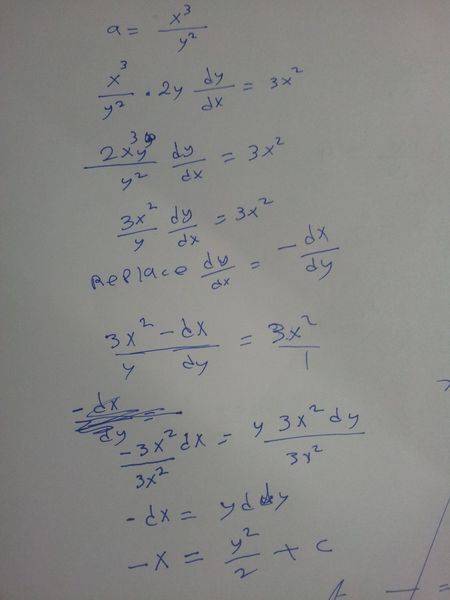
SUMMARY
The discussion centers on the calculation of orthogonal trajectories for the family of curves defined by the equation g(x, y) = x³/y² = a. The user presents the differential equation 2ay/dx = 3x² and seeks validation of their answer. The correct approach involves calculating the gradients ∇f and ∇g, where ∇g = (3x²/y², -2x³/y³) and ∇f = (1, 2y). The condition for orthogonality is established by ensuring that ∇f.∇g = 0, leading to the equation 3x²/y² - 4x³/y² = 0.
PREREQUISITES
- Understanding of differential equations and their applications.
- Familiarity with the concept of orthogonal trajectories in calculus.
- Knowledge of gradient vectors and their significance in multivariable calculus.
- Proficiency in manipulating algebraic expressions involving polynomials.
NEXT STEPS
- Study the method for finding orthogonal trajectories in detail.
- Learn about gradient vectors and their applications in optimization problems.
- Explore the implications of the condition ∇f.∇g = 0 in multivariable calculus.
- Practice solving differential equations related to families of curves.
USEFUL FOR
Students and professionals in mathematics, particularly those studying calculus and differential equations, as well as educators looking to enhance their understanding of orthogonal trajectories.