SUMMARY
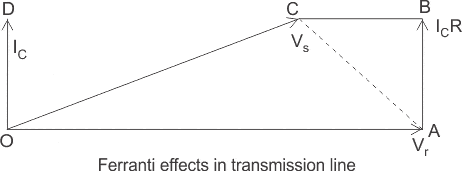
The Ferranti effect describes the phenomenon where the receiving end voltage of a transmission line increases, particularly in open-circuit conditions, due to the line's capacitance. The discussion clarifies that the capacitive current leads the voltage by 90 degrees, which is counterintuitive since inductors typically cause a lag. The power in this scenario is derived from the voltage multiplied by the current, which remains zero in an open circuit, indicating that the increase in voltage does not require a corresponding increase in current. The references provided include detailed explanations of these concepts, emphasizing the relationship between voltage, current, and phase angles in electrical circuits.
PREREQUISITES
- Understanding of the Ferranti effect in electrical engineering
- Knowledge of phasor representation and phase relationships
- Familiarity with inductive and capacitive reactance
- Basic principles of AC circuit analysis
NEXT STEPS
- Study the mathematical derivation of the Ferranti effect in transmission lines
- Learn about phasor diagrams and their application in AC circuit analysis
- Explore the concepts of inductive and capacitive reactance in detail
- Investigate the implications of open-circuit conditions in power systems
USEFUL FOR
Electrical engineers, power system analysts, and students studying transmission line theory will benefit from this discussion, particularly those interested in the dynamics of voltage and current in AC circuits.