Quick question on Geodesic Equation

Click For Summary

Discussion Overview

The discussion centers around the derivation of the geodesic equation, particularly the relationship involving the Christoffel symbols in a non-relativistic approximation. Participants explore the mathematical expressions and assumptions underlying the geodesic equation, with a focus on the specific case of the Christoffel symbol ##\Gamma_{00}^{\mu}##.

Discussion Character

  • Technical explanation
  • Debate/contested
  • Mathematical reasoning

Main Points Raised

  • Some participants reference the definition of the Christoffel symbols as ##\Gamma_{\alpha \beta}^{\mu} = \frac{\partial x^{\mu}}{\partial y^{\lambda}} \frac{\partial^2 y^{\lambda}}{\partial x^{\alpha} \partial x^{\beta}}##, questioning its application in the context of the geodesic equation.
  • Others argue that the relationship ##\Gamma_{00}^{\mu} = -\frac{1}{2} g^{\mu \lambda} \frac{\partial g_{00}}{\partial x^{\lambda}}## can be derived under the assumption of a stationary metric, which simplifies the derivation.
  • A participant expresses confusion regarding the varying metrics used in the derivation and requests clarification on the steps leading to the desired relationship.
  • One participant suggests that the derivation involves considering a weak gravitational field and perturbing the Minkowski metric, leading to a first-order approximation commonly used in gravitational wave theory.
  • Another participant emphasizes that neglecting time derivatives in the Newtonian limit is crucial for arriving at the relationship in question.
  • Some participants express that the explanations provided may be too advanced for their current understanding, indicating a need for more foundational material.

Areas of Agreement / Disagreement

Participants exhibit disagreement regarding the derivation of the Christoffel symbols and the assumptions necessary for the geodesic equation. While some agree on the general approach involving perturbations of the metric, others question the clarity and completeness of the derivations presented.

Contextual Notes

There are unresolved assumptions regarding the independence of the metric from time and the specific conditions under which the approximations are valid. Participants also note potential gaps in the derivations provided by the lecturer's notes.

unscientific
Messages
1,728
Reaction score
13
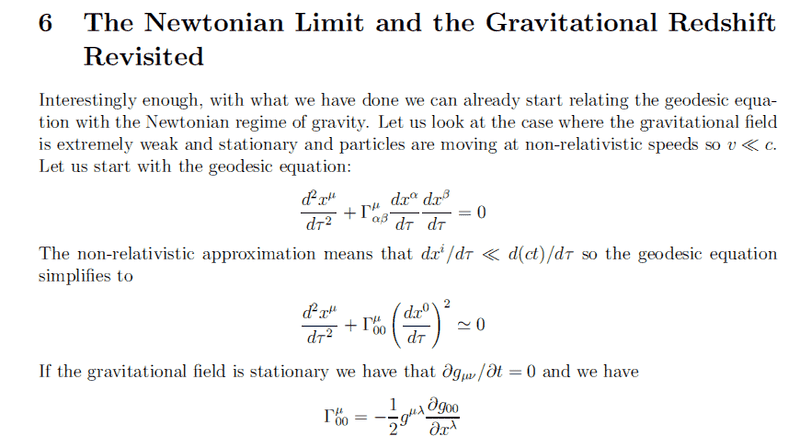
Starting with the geodesic equation with non-relativistic approximation:

\frac{d^2 x^{\mu}}{d \tau^2} + \Gamma_{00}^{\mu} \left( \frac{dx^0}{d\tau} \right)^2 = 0

I know that ## \Gamma_{\alpha \beta}^{\mu} = \frac{\partial x^{\mu}}{\partial y^{\lambda}} \frac{\partial^2 y^{\lambda}}{\partial x^{\alpha} \partial x^{\beta}}##, so
\Gamma_{00}^{\mu} = \frac{\partial x^{\mu}}{\partial y^{\lambda}} \frac{\partial^2 y^{\lambda}}{\partial t^2}

How did they get the relation ##\Gamma_{00}^{\mu} = -\frac{1}{2} g^{\mu \lambda} \frac{\partial g_{00}}{\partial x^{\lambda}}##?
2dqtvlf.png
 
Physics news on Phys.org
unscientific said:
I know that ##\Gamma_{\alpha \beta}^{\mu} = \frac{\partial x^{\mu}}{\partial y^{\lambda}} \frac{\partial^2 y^{\lambda}}{\partial x^{\alpha} \partial x^{\beta}}##

Do you have a reference? That's not the formula for the Christoffel symbols that I'm familiar with. The one I'm familiar with, as given, for example, here, reduces to the relation you are asking about immediately for the 0-0 case if you assume that the metric is independent of time (which is what "stationary" means).
 
unscientific said:
I know that ## \Gamma_{\alpha \beta}^{\mu} = \frac{\partial x^{\mu}}{\partial y^{\lambda}} \frac{\partial^2 y^{\lambda}}{\partial x^{\alpha} \partial x^{\beta}}##, so
\Gamma_{00}^{\mu} = \frac{\partial x^{\mu}}{\partial y^{\lambda}} \frac{\partial^2 y^{\lambda}}{\partial t^2}

I think I've seen that somewhere, if I remember correctly it's the christoffel symbols in a general coordinate transform (i.e. non-inertial).
Just use the ones written in terms of the metric.
 
PeterDonis said:
Do you have a reference? That's not the formula for the Christoffel symbols that I'm familiar with. The one I'm familiar with, as given, for example, here, reduces to the relation you are asking about immediately for the 0-0 case if you assume that the metric is independent of time (which is what "stationary" means).

HomogenousCow said:
I think I've seen that somewhere, if I remember correctly it's the christoffel symbols in a general coordinate transform (i.e. non-inertial).
Just use the ones written in terms of the metric.

I got these from my lecturer's notes.

I tend to get confused by the ever-changing metrics they use. It would be very helpful if I could see the steps leading to ##
\Gamma_{00}^{\mu} = -\frac{1}{2} g^{\mu \lambda} \frac{\partial g_{00}}{\partial x^{\lambda}} ##.
 
unscientific said:
I got these from my lecturer's notes.

I tend to get confused by the ever-changing metrics they use. It would be very helpful if I could see the steps leading to ##
\Gamma_{00}^{\mu} = -\frac{1}{2} g^{\mu \lambda} \frac{\partial g_{00}}{\partial x^{\lambda}} ##.

Hi. First, I have never understood why folks like to look at the geodesic equation in a flat-space, non-relativistic limit, as that defeats the beauty of G.R., but, nevertheless, here is how your lecturer obtained that equation, at least according to me:

Assume a weak gravitational field, where your spacetime metric ##g_{uv}## is perturbed by a Minkowski metric ##\eta_{uv}##. So, we have that:
##g_{uv} = \eta_{uv} + h_{uv}##, where ##h_{uv}## is the relativistic part of the metric tensor. If you have done some G.R. already, then, you will see this technique commonly used in gravitational wave theory.

The full definition of the metric connection (assuming it is torsion-free, and in a coordinate basis) is the Christoffel symbol definition, which is:
##\Gamma^{a}_{by} = \frac{1}{2}g^{ad} \left(g_{dy,b} + g_{db,y} - g_{by,d}\right)##.
Substituting in our definition of ##g_{uv}## from above into this expression, we get that:
##\Gamma^{a}_{by} = \frac{1}{2} \eta^{ad} \left(h_{dy,b} + h_{db,y} - h_{by,d}\right)##, this is a first-order approximation of course, as is commonly the case in Newtonian gravity.

We now just use the above equations to find for example ##\Gamma^{i}_{00}## as:
##\Gamma^{i}_{00} = \frac{1}{2} \eta^{ip} \left(h_{0p,0} + h_{0p,0} - h_{00,p}\right)##.
The key thing is the following, the terms:
##h_{0p,0} + h_{0p,0}## must vanish in the Newtonian limit, and using a static approximation, they indeed do. You will notice that both of these terms are derivatives with respect to time. In the Newtonian world, where observers move at speeds v << c, gravitational systems have a very weak time-dependence, compared to their spatial dependence. For example, compare any Newtonian gravitational system's timescales/age to the age of the Sun, or galaxy, it is very, very small on these scales. So, we neglect all time derivatives in this approximation, and obtain:
##\Gamma^{i}_{00} = -\frac{1}{2} \eta^{ip} \left(h_{00,p}\right)##.

Which is precisely the relationship you seek.

I hope that helps.

Dr. Ikjyot Singh Kohli
 
dr_ikjyotsinghk said:
Hi. First, I have never understood why folks like to look at the geodesic equation in a flat-space, non-relativistic limit, as that defeats the beauty of G.R., but, nevertheless, here is how your lecturer obtained that equation, at least according to me:

Assume a weak gravitational field, where your spacetime metric ##g_{uv}## is perturbed by a Minkowski metric ##\eta_{uv}##. So, we have that:
##g_{uv} = \eta_{uv} + h_{uv}##, where ##h_{uv}## is the relativistic part of the metric tensor. If you have done some G.R. already, then, you will see this technique commonly used in gravitational wave theory.

The full definition of the metric connection (assuming it is torsion-free, and in a coordinate basis) is the Christoffel symbol definition, which is:
##\Gamma^{a}_{by} = \frac{1}{2}g^{ad} \left(g_{dy,b} + g_{db,y} - g_{by,d}\right)##.
Substituting in our definition of ##g_{uv}## from above into this expression, we get that:
##\Gamma^{a}_{by} = \frac{1}{2} \eta^{ad} \left(h_{dy,b} + h_{db,y} - h_{by,d}\right)##, this is a first-order approximation of course, as is commonly the case in Newtonian gravity.

We now just use the above equations to find for example ##\Gamma^{i}_{00}## as:
##\Gamma^{i}_{00} = \frac{1}{2} \eta^{ip} \left(h_{0p,0} + h_{0p,0} - h_{00,p}\right)##.
The key thing is the following, the terms:
##h_{0p,0} + h_{0p,0}## must vanish in the Newtonian limit, and using a static approximation, they indeed do. You will notice that both of these terms are derivatives with respect to time. In the Newtonian world, where observers move at speeds v << c, gravitational systems have a very weak time-dependence, compared to their spatial dependence. For example, compare any Newtonian gravitational system's timescales/age to the age of the Sun, or galaxy, it is very, very small on these scales. So, we neglect all time derivatives in this approximation, and obtain:
##\Gamma^{i}_{00} = -\frac{1}{2} \eta^{ip} \left(h_{00,p}\right)##.
ve
Which is precisely the relationship you seek.

I hope that helps.

Dr. Ikjyot Singh Kohli
Thanks a lot for working with me on this, I really appreciate it. But, I think these are too advanced for me. I am trying to work with the notes I have here - Chapters 5 and 6.
 

Attachments

unscientific said:
Thanks a lot for working with me on this, I really appreciate it. But, I think these are too advanced for me. I am trying to work with the notes I have here - Chapters 5 and 6.

Hi. No problem. I am not familiar with your textbook or set of notes. I am sure, however, that there is no other way to derive the expressions above. I believe your lecturer just skipped some steps, because they may have been too technical, which is unfortunate, but frequently happens.
 
dr_ikjyotsinghk said:
The full definition of the metric connection (assuming it is torsion-free, and in a coordinate basis) is the Christoffel symbol definition, which is:
##\Gamma^{a}_{by} = \frac{1}{2}g^{ad} \left(g_{dy,b} + g_{db,y} - g_{by,d}\right)##.

Yes, this is the definition I am familiar with.

dr_ikjyotsinghk said:
Substituting in our definition of ##g_{uv}## from above into this expression

To get the expression unscientific is asking about, there's a simpler way, if you know that the metric is independent of time (i.e., of ##x^0##), which is the "stationary" assumption referred to in the OP. We have, from the general expression above,

$$
\Gamma^a{}_{00} = \frac{1}{2}g^{ad} \left(g_{d0,0} + g_{d0,0} - g_{00,d}\right)
$$

But if the metric is independent of ##x^0##, the first two terms inside the parentheses vanish, so we're left with

$$
\Gamma^a{}_{00} = - \frac{1}{2}g^{ad} \left( g_{00,d} \right)
$$

as desired.

dr_ikjyotsinghk said:
I am sure, however, that there is no other way to derive the expressions above.

There is for the expression the OP asks about; see above. That expression is valid for any stationary metric; you don't need to make the weak field approximation. (The lecture notes do make that approximation, but later on in the derivation when it's actually needed; they don't make it just to derive the expression above.)
 
Last edited:
unscientific said:
I am trying to work with the notes I have here

About halfway down page 11, you'll find the expression for ##\Gamma## given in post #5 (with different labeling of the indexes, but that doesn't matter).
 

Similar threads

  • · Replies 4 ·
Replies
4
Views
1K
  • · Replies 8 ·
Replies
8
Views
3K
  • · Replies 5 ·
Replies
5
Views
2K
  • · Replies 5 ·
Replies
5
Views
1K
  • · Replies 76 ·
3
Replies
76
Views
4K
  • · Replies 17 ·
Replies
17
Views
2K
  • · Replies 7 ·
Replies
7
Views
2K
  • · Replies 2 ·
Replies
2
Views
2K
  • · Replies 2 ·
Replies
2
Views
2K
  • · Replies 2 ·
Replies
2
Views
2K