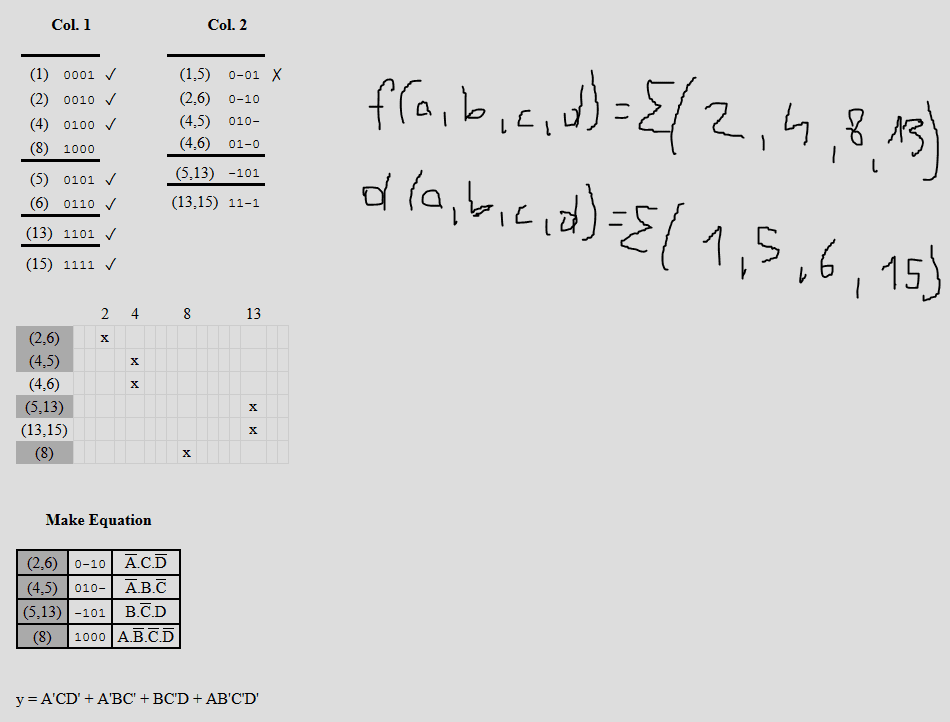
Why do we take 4,5 and 5,13 instead of 4,6 and 13,15?

  • Thread starter Thread starter tomekrx
  • Start date Start date
  • Tags Tags
    Method Qm
Click For Summary
SUMMARY

The discussion centers on the Quine-McCluskey (QM) method for minimizing Boolean functions, specifically addressing why the pairs (4,5) and (5,13) are preferred over (4,6) and (13,15). The QM method allows for the combination of minterms based on shared bit patterns, with (4,5) and (5,13) sharing the middle bits, making them more efficient for minimization. The essential prime implicants are determined through a prime implicant chart, where columns with a single "X" indicate essential implicants necessary for the minimized equation. The final equations derived from the essential implicants are functionally equivalent to the original verbose equation.

PREREQUISITES
  • Understanding of Boolean algebra and minimization techniques
  • Familiarity with the Quine-McCluskey algorithm
  • Knowledge of prime implicants and essential prime implicants
  • Basic skills in constructing and interpreting prime implicant charts
NEXT STEPS
  • Study the Quine-McCluskey algorithm in detail
  • Learn how to construct and analyze prime implicant charts
  • Explore Petrick's method for further reduction of Boolean expressions
  • Practice minimizing Boolean functions using the QM method with various examples
USEFUL FOR

This discussion is beneficial for digital logic designers, computer engineers, and students studying Boolean algebra who seek to optimize logic circuits using the Quine-McCluskey method.

tomekrx
Messages
1
Reaction score
0
Homework Statement
Quine McCluskey (QM) Method
Relevant Equations
little problem
Hello,
can anyone tell me why do we take 4,5 and 5,13 instead of 4,6 and 13,15?Thats QM method
241172
 
Physics news on Phys.org
The wikipedia article summarizes it pretty well:

https://en.wikipedia.org/wiki/Quine–McCluskey_algorithm

Not really understanding how it works yet, could the choices be due to fewer bit variations?

basically 4,5 is ##(0 1 0 -)## and 5,13 is ##(- 1 0 1)## with the middle bits ##(-10-)## in common to both?

whereas 4,6 which is ##(01-0)## and 13,15 is ##(11-1)## only have the ##(-1--)## bit in common.

from the wikipedia article above:
Step 2: prime implicant chart[edit]
None of the terms can be combined any further than this, so at this point we construct an essential prime implicant table. Along the side goes the prime implicants that have just been generated, and along the top go the minterms specified earlier. The don't care terms are not placed on top—they are omitted from this section because they are not necessary inputs.

4810111215ABCD
m(4,12)*
13px-Dark_Red_x.svg.png
100
m(8,9,10,11)
13px-Dark_Red_x.svg.png
10
m(8,10,12,14)
13px-Dark_Red_x.svg.png
10
m(10,11,14,15)*
13px-Dark_Red_x.svg.png
11
To find the essential prime implicants, we run along the top row. We have to look for columns with only 1 "X". If a column has only 1 "X", this means that the minterm can only be covered by 1 prime implicant. This prime implicant is essential.

For example: in the first column, with minterm 4, there is only 1 "X". This means that m(4,12) is essential. So we place a star next to it. Minterm 15 also has only 1 "X", so m(10,11,14,15) is also essential. Now all columns with 1 "X" are covered.

The second prime implicant can be 'covered' by the third and fourth, and the third prime implicant can be 'covered' by the second and first, and neither is thus essential. If a prime implicant is essential then, as would be expected, it is necessary to include it in the minimized boolean equation. In some cases, the essential prime implicants do not cover all minterms, in which case additional procedures for chart reduction can be employed. The simplest "additional procedure" is trial and error, but a more systematic way is Petrick's method. In the current example, the essential prime implicants do not handle all of the minterms, so, in this case, one can combine the essential implicants with one of the two non-essential ones to yield one equation:

{\displaystyle f_{A,B,C,D}=BC'D'+AB'+AC\ }
f_{A,B,C,D} = BC'D' + AB' + AC \
[11]
or

{\displaystyle f_{A,B,C,D}=BC'D'+AD'+AC\ }

Both of those final equations are functionally equivalent to the original, verbose equation:

{\displaystyle f_{A,B,C,D}=A'BC'D'+AB'C'D'+AB'C'D+AB'CD'+AB'CD+ABC'D'+ABCD'+ABCD.\ }
f_{A,B,C,D} = A'BC'D' + AB'C'D' + AB'C'D + AB'CD' + AB'CD + ABC'D' + ABCD' + ABCD. \
 

Similar threads

  • · Replies 12 ·
Replies
12
Views
2K
  • · Replies 11 ·
Replies
11
Views
3K
  • · Replies 5 ·
Replies
5
Views
2K
  • · Replies 16 ·
Replies
16
Views
2K
  • · Replies 7 ·
Replies
7
Views
2K
Replies
11
Views
2K
  • · Replies 127 ·
5
Replies
127
Views
11K
  • · Replies 26 ·
Replies
26
Views
3K
  • · Replies 23 ·
Replies
23
Views
4K
  • · Replies 0 ·
Replies
0
Views
2K
