(R/I)-Modules .... Dummit and Foote Example (5), Section 10.1

  • Context: Undergrad 
  • Thread starter Thread starter Math Amateur
  • Start date Start date
  • Tags Tags
    Example Section
Click For Summary
SUMMARY

This discussion centers around Example (5) from Section 10.1 of "Abstract Algebra" (Third Edition) by Dummit and Foote, specifically addressing the conditions necessary for a module \( M \) to be an \( (R/I) \)-module. It is established that for the operation defining \( M \) as an \( (R/I) \)-module to be well-defined, it is essential that \( am = 0 \) for all \( a \in I \) and \( m \in M \). The conversation also clarifies the nature of the multiplications involved in the equation \( (r+I)m = rm \) and emphasizes the importance of verifying that the defined function is indeed a function.

PREREQUISITES
  • Understanding of module theory and the definition of modules over rings.
  • Familiarity with the concepts of quotient rings and ideals, specifically \( R/I \).
  • Knowledge of function definitions and the criteria for well-defined functions in mathematics.
  • Basic understanding of operations in algebraic structures, particularly in the context of groups and rings.
NEXT STEPS
  • Study the properties of \( R/I \)-modules and their applications in abstract algebra.
  • Learn about the well-definedness of functions in algebraic structures, focusing on examples from group theory.
  • Explore the relationship between left and right modules, particularly in the context of \( R/I \)-modules.
  • Investigate the extension of operations from one algebraic structure to another, using examples from both module and group theory.
USEFUL FOR

Students of abstract algebra, mathematicians specializing in module theory, and educators seeking to clarify the concepts of modules and their operations in the context of quotient rings.

Math Amateur
Gold Member
MHB
Messages
3,920
Reaction score
48
I am reading Dummit and Foote's book: "Abstract Algebra" (Third Edition) ...

I am currently studying Chapter 10: Introduction to Module Theory ... ...

I need some help with an aspect of Example (5) of Section 10.1 Basic Definitions and Examples ... ...

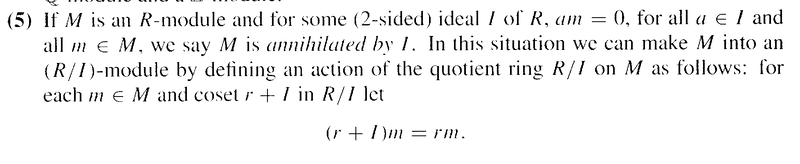
Example (5) reads as follows:
D&F - 1 - EXample 5, Section 10.1 ... PART 1 ... .png

D&F - 2 - EXample 5, Section 10.1 ... PART 2 ... .png


I do not fully understand this example and hence need someone to demonstrate (explicitly and completely) why it is necessary for ##am = 0## for all ##a \in I## and all ##m \in M## for us to be able to make ##M## into an ##(R/I)##-module. ...
Help will be much appreciated ..

Peter
 

Attachments

  • D&F - 1 - EXample 5, Section 10.1 ... PART 1 ... .png
    D&F - 1 - EXample 5, Section 10.1 ... PART 1 ... .png
    16.2 KB · Views: 756
  • D&F - 2 - EXample 5, Section 10.1 ... PART 2 ... .png
    D&F - 2 - EXample 5, Section 10.1 ... PART 2 ... .png
    11.4 KB · Views: 710
Physics news on Phys.org
Hey Peter.

It is needed to make sure that the operation that turns ##M## in a ##R/I## module is well defined, i.e., one must show that what is written down, is a (well-defined) function.

This is routine work.

Indeed, suppose that ##(r_1 + I, m_1) = (r_2 +I,m_2)##, then ##m_1 = m_2## and ##r_1 + I = r_2 + I##.

The latter one implies that ##r_1 - r_2 \in I##, and by assumption ##m_1(r_1 - r_2) = 0##, so that ##m_1r_1 = m_1r_2 = m_2r_2## and hence the function is well defined.

Hope this helps.
 
Last edited by a moderator:
  • Like
Likes   Reactions: xaos and Math Amateur
Thanks Math_QED ...

BUT ... I need a clarification ...

Dummit and Foote write elements of the ##R/I##-module as ##m## ... what are the elements of the form ##(m_1, r_1 + I)##?

I can understand an element of the form ##(r+I)m## belongs to the left ##R/I##-module ... but how do we get an element of the form ##(m_1, r_1 + I)##?

Can you help ...

Sorry if i am being slow ...

Peter***EDIT***

Did you mean ##(m_1, r_1 + I) \equiv m_1(r_1 + I)## ... that is an element from a right ##R/I##-module ...?
 
Last edited:
Math Amateur said:
Thanks Math_QED ...

BUT ... I need a clarification ...

Dummit and Foote write elements of the ##R/I##-module as ##m## ... what are the elements of the form ##(m_1, r_1 + I)##?

I can understand an element of the form ##(r+I)m## belongs to the left ##R/I##-module ... but how do we get an element of the form ##(m_1, r_1 + I)##?

Can you help ...

Sorry if i am being slow ...

Peter

Sorry, I wrote the module as a right module, while the book writes it as a left module. (I edited my previous post and changed the order in the tupels) However, this doesn't change your question of course. The operation in the R/I module M is:

##R/I \times M \to M: (r+I,m) \mapsto rm##

And for convenience we write this as ##(r+I)m = rm##

But who says that what I wrote down is a function? This needs to be checked. I.e., one must check that for every element ##(r+I,m) \in R/I \times M##, there is precisely one output associated with this input (see uniqueness of image in the definition of function).

That's what I proved: Hope it is clear now.

If you like an analogy that you have already encountered (probably), think about the function ##\phi: G/\ker f \to f(G): g + \ker f \mapsto f(g)## which you already encountered in the first isomorphism theorem of groups. We must also prove that this function is well defined.
 
  • Like
Likes   Reactions: Math Amateur
Thanks Math_QED ...

Yes ... clear now ... post above is most helpful ...

Peter
 
  • Like
Likes   Reactions: member 587159
Hi Math_QED ...

Another question that you may be able to help with ... I am puzzled about the definition and nature of the "multiplications" involved in the equation

##(r+I)m = rm## ... ... ... ... ... (1)It seems to me that there are two multiplications involved and I am not sure how they are defined ... indeed suppose the two multiplications are ##\star## and ##\circ## ... ... then, (1) becomes##(r+I) \star m = r \circ m##But how are ##\star## and ##\circ## defined ... where do they come from ... what is their nature ,,,Can you help ... ...
 
Math Amateur said:
Hi Math_QED ...

Another question that you may be able to help with ... I am puzzled about the definition and nature of the "multiplications" involved in the equation

##(r+I)m = rm## ... ... ... ... ... (1)It seems to me that there are two multiplications involved and I am not sure how they are defined ... indeed suppose the two multiplications are ##\star## and ##\circ## ... ... then, (1) becomes##(r+I) \star m = r \circ m##But how are ##\star## and ##\circ## defined ... where do they come from ... what is their nature ,,,Can you help ... ...

You are right: the multiplication in the R/I module is build using the multiplication in the R-module! This is something that is done a lot in mathematics: extending known structures to other structures.

This thing also happens for example when we define an operation on the sets of cosets ##g+N## where ##g## is an element of a group ##G## and ##N## is a normal subgroup. We define ##(gN)\circ(hN) = (g.h)N## where ##\circ## is the operation in the quotient group, ##.## the operation in the group ##G##. This also gives another example of an addition where it is not clear whether this is well defined. Turns out that the addition I wrote down here makes sense if and only if ##N## is a normal subgroup.

To give a concrete answer to your question: the operation ##\circ## in your case is given. It is just an operation on the R-module ##M##. The other one is defined, in terms of ##\circ##, via the formula you wrote down.
 
  • Like
Likes   Reactions: Math Amateur
Thanks Math_QED ...

Very much appreciate all your help on the above issues ...

Peter
 

Similar threads

  • · Replies 8 ·
Replies
8
Views
2K
  • · Replies 2 ·
Replies
2
Views
2K
  • · Replies 1 ·
Replies
1
Views
1K
Replies
1
Views
1K
  • · Replies 4 ·
Replies
4
Views
2K
  • · Replies 4 ·
Replies
4
Views
2K
  • · Replies 4 ·
Replies
4
Views
1K
  • · Replies 6 ·
Replies
6
Views
2K
  • · Replies 2 ·
Replies
2
Views
2K
Replies
2
Views
2K