Radiation Increase Detected in Northern Europe

Click For Summary

Discussion Overview

The discussion revolves around the recent detection of increased radiation levels in Northern Europe, specifically isotopes associated with nuclear fission. Participants explore the implications of this event, potential sources, and historical parallels to past incidents, particularly the Chernobyl disaster in 1986.

Discussion Character

  • Exploratory
  • Debate/contested
  • Historical

Main Points Raised

  • Some participants note that isotopes such as iodine-131, cesium-134, cesium-137, cobalt-60, and ruthenium-103 were detected at higher levels, suggesting a possible anomaly at a nuclear power plant.
  • Others draw parallels to the Chernobyl disaster, highlighting that Sweden was the first to detect radiation then as well, with concerns about the timing and severity of the current situation.
  • One participant mentions that the sensitivity of radiation detectors allows for the detection of very small releases, referencing the Fukushima incident as an example.
  • There is a question raised about why the focus is on land-based reactors rather than naval reactors, with some suggesting that the shape and spread of the radiation plume may indicate its source.
  • Participants discuss the differences in fuel composition between naval and civilian reactors, noting that the detected fission products do not necessarily indicate the type of reactor involved.

Areas of Agreement / Disagreement

Participants express a range of views, with some drawing historical comparisons and others questioning the assumptions about the source of the radiation. There is no consensus on the implications or the exact source of the detected radiation.

Contextual Notes

Participants reference the timing of detection and reporting, noting that the initial responses may not fully reflect the severity of the situation. There are also discussions about the differences in reactor types and their implications for the detected isotopes.

Messages
23,829
Reaction score
11,305
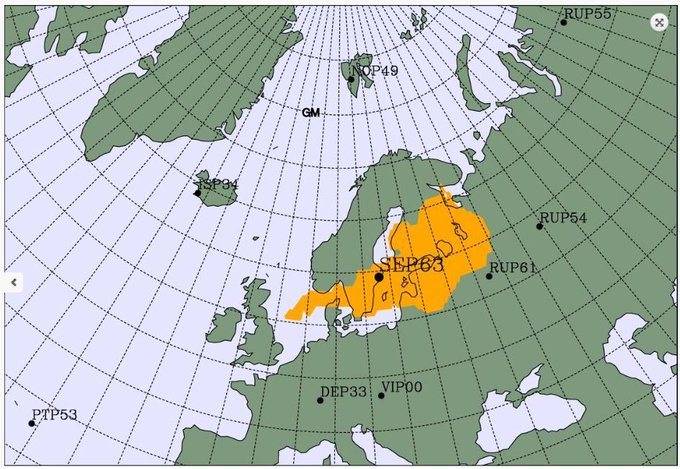
A radiation increase of isotopes commonly associated with nuclear power production has been detected in Northern Europe in the past few weeks:
EbdAa9qXQAYji-z?format=jpg&name=small.jpg


In a tweet, Lassina Zerbo, executive secretary of the Comprehensive Nuclear-Test-Ban Treaty Organization in Austria, said that a monitoring station in Sweden detected three isotopes associated with nuclear fission at higher than usual levels on June 22 and 23.
...
The combination of radionuclides may be explained by an anomaly in the fuel elements of a nuclear power plant,” said the Dutch National Institute for Public Health and the Environment (RIVM) in a statement.
[quote from that statement]
Iodine-131 was detected in Norway, while cesium-134, cesium-137, cobalt-60 and ruthenium-103 were detected in Sweden and Finland. The amount of radioactivity was very low and there was no impact on the environment or human health.
https://www.foxnews.com/science/mysterious-radiation-spike-reported-parts-of-northern-europe
https://www.cnn.com/2020/06/29/europe/russia-denies-nuclear-leaks-intl/index.html

The data points to a potential "anomaly" at a nuclear power plant, perhaps the Leningrad plant near St. Petersburg or the Kola plant near Murmansk. Russia says there are no issues at those plants. I'm not sure if we're going to get more information about this or not...
 
Chemistry news on Phys.org
Last time this happened exactly via the same route was in 1986.
 
  • Wow
Likes   Reactions: russ_watters
fresh_42 said:
Last time this happened exactly via the same route was in 1986.
Well, given the timeframe here (whatever happened was over a week ago) I would expect/hope that if it were a serious accident the fallout would be much greater. My understanding was the spiking radiation was noticed quickly and it was significant and widespread across Europe. Still, even a minor "anomaly" from everyone's least favorite nuclear power country would be concerning.

Edit; Yeah, wikipedia tells me that elevated radiation levels were first detected in Sweden two days after that accident, and the significance was pretty much immediately apparent, and the initial denial was superseded later in the day.
 
It just reminded me on May 1986. It has been Sweden to first detect it then, too, and it had also a delay of seven to ten days. And of course nobody had the severity in mind which later turned out to be. I'm not claiming that this incident is similar, but the parallels are frightening.
 
  • Like
Likes   Reactions: Klystron and russ_watters
fresh_42 said:
It just reminded me on May 1986. It has been Sweden to first detect it then, too, and it had also a delay of seven to ten days.
Wikipedia says it was 2 days.

[edit] But yeah, the general theme is parallel and concerning, which is why I posted it.
 
russ_watters said:
Wikipedia says it was 2 days.
Maybe. It took a while till the news were around everywhere. Detection and publishing it might not have been to the same date, especially as they couldn't rule out at the beginning that it was one of their own plants. The mandate for reports were a consequence of it, not the other way around.
 
  • Like
Likes   Reactions: russ_watters
The sensitivity of these detectors is remarkable. A <5 g release at Fukushima was easily observable in Europe, half the world away. 5g is about the weight of a nickel.

Why are people jumping to the conclusion of land-based reactors? (As opposed to submarines)
 
Last edited:
  • Like
  • Wow
Likes   Reactions: russ_watters and mcastillo356
Vanadium 50 said:
Why are people jumping to the conclusion of land-based reactors? (As opposed to submarines)
I think one of the articles mentioned the shape and spread of the plume suggested a direction (and maybe distance?). But also, aren't naval reactors a different fuel composition than civilian power reactors? Higher enrichment?
 
russ_watters said:
shape and spread of the plume suggested a direction

It did. The Baltic Sea lies in that direction.

russ_watters said:
But also, aren't naval reactors a different fuel composition than civilian power reactors?

I can't speak to that. But what they claim is fission products, not the primary fuel and its enrichment.
 

Similar threads

  • · Replies 3 ·
Replies
3
Views
5K