No, I didn't notice. Can you show me?

  • Context: Undergrad 
  • Thread starter Thread starter john baez
  • Start date Start date
  • Tags Tags
    Formula
Click For Summary
SUMMARY

This discussion centers on proving one of Ramanujan's formulas, specifically the series involving factorials in the denominators. The approach utilizes Taylor series and differential equations, showcasing a puzzle-like structure with an easy outer layer and a more complex inner core. Participants explore Ramanujan's potential methods, including his possible reliance on GS Carr's "A Synopsis of Elementary Results in Pure Mathematics." The conversation highlights the integration techniques that reveal deeper insights into the formula's structure.

PREREQUISITES
  • Understanding of Taylor series
  • Familiarity with differential equations
  • Basic knowledge of calculus
  • Awareness of Ramanujan's mathematical contributions
NEXT STEPS
  • Study advanced applications of Taylor series in mathematical proofs
  • Explore differential equations in the context of series summation
  • Research Ramanujan's methodologies and techniques in number theory
  • Investigate the historical context of GS Carr's "A Synopsis of Elementary Results in Pure Mathematics"
USEFUL FOR

Mathematicians, students of advanced calculus, and anyone interested in the historical and theoretical aspects of Ramanujan's work will benefit from this discussion.

john baez
Science Advisor
Insights Author
Gold Member
Messages
287
Reaction score
268
A while ago I decided to figure out how to prove one of Ramanujan’s formulas. I feel this is the sort of thing every mathematician should try at least once.

I picked the easiest one I could find:
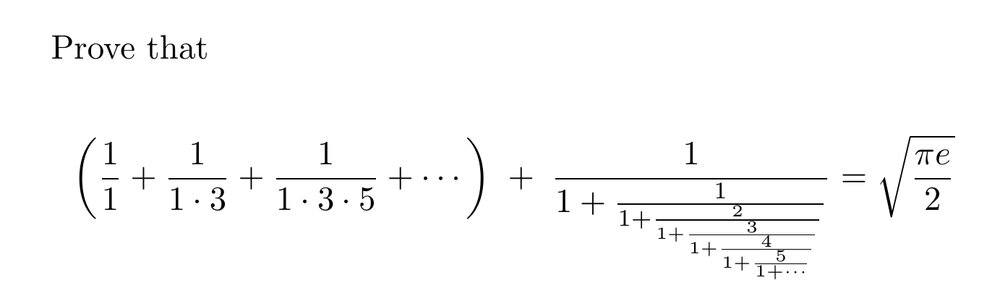
ramanujan_challenge_1.jpg


Hardy called it one of the “least impressive”. Still, it was pretty interesting: it turned out to be a puzzle within a puzzle! It has an easy outer layer which one can solve using standard ideas in calculus, and a tougher inner core which requires more cleverness - but still, nothing beyond calculus.

Read more and learn how to prove this formula here:

 
  • Like
  • Informative
Likes   Reactions: Charles Link, jedishrfu, etotheipi and 1 other person
Physics news on Phys.org
Interesting set of slides, I would not have thought to attack this problem using Taylor series and differential equations.

How did Ramanujan tackle it?

Was his approach limited to what he learned from the GS Carr book: A Synopsis of Elementary Results in Pure Mathematics?

It seems he could have approached it in the same way.
 
I would not have thought to attack this problem using Taylor series and differential equations.

When you see a series whose terms have something like factorials in their denominators:

## 1 + \frac{1}{1 \cdot 3} + \frac{1}{1 \cdot 3 \cdot 5} + \cdots ##

you should try to sum it using a Taylor series. A reasonable guess is to use this:

## f(x) = \frac{x}{1} + \frac{x^3}{1 \cdot 3} + \frac{x^5}{1 \cdot 3 \cdot 5} +\cdots ##

You can try to just guess a function that has this Taylor series, but in this example it's rather hard, so it's better to play around by integrating ##f##, differentiating it, multiplying it by stuff, and so on. The goal is to get equations you can solve to figure out what ##f## is.

How did Ramanujan tackle it?

I don't think anyone knows. But remember, he couldn't possibly have started by trying to prove this identity. He must have started by playing around with formulas and eventually found this identity.

Was his approach limited to what he learned from the GS Carr's book A Synopsis of Elementary Results in Pure Mathematics?

Quite possibly. Since Gaussians are so important he may have noticed that

## e^{x^2/2} \int_0^x e^{-t^2/2} \, dt = \frac{x}{1} + \frac{x^3}{1 \cdot 3} + \frac{x^5}{1 \cdot 3 \cdot 5} +\cdots ##

and since he was a master of continued fractions, he probably also showed something like this:

## e^{x^2/2} \int_x^\infty e^{-t^2/2} \, d t = \frac{1}{x + \frac{1}{x + \frac{2}{x + \frac{3}{x + \frac{4}{\qquad {\ddots}}}}}} ##

(A very similar formula is equation (1.8) in his first letter to Hardy, written in 1913.) It's easy to put these two formulas together and get

## \left(\frac{1}{1} + \frac{1}{1 \cdot 3} + \frac{1}{1 \cdot 3 \cdot 5} + \cdots\right) \; + \; \frac{1}{1 + \frac{1}{1 + \frac{2}{1 + \frac{3}{1 + \frac{4}{1 + \frac{5}{\quad{}_{\tiny{\ddots}}}}}}}} = \sqrt{\frac{\pi e}{2}} ##

and this is the puzzle he posed in 1914.
 
  • Like
  • Informative
Likes   Reactions: Keith_McClary, mfb, member 587159 and 2 others
This integration trick discloses how one of the problems I prepared for december can be solved. I wonder whether someone will notice.
 
  • Informative
  • Wow
Likes   Reactions: Keith_McClary and etotheipi

Similar threads

  • · Replies 6 ·
Replies
6
Views
2K
  • · Replies 17 ·
Replies
17
Views
2K
  • · Replies 7 ·
Replies
7
Views
2K
  • · Replies 4 ·
Replies
4
Views
3K
  • · Replies 7 ·
Replies
7
Views
3K
  • · Replies 8 ·
Replies
8
Views
7K
  • · Replies 4 ·
Replies
4
Views
3K
  • · Replies 66 ·
3
Replies
66
Views
7K
  • · Replies 11 ·
Replies
11
Views
3K
  • · Replies 19 ·
Replies
19
Views
7K