Re-exciting organic scintillator

3 replies · 2K views · last reply
rphys
Messages
4
Reaction score
0
I've attached an image from the book "nuclear physics" by John Lilley.

It says "in only one case is the restulting photon energy sufficient to cause re-excitation". My question is what is this one case? I recall my lecturer saying only decay to S01 is sufficient to cause re-excitation, but I can't find any evidence for this.

Thanks for any help
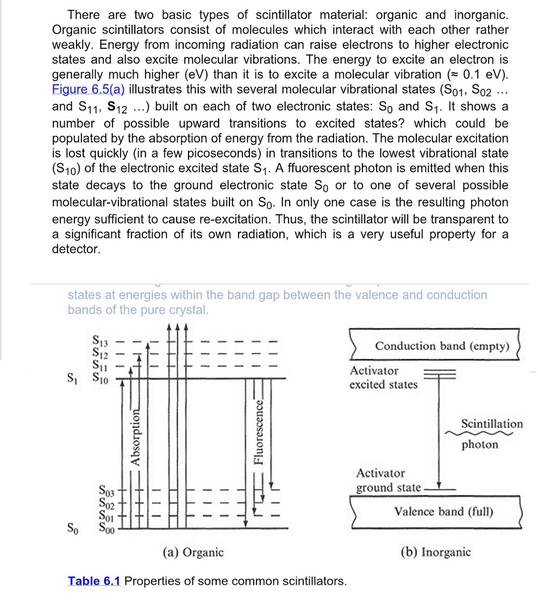
Two-panel diagram of scintillator energy levels: (a) Organic energy level diagram with singlet states S1 and S0 and vibrational sublevels, showing Absorption and Fluorescence arrows; (b) Inorganic band diagram with conduction band (empty), activator excited states, scintillation photon, activator ground state and valence band (full).
 
Attachments
  • Two-panel diagram of scintillator energy levels: (a) Organic energy level diagram with singlet states S1 and S0 and vibrational sublevels, showing Absorption and Fluorescence arrows; (b) Inorganic band diagram with conduction band (empty), activator excited states, scintillation photon, activator ground state and valence band (full).
    2nkklc1.jpg
    64.1 KB · Views: 557
Most electrons are in S00, they need an energy of at least S10-S00 to be excited. There is only one way an electron in S10 can release that much energy: If it goes to S00. That is usually filled so it is a rare process. You can also have S10->S01 but then you need an electron in S01 to get excited. Transitions to down higher energy levels need even higher energy levels of electrons for re-excitations but they are getting really rare.
 
  • Like
Likes   Reactions: rphys
mfb said:
Most electrons are in S00, they need an energy of at least S10-S00 to be excited. There is only one way an electron in S10 can release that much energy: If it goes to S00. That is usually filled so it is a rare process. You can also have S10->S01 but then you need an electron in S01 to get excited. Transitions to down higher energy levels need even higher energy levels of electrons for re-excitations but they are getting really rare.

So would you say the book is referring to fluorescence photons emitted during decay to S00 as being the ones with sufficient energy to cause re-excitation? I am tempted to repeat what the book has said (only one case) and keep it vague because I am not sure about this.
 
rphys said:
So would you say the book is referring to fluorescence photons emitted during decay to S00 as being the ones with sufficient energy to cause re-excitation?
That's how I would interpret the statement of the book. It depends on the temperature as well but you'll have empty S0x states accessible at every reasonable temperature.
 
  • Like
Likes   Reactions: rphys