Real ordered pairs (y,a) satisfying cubic with y in [0,2.5]

  • Topic:
  • Thread starter Thread starter anemone
  • Start date Start date
Join the discussion
Registration is free. Start your own thread to ask a follow-up.
3 replies · 2K views
anemone
Gold Member
MHB
POTW Director
Messages
3,851
Reaction score
115
Hi MHB,

This is another interesting problem that I tried to work on it with no luck so far to break the code...

Problem:

Find the number of real order pairs of $(y, a)$ that satisfy $$100y^3-3\left( 150+\frac{a}{8} \right)y^2+3\left( 125+\frac{5a}{8} \right)y-3\left( \frac{59a}{96}-\frac{75}{2} \right)=0$$ such that $0 \le y \le 2.5$.

At first glance, my mind draws a blank and this is not good because whenever this happens to me, chances are I will not be able to solve the problem. And here I am now, asking for a modicum of help or ideas to crack this problem.


Thanks.
 
Mathematics news on Phys.org
anemone said:
Hi MHB,

This is another interesting problem that I tried to work on it with no luck so far to break the code...

Problem:

Find the number of real order pairs of $(y, a)$ that satisfy $$100y^3-3\left( 150+\frac{a}{8} \right)y^2+3\left( 125+\frac{5a}{8} \right)y-3\left( \frac{59a}{96}-\frac{75}{2} \right)=0$$ such that $0 \le y \le 2.5$.

At first glance, my mind draws a blank and this is not good because whenever this happens to me, chances are I will not be able to solve the problem. And here I am now, asking for a modicum of help or ideas to crack this problem.


Thanks.


If y is the independent variable You can to arrive to write a single valued function $\displaystyle a = \varphi(y)$ because Your equation is linear in a, so that is...

$\displaystyle f(y)\ a + g(y) = 0 \implies \varphi(y) = - \frac{g(y)}{f(y)}\ (1)$

Kind regards

$\chi$ $\sigma$
 
chisigma said:
If y is the independent variable You can to arrive to write a single valued function $\displaystyle a = \varphi(y)$ because Your equation is linear in a, so that is...

$\displaystyle f(y)\ a + g(y) = 0 \implies \varphi(y) = - \frac{g(y)}{f(y)}\ (1)$

Kind regards

$\chi$ $\sigma$

Thanks for your reply, chisigma.

To be honest with you:o, I have actually tried that (I am sorry for not showing my attempt in the first place) and found that there really is nothing much to do afterwards but I might be wrong.
According to your suggestion, I get:

$$100y^3-3(150)y^2+3(125)y+3(\frac{75}{2})=a\left( \frac{3y^2}{8}-\frac{15y}{8}+\frac{59}{32} \right)$$

And I even sketched the functions of $f(y)=100y^3-3(150)y^2+3(125)y+3(\frac{75}{2})$ and $g(y)=\dfrac{3y^2}{8}-\dfrac{15y}{8}+\dfrac{59}{32}$ but I don't see the relation between $a$ and the given restriction where $0 \le y \le 2.5$ and the newly formed equation, and hence how to find the number of real order pairs of $(a, y)$ based on that.
 
Hmm...if I express $a$ as the subject of the formula, I get:

$$a=\frac{100y^3-3(150)y^2+3(125)y+3(\frac{75}{2})}{\large \left( \frac{3y^2}{8}-\frac{15y}{8}+\frac{59}{32} \right)}$$

$$\;\;\;=\frac{3200y^3-14400y^2+12000y+3600}{12y^2-60y+59}$$

$$\;\;\;=\frac{800y}{3}+\frac{400}{3}+\frac{12800}{3} \left(\frac{y-1}{12y^2-60y+59} \right)$$

$$\;\;\;=\frac{800y}{3}+\frac{400}{3}+\frac{12800}{3} \left(\frac{y-1}{12(y-3.6547)(y-1.3453)} \right)$$

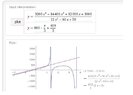
And if I plot the sketch of $a$ versus $y$, I get:

View attachment 1585

From the graph, we can tell there are infinitely many real order pairs of $(y, a)$, with $a\ne 1.3453$ for $0 \le y \le 2.5$.

I think I have solved this problem! :)
 
Attachments
  • Find (a,y).JPG
    Find (a,y).JPG
    18.5 KB · Views: 151