Rectangular Box with two non zero potential faces

Join the discussion
Registration is free. Ask a follow-up in this thread, or start your own.
4 replies · 2K views
guyvsdcsniper
Messages
264
Reaction score
37
Homework Statement
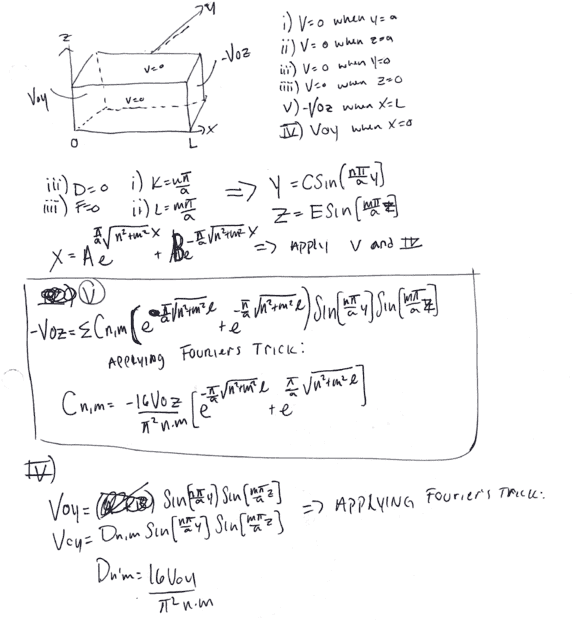
a conducting rectangular hollow box has zero potential on all its rectangular sides and a potential of
Voy at x=0 and -Voz at x=l

Find the potential inside
Relevant Equations
laplace's equation
I believe what I have to do to solve this problem is find the potential at each end face and then use the super position principle to find the net potential. So my boundary condition v and iv will give the potential at each respective position.
Im just a bit confused about my boundary V.

Usually when doing these problems the condition causes a coefficient to be zero. Here we have a potential when x=l
So i get this big ugly exponential attached to my coefficient.

Does this seem correct
Screen Shot 2022-05-05 at 8.19.15 AM.png
 
Physics news on Phys.org
Yes, generally you will get some sort of exponential attached. You could get rid of it (should you wish to do so) by using (l-x) as a coordinate for that part of the solution rather than x. (Also, you may find it more aesthetically pleasing to use sinh and cosh instead of the exponential functions.)

On a completely different note: The Roman number 6 is written VI while IV is the Roman number 4.
 
Orodruin said:
Yes, generally you will get some sort of exponential attached. You could get rid of it (should you wish to do so) by using (l-x) as a coordinate for that part of the solution rather than x. (Also, you may find it more aesthetically pleasing to use sinh and cosh instead of the exponential functions.)

On a completely different note: The Roman number 6 is written VI while IV is the Roman number 4.
Ohh that is write I can write the exponential as for condition V as 2cosh(x).

so then I would get 2cosh(l-x)?
 
Orodruin said:
Yes, although you can absorb the 2 into the coefficient.
I did something similar to this in a 2-D laplace equation but now that it is 3-D the exponential is raised to a half power, π/a√(n2+m2)(l-x)
So then I would have Cosh(π/a√(n2+m2)(l-x))

Is that correct?