MHB Relative Extrema vs Absolute Extrema

Click For Summary
Relative extrema refer to the highest or lowest points within a specific neighborhood of a function, while absolute extrema represent the highest or lowest points across the entire domain. Finding absolute extrema is more complex because it requires evaluating critical points, poles, and boundary behavior of the function. For example, a function may have multiple relative minima and maxima, but only one absolute minimum, especially if it approaches infinity at the boundaries. Understanding these differences is crucial for analyzing the behavior of functions in calculus. Overall, the distinction between relative and absolute extrema is fundamental in optimization problems.
harpazo
Messages
208
Reaction score
16
In basic terms, what is the main difference between relative extrema and absolute extrema? I know that absolute extrema is more involved but why is this the case?
 
Physics news on Phys.org
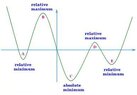
A relative maximum (minimum) is the greatest (smallest) in its neighborhood but an absolute maximum (minimum) is the greatest (smallest) anywhere (in the domain). For example:

View attachment 6470

In the picture we see that the function has $3$ relative minima and an absolute minimum, which is smallest of all relative minima. It also has $2$ relative maxima, but it has no absolute maximum, since at the boundaries the function goes to $+\infty$.
In general, to find an absolute extrema, besides the critical points we have to check also the poles of the function and the boundaries of its domain.
 

Attachments

  • extrema.jpg
    extrema.jpg
    10.4 KB · Views: 167
Last edited by a moderator:
mathmari said:
A relative maximum (minimum) is the greatest (smallest) in its neighborhood but an absolute maximum (minimum) is the greatest (smallest) anywhere (in the domain). For example:


In the picture we see that the function has $3$ relative minima and an absolute minimum, which is smallest of all relative minima. It also has $2$ relative maxima, but it has no absolute maximum, since at the boundaries the function goes to $+\infty$.
In general, to find an absolute extrema, besides the critical points we have to check also the poles of the function and the boundaries of its domain.

Very cool. Nice picture.
 
There are probably loads of proofs of this online, but I do not want to cheat. Here is my attempt: Convexity says that $$f(\lambda a + (1-\lambda)b) \leq \lambda f(a) + (1-\lambda) f(b)$$ $$f(b + \lambda(a-b)) \leq f(b) + \lambda (f(a) - f(b))$$ We know from the intermediate value theorem that there exists a ##c \in (b,a)## such that $$\frac{f(a) - f(b)}{a-b} = f'(c).$$ Hence $$f(b + \lambda(a-b)) \leq f(b) + \lambda (a - b) f'(c))$$ $$\frac{f(b + \lambda(a-b)) - f(b)}{\lambda(a-b)}...

Similar threads

Replies
2
Views
2K
  • · Replies 4 ·
Replies
4
Views
2K
  • · Replies 7 ·
Replies
7
Views
3K
  • · Replies 3 ·
Replies
3
Views
5K
  • · Replies 1 ·
Replies
1
Views
2K
  • · Replies 1 ·
Replies
1
Views
2K
  • · Replies 1 ·
Replies
1
Views
2K
  • · Replies 10 ·
Replies
10
Views
3K
  • · Replies 2 ·
Replies
2
Views
2K
Replies
7
Views
2K