Relativistic Aberration: Intuitive Understanding

  • Context: Undergrad 
  • Thread starter Thread starter Happiness
  • Start date Start date
  • Tags Tags
    Aberration Relativistic
Click For Summary
SUMMARY

Relativistic aberration describes how light rays emitted from a moving source appear tilted in the direction of motion, a phenomenon known as relativistic beaming. When a source emits light vertically while moving horizontally, the emitted light rays are concentrated conically towards the direction of motion, resulting in an angle less than 90 degrees with the horizontal axis. The discussion critiques the "bird poop" model for failing to accurately represent light pulse behavior in both classical and relativistic contexts, emphasizing that light pulses maintain their speed while acquiring horizontal velocity. The analogy of rain hitting a moving car illustrates this effect effectively.

PREREQUISITES
  • Understanding of relativistic physics concepts
  • Familiarity with Lorentz transformations
  • Basic knowledge of light behavior and photon theory
  • Concept of classical versus relativistic frames of reference
NEXT STEPS
  • Study the principles of relativistic beaming in detail
  • Explore Lorentz transformations and their applications
  • Investigate the implications of light pulse behavior in different frames
  • Examine real-world examples of relativistic effects, such as in astrophysics
USEFUL FOR

Physics students, educators, and professionals interested in advanced concepts of relativity and light behavior, particularly those exploring the implications of relativistic effects in various contexts.

Happiness
Messages
686
Reaction score
30
The rays of light from a moving source are tilted towards the direction of the source's motion. It is as if light emitted by a moving object is concentrated conically, towards its direction of motion. This effect is called relativistic beaming.

For example, if a source is emitting light vertically downwards when it is at rest, then when it is moving to the right, the light ray from the moving source is tilted to the right, such that the ray makes an angle less than ##90^\circ## to the rightwards-pointing horizontal axis.

If we visualise the source to be emitting photons vertically downwards, then since the source is moving to the right, the second photon emitted should be displaced to the right from the first one. Then if we join up these photons with a line to form a light ray, then we would get a light ray that is pointing downwards but tilted to the left, like this:
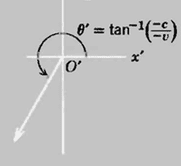
Screen Shot 2017-09-19 at 2.41.26 AM.png


This photon model (or equivalently, bird poop dropping at regular intervals) produces the opposite prediction from the observations of relativistic aberration. What is wrong with the bird-poop-dropping model?
 
Physics news on Phys.org
First of all, unless you want to go all out on relativistic field theory, you better forget about photons and instead think of light pulses.

Second, your understanding of your "bird poop" model is flawed also in the classical scenario. Classically, if the bird poop is just below the bird in one frame it will be below the bird in all frames. This is also true in relativity.

Third, the point is not what the line connecting the light pulses (or poops) is. The issue is in which direction each pulse (poop) is moving.
 
  • Like
Likes   Reactions: vanhees71, Happiness and SiennaTheGr8
Orodruin said:
Classically, if the bird poop is just below the bird in one frame it will be below the bird in all frames. This is also true in relativity.

Am I right to say that the light ray from a rightward-moving source is tilted to the right such that a light pulse is always vertically below the source? In a sense, a light pulse that is "dropped" vertically from the source acquires the same horizontal velocity as the source (though counter-classically is able to maintain its speed as ##c##). Consequently, it has to be traveling in a path tilted to the right.
 
Happiness said:
In a sense, a light pulse that was "dropped" vertically from the source acquires the same horizontal velocity as the source (though counter-classically is able to maintain its speed as ccc). Consequently, it has to be traveling in a path tilted to the right.
Yes, this is a correct assessment. You have essentially the same type of effect, but more clearly experienced, when you drive a car in heavy rain. The rain is always below the clouds (in the ground frame and in the car frame - assuming no wind) but in the car frame it comes towards the car on the windshield from the front.
 
Orodruin said:
Second, your understanding of your "bird poop" model is flawed also in the classical scenario. Classically, if the bird poop is just below the bird in one frame it will be below the bird in all frames. This is also true in relativity.

Good point.

Even in Galilean relativity, a pair of observers in different frames must disagree on the angle between the axis of their relative motion and some third party's velocity vector (provided that the angle isn't ##0## or ##\pi##). The Lorentz transformation of that angle is a bit more complicated, but really it's the same basic phenomenon, and the aberration of light is just a special case.
 

Similar threads

  • · Replies 3 ·
Replies
3
Views
2K
  • · Replies 10 ·
Replies
10
Views
1K
  • · Replies 34 ·
2
Replies
34
Views
3K
  • · Replies 12 ·
Replies
12
Views
2K
  • · Replies 6 ·
Replies
6
Views
2K
  • · Replies 25 ·
Replies
25
Views
2K
  • · Replies 4 ·
Replies
4
Views
1K
Replies
3
Views
1K
  • · Replies 57 ·
2
Replies
57
Views
7K
  • · Replies 25 ·
Replies
25
Views
1K