Relevant equations for an airplane landing

Click For Summary
SUMMARY

The discussion centers on modeling the descent of an airplane using equations of motion, specifically focusing on the acceleration constraints defined by -amax < ay < amax. Participants explore various approaches to derive the equations for vertical position y(t) and vertical velocity v(t) during descent. Key equations discussed include v(t) = -amax*tlim + amax*(t-tl) and y(t) = -amax*t^2lim + amax*(t-tl)^2/2. The conversation emphasizes the importance of correctly applying boundary conditions, particularly ensuring that vy = 0 upon landing.

PREREQUISITES
  • Understanding of kinematics and equations of motion
  • Familiarity with acceleration constraints in physics
  • Proficiency in mathematical modeling and integration techniques
  • Experience with plotting tools like Gnuplot for visualizing equations
NEXT STEPS
  • Study the principles of kinematic equations in physics
  • Learn about acceleration profiles and their impact on motion
  • Research numerical methods for solving differential equations
  • Explore advanced plotting techniques in Gnuplot for better visualization of motion
USEFUL FOR

Aerospace engineers, physics students, and anyone involved in modeling motion dynamics, particularly in aviation contexts.

santimirandarp
Messages
21
Reaction score
0
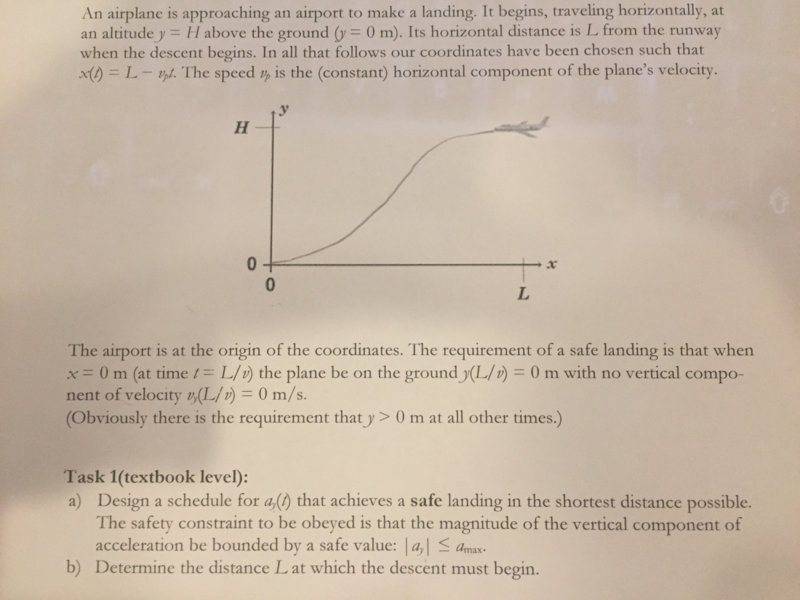
The problem

I'm pasting the problem below mainly for the plot of y vs x.
DnRIV2.jpg


A possible way to think of it

I suppose the important thing here is to find y(t) with the condition that -amax<ay<amax, and vy(L/vp)=0
My attempt

I've modeled acceleration as a(t)=-kt and got an equation for y(t) as a function of t3 which can be replaced by L/v. But the problem is that, plotting on gnuplot, the solution doesn't convince me. Would you give me some hints on how to model a(t), please?
 

Attachments

  • DnRIV2.jpg
    DnRIV2.jpg
    46.9 KB · Views: 929
Last edited:
Physics news on Phys.org
You have a maximal bound on the allowed acceleration. How can you use this to go down as fast as possible if you do not care about having ##v_y = 0## when you land?
 
Orodruin said:
You have a maximal bound on the allowed acceleration. How can you use this to go down as fast as possible if you do not care about having ##v_y = 0## when you land?
Writing v(t)=-t2/2 I don't see any conclusion (v(0)=0). All I can see is that |v(t)| will increase continuously and of course that's wrong because at t=L/v, vy=0
 
Last edited:
No, you are just making an assumption that ##a = -kt##. There are no grounds for making this assumption and it leads to a false result. For times ##t < a_0/k##, it will not accelerate enough - leading to a slower descent than possible - and for ##t > a_0/k## it violates the requirement that ##|a| < a_0##.
 
Orodruin said:
No, you are just making an assumption that ##a = -kt##. There are no grounds for making this assumption and it leads to a false result. For times ##t < a_0/k##, it will not accelerate enough - leading to a slower descent than possible - and for ##t > a_0/k## it violates the requirement that ##|a| < a_0##.
Fine but acceleration is function of time, I just tried the simplest. Cause, for example, a(t)=1/t seems more complex. Do you see any way to solve it?
 
santimirandarp said:
Fine but acceleration is function of time, I just tried the simplest.
No you did not try the simplest. There is nothing stating that the acceleration must be continuous or given by an easy functional expression.
 
Orodruin said:
No you did not try the simplest. There is nothing stating that the acceleration must be continuous or given by an easy functional expression.
But if we state that a=amax wouldn't be wrong? I mean, it must change with time (at least its sign).
 
Orodruin said:
No you did not try the simplest. There is nothing stating that the acceleration must be continuous or given by an easy functional expression.
Oh I see. Do you mean it should be splitted up? But in that case it'd be quite unreal/unphysical.
 
santimirandarp said:
But in that case it'd be quite unreal/unphysical.
While it is true that you probably cannot change the acceleration instantly from one value to another, you can get close enough to it for it not to matter as long as the overall time-scale of the descent is much longer than the time it takes to reverse the acceleration.
 
  • #10
After some more trials this is what I've got. For t>tc which is the time where acceleration change its sign,

v(t)=-amax*tlim+ amax*(t-tl)/
and
y(t)= -amax*t2lim+ amax*(t-tl)2/

as t=L/vp, replacing into t, deriving respect to L, and solving for L, it yields:

L=tc*vp

Any suggestion?
 
  • #11
santimirandarp said:
v(t)=-amax*tlim+ amax*(t-tl)/
and
y(t)= -amax*t2lim+ amax*(t-tl)2/

Here you are guessing that the quickest way down is max acceleration down until at some point you apply max acceleration up. I think that is right. However then you somehow put this together with the horizontal motion and L. Your equations are in the y dimension. Stay there a minute.

Look at the first equation. They told you vy had to be zero when you reach the ground. What does that tell you about the two intervals?

Now look at your second equation. The initial vertical velocity is zero, so you don’t need a v0 t term for the first segment of descent. But is that true for the second segment? As you have it written the plane will wind up right back where it started.
 
  • Like
Likes   Reactions: santimirandarp
  • #12
Good points.

1) I think is correct because t=L/v, time of flight is independent of the dimension.

2) The time intervals of acceleration are identical, that follows from v(t).

3) The integration was wrong y(t)= yl -amax*tl*(t-tl)+ amax*(t-tl)2/2

I'm not sure of this last step. So tired of this problem.
 
  • #13
santimirandarp said:
3) The integration was wrong y(t)= yl -amax*tl*(t-tl)+ amax*(t-tl)2/2

Still not right I’m afraid. Try thinking of it as two problems. First from H to H/2 with a down, then take the result as the initial conditions (position and velocity) for H/2 to 0 with a up.
 
  • #14
Adding yl=H/2 it'd be complete isn't it?
 
  • #15
santimirandarp said:
Adding yl=H/2 it'd be complete isn't it?

Actually, I think I was wrong. That wasn’t what was bothering me. I didn’t think the second term looked right. However, looking at it again I can’t figure out what I even thought was wrong. It looks ok to me. Sorry about that.
 
  • #16
santimirandarp said:
Adding yl=H/2 it'd be complete isn't it?

In fact, hallelujah, it leads directly to where I would have started the problem. You have an expression for y(t) in the second half of the motion. You will definitely want that H/2 in there. Now you know when the plane lands y(t) = 0. Is there anything you can say about t at that time compared to tl?
 
  • #17
santimirandarp said:
3) The integration was wrong y(t)= yl -amax*tl*(t-tl)+ amax*(t-tl)2/2
I'm a bit confused by your changing notation. Assuming tc, tl and tlim are all the time at which acceleration reverses, that's not quite what I get. What does your expression yield for y(tc)?

Edit: I tried interpreting tl as the time at landing, but that doesn't seem to work either.
 
Last edited:

Similar threads

Replies
15
Views
1K
  • · Replies 6 ·
Replies
6
Views
5K
  • · Replies 4 ·
Replies
4
Views
4K
  • · Replies 6 ·
Replies
6
Views
2K
Replies
12
Views
2K
  • · Replies 1 ·
Replies
1
Views
3K
  • · Replies 8 ·
Replies
8
Views
3K
  • · Replies 3 ·
Replies
3
Views
4K
  • · Replies 7 ·
Replies
7
Views
3K
  • · Replies 2 ·
Replies
2
Views
1K