Representation of elements of the Grassmannian space

Click For Summary
SUMMARY

The discussion focuses on the representation of k-subspaces of ℝn within the context of Grassmannians, specifically comparing the Plücker embedding and the Projection embedding. The Plücker embedding is widely documented in algebraic geometry literature, while the Projection embedding is noted for its intuitive simplicity but lacks extensive coverage in classical texts. Participants express a need for clarity on the definitions and symbols used, particularly regarding the representation of elements in the Grassmannian space.

PREREQUISITES
  • Understanding of Grassmannians and their properties
  • Familiarity with Plücker embedding techniques
  • Basic knowledge of algebraic geometry
  • Concept of k-subspaces in ℝn
NEXT STEPS
  • Research the mathematical foundations of Grassmannians
  • Study the Plücker embedding in detail, including its applications
  • Explore the Projection embedding and its advantages over Plücker embedding
  • Review classical literature on algebraic geometry for historical context
USEFUL FOR

Mathematicians, algebraic geometers, and students studying Grassmannians and their embeddings will benefit from this discussion.

mnb96
Messages
711
Reaction score
5
Hi,

I am studying some material related to Grassmannians and in particular how to represent k-subspaces of ℝn as "points" in another space.

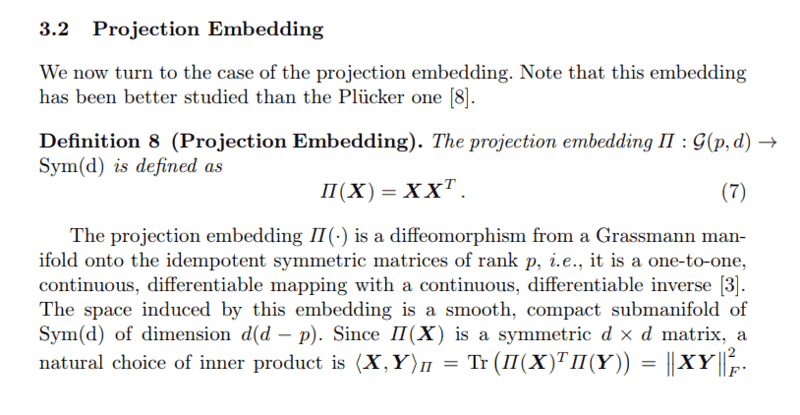
I think understood the general idea behind the Plücker embedding, however, I recently came across another type of embedding (the "Projection embedding") that sounds more intuitive and simpler to understand (see attached figure for its definition).

Can anyone elaborate a bit more on the main differences between Plücker and Projection embeddings?

In the past I browsed some old textbooks in the classical literature of algebraic geometry, and while the Plücker embedding is always treated extensively, the Projection embedding is not even mentioned at all. Why?
upload_2018-11-5_14-12-3.png
 

Attachments

  • upload_2018-11-5_14-12-3.png
    upload_2018-11-5_14-12-3.png
    49 KB · Views: 757
Physics news on Phys.org
you need to define some of the symbols in your post to make it possible for us to comment. e.g what is X ? if a matrix, how does it represent an element of the grassmannian? also the text you quote contradicts your statement that the projection method is less studied than the plucker one. why not just look at some of the references in [8], which you do not give us.
 

Similar threads

  • · Replies 6 ·
Replies
6
Views
3K
  • · Replies 1 ·
Replies
1
Views
2K
  • · Replies 9 ·
Replies
9
Views
2K
  • · Replies 5 ·
Replies
5
Views
2K
  • · Replies 4 ·
Replies
4
Views
2K
  • · Replies 6 ·
Replies
6
Views
4K
  • · Replies 5 ·
Replies
5
Views
2K
  • · Replies 2 ·
Replies
2
Views
2K
  • · Replies 5 ·
Replies
5
Views
3K
  • · Replies 5 ·
Replies
5
Views
2K