Restricted Open Shell Hartree Fock Method

Click For Summary
SUMMARY

The discussion focuses on the Restricted Open Shell Hartree-Fock (ROHF) method, detailing its implementation and differences from other Hartree-Fock methods such as Restricted Hartree-Fock (RHF) and Unrestricted Hartree-Fock (UHF). Key points include the process for multiplying supermatrices by normal matrices, normalizing the overlap matrix, and the feasibility of computing excited states using the Hartree-Fock method through configuration interaction (CI). The foundational work of C. J. Roothaan in 1960 is referenced as a critical source for understanding these concepts.

PREREQUISITES
  • Understanding of Hartree-Fock methods (RHF, UHF, ROHF)
  • Familiarity with matrix multiplication techniques
  • Knowledge of quantum chemistry principles
  • Basic concepts of electronic states and configuration interaction (CI)
NEXT STEPS
  • Study the mathematical foundations of matrix multiplication in quantum chemistry
  • Explore the differences and applications of ROHF, RHF, and UHF methods
  • Research normalization techniques for overlap matrices in quantum systems
  • Learn about configuration interaction (CI) for computing excited states in quantum chemistry
USEFUL FOR

Quantum chemists, computational chemists, and researchers working on electronic structure methods who seek to deepen their understanding of open-shell systems and Hartree-Fock methodologies.

twist.1995
Messages
7
Reaction score
1
Hello, dear scientists and forum users.
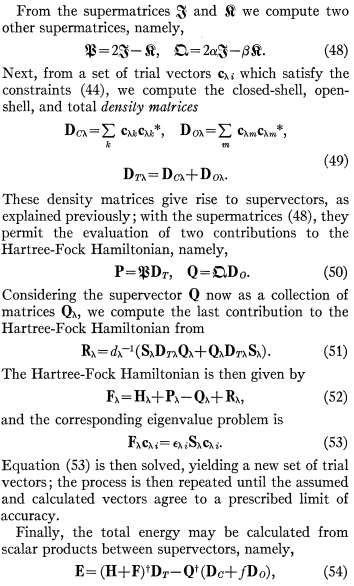
I have recently finished programming the restricted closed-shell and unrestricted Hartree-Fock matrix equations. They seem to work fine for small diatomic molecules. However, I cannot understand the restricted open-shell theory that was firstly published by Roothaan. Particularly, in his equations, he separates the matrices according to "SPECIES" and calls them supervectors or supermatrices. Could someone explain how I can 1) multiply supermatrices by normal matrices, 2) Normalize the overlap matrix to the half of the number of open-shell or closed-shell electrons 3) Understand the difference between ROHF, RHF and UHF.
Also, I am wondering in if it is possible to compute the excited states and energies using HF method. Thanks.
See the figure below (extracted from Roothaan's paper, Ref: C. J. Roothaan. 1960. Self-Consistent Field Theory for Open Shells of Electronic Systems. Review of Modern Physics: 32, 2.)
upload_2018-6-28_11-8-49.png
 

Attachments

  • upload_2018-6-28_11-8-49.png
    upload_2018-6-28_11-8-49.png
    33 KB · Views: 563
Physics news on Phys.org
To answer your questions:1) To multiply supermatrices by normal matrices, you need to use matrix multiplication. This means that each element of the first matrix must be multiplied by the corresponding element of the second matrix, and the results are then added together. For example, if you have two matrices A and B, and A is an nxm matrix and B is an mxn matrix, then the resulting matrix C is an nxn matrix where Cij = Σm akibkj.2) To normalize the overlap matrix to the half of the number of open-shell or closed-shell electrons, you need to use the formula 1/2*N, where N is the total number of electrons (open-shell or closed-shell).3) ROHF, RHF, and UHF are all different types of Hartree-Fock methods. ROHF stands for Restricted Open-Shell Hartree-Fock, and it is used when the number of electrons in the system is not evenly divided between spin up and spin down states. RHF stands for Restricted Hartree-Fock, and it is used when the number of electrons in the system is evenly divided between spin up and spin down states. Finally, UHF stands for Unrestricted Hartree-Fock, and it is used when the electrons can be in either spin up or spin down states without any restrictions. 4) Yes, it is possible to compute excited states and energies using the HF method. However, this requires a more sophisticated approach called configuration interaction (CI). In CI, multiple configurations are considered and the resulting wavefunction is a linear combination of these configurations. This approach can be used to accurately calculate excited states and their energies.
 

Similar threads

  • · Replies 2 ·
Replies
2
Views
2K
  • · Replies 4 ·
Replies
4
Views
3K
  • · Replies 1 ·
Replies
1
Views
13K
  • · Replies 5 ·
Replies
5
Views
5K
  • · Replies 10 ·
Replies
10
Views
5K
  • · Replies 20 ·
Replies
20
Views
5K
  • · Replies 5 ·
Replies
5
Views
3K