Reviewing Cross Product: Simplest Method Possible

4 replies · 2K views · last reply
ineedhelpnow
Messages
649
Reaction score
0
HEY GUYS! (Wave)
ok so i have this question i did. and now I am reviewing for the test and i looked at how i did it and i did in the most complicated way ever. i don't FULLY understand chegg's method. so i hope someone can provide me with the SIMPLEST method possible. thank u! (Blush) (p.s. don't ask me what the green stain on my final answer is because i have no idea) i would really appreciate a step by step solution at one shot so i can fully understand it.

View attachment 3211View attachment 3213View attachment 3212View attachment 3210

$\left| \tau\right| = \left| r \right| \left| F \right| sin (\theta)$
 
Attachments
  • Handwritten working on lined paper: |r| = sqrt(0^2 + 0.3^2 + 0^2) = 0.3; |F| = sqrt(0^2 + 3^2 + (-4)^2) = sqrt(9 + 16) = sqrt(25) = 5; 0.9 = (0.3)(5)cos θ; cos θ = 0.6; sin θ = sqrt(1 - (0.6)^2) = 0.8, so sin θ = 0.8; back to the original equation for |τ|: 100 = (0.3)|F|(0.8); 100/0.24 = |F|; |F| ≈ 417 N.
    DSC00013.JPG
    15.1 KB · Views: 135
  • Printed textbook problem: A wrench 30 cm long lies along the positive y-axis and grips a bolt at the origin. A force is applied in the direction <0, 3, -4> at the end of the wrench. Find the magnitude of the force needed to supply 100 N·m of torque to the bolt.
    DSC00010.JPG
    10.2 KB · Views: 132
  • Handwritten working on lined paper: r·v = |r||v|cosθ, then r·v = (0)(0) + (0.3)(3) + (0)(-4) = 0.9, |r| = 0.3, |v| = 5, 0.9 = (0.3)(5)cosθ, cosθ = 0.6, sinθ = 0.8, and 'back to the original equation for |τ|'.
    DSC00012.JPG
    17.3 KB · Views: 154
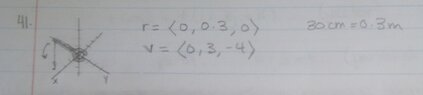
  • Handwritten notes on lined paper: problem 41 with r = <0, 0.3, 0> and v = <0, 3, -4>, plus 30 cm = 0.3 m, next to a sketch of a rod with an axis labelled Y and an X axis.
    DSC00011.JPG
    4.9 KB · Views: 148
ineedhelpnow said:
HEY GUYS! (Wave)
ok so i have this question i did. and now I am reviewing for the test and i looked at how i did it and i did in the most complicated way ever. i don't FULLY understand chegg's method. so i hope someone can provide me with the SIMPLEST method possible. thank u! (Blush) (p.s. don't ask me what the green stain on my final answer is because i have no idea) i would really appreciate a step by step solution at one shot so i can fully understand it.

Your result is correct! (Yes)

Here is how I would do it.

The formula for torque is:
$$\boldsymbol{\tau} = \mathbf r \times \mathbf F \tag 1$$

Normalizing the direction vector of the force, we have:
$$\mathbf{\hat F} = \frac 1 5 \begin{pmatrix}0\\3\\-4\end{pmatrix} \tag 2$$

Substituting the data of $\mathbf r$ and $(2)$ into $(1)$ we get:
$$\boldsymbol\tau
= \begin{pmatrix}0\\0.3\\0\end{pmatrix}
\times \frac 1 5 F \begin{pmatrix}0\\3\\-4\end{pmatrix}
=\frac{1}{50}F \begin{pmatrix}0\\3\\0\end{pmatrix}
\times \begin{pmatrix}0\\3\\-4\end{pmatrix}
=\frac{1}{50}F \begin{pmatrix}-12\\0\\0\end{pmatrix}
$$

So:
$$\tau=\frac{12}{50}F=100 \Rightarrow F = 417 \text{ N}$$

Btw, what is that $\color{Green}{\text{green stain}}$ on your answer?
Were you eating? (Wondering)
 
ive never really seen it don't that way. is there an easy way to first solve for theta and then continue the rest of the problem.

lol i don't know. i think its a food stain. i was eating while doing it. i think its like oil or something (Giggle)
 
now that i look back at it, i think it does make sense the way i did it. when i was doing it, i didnt get it much but now i realize that all i did was use the dot product as well as the cross product. i think i understand it more now because I am familiar with the equation $r \cdot v= \left| r \right| \left| v \right| cos (\theta)$
 
ineedhelpnow said:
ive never really seen it don't that way. is there an easy way to first solve for theta and then continue the rest of the problem.

That's how your solution works.
First use the dot product to find the angle between the 2 vectors:
$$\mathbf r \cdot \mathbf v = r_x v_x + r_y v_y + r_z v_z$$
$$\mathbf r \cdot \mathbf v = |r|\cdot |v|\cdot \cos(\theta)$$
Then use the cross product to find the torque:
$$\tau = |\mathbf r \times \mathbf F| = |r|\cdot |F|\cdot \sin(\theta)$$

In my version I skipped those steps with the dot product, and went straight for the cross product.