Rewriting Brackets: How to Factor Out the s & Distribute Power of 6

  • Thread starter Thread starter umzung
  • Start date Start date
Click For Summary
SUMMARY

The discussion focuses on the mathematical process of factoring out 's' and distributing the power of 6 in the expression \(\frac{1}{2}s + \frac{1}{2}s^2\). Participants clarify that the expression can be rewritten as \(\frac{1}{2}s(1+s)\), leading to \(\left(\frac{1}{2}s + \frac{1}{2}s^2\right)^6 = \frac{1}{64}s^6(1+s)^6\). This transformation utilizes the property \((ab)^n = a^n b^n\) to simplify the expression without direct multiplication.

PREREQUISITES
  • Understanding of algebraic expressions and factoring techniques
  • Familiarity with the properties of exponents
  • Knowledge of polynomial expressions
  • Basic skills in manipulating fractions
NEXT STEPS
  • Study the properties of exponents in depth, particularly \((ab)^n = a^n b^n\)
  • Practice factoring polynomial expressions involving multiple terms
  • Explore advanced algebraic techniques for simplifying complex expressions
  • Learn about the binomial theorem and its applications in polynomial expansion
USEFUL FOR

Students studying algebra, mathematics educators, and anyone looking to enhance their skills in factoring and simplifying polynomial expressions.
umzung
Messages
21
Reaction score
0
Homework Statement
How does one bracket become the other?
Relevant Equations
See the attempt at a solution.
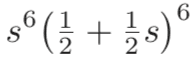
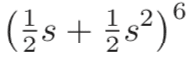
How does
Screenshot 2019-11-26 22.17.43.png
become
Screenshot 2019-11-26 22.17.54.png
?

I can see the s has been factored out and the power of 6 distributed, but how do we know this happens, short of multiplying out the brackets?
 
Physics news on Phys.org
First factor the s in the top expression. Then what happens with the power 6? I think it will be clearer then.
 
umzung said:
Homework Statement: How does one bracket become the other?
Homework Equations: See the attempt at a solution.

How does View attachment 253352become View attachment 253353?

I can see the s has been factored out and the power of 6 distributed, but how do we know this happens, short of multiplying out the brackets?
Just factor the expression inside the parentheses.
##\frac 1 2 s + \frac 1 2 s^2 = s( \frac 1 2 + \frac 1 2 s)##.

Then use the property that ##(ab)^n = a^nb^n##
 
Mark44 said:
Just factor the expression inside the parentheses.
##\frac 1 2 s + \frac 1 2 s^2 = s( \frac 1 2 + \frac 1 2 s)##.

Then use the property that ##(ab)^n = a^nb^n##
That's clearer, thanks.
 
I would actually go a little further than that. \frac{1}{2}s+ \frac{1}{2}s^2= \frac{1}{2}s(1+ s) so that \left(\frac{1}{2}s+ \frac{1}{2}s^2\right)^6= \frac{1}{64}s^6(1+ s)^6.
 

Similar threads

Replies
5
Views
3K
  • · Replies 1 ·
Replies
1
Views
2K
  • · Replies 17 ·
Replies
17
Views
2K
Replies
6
Views
1K
  • · Replies 13 ·
Replies
13
Views
3K
Replies
8
Views
2K
  • · Replies 1 ·
Replies
1
Views
1K
Replies
2
Views
2K
  • · Replies 4 ·
Replies
4
Views
2K
  • · Replies 1 ·
Replies
1
Views
2K