Right Hand Rule doesn't work for this problem?

Click For Summary

Homework Help Overview

The discussion revolves around the application of the right-hand rule in the context of an electron's motion in Earth's magnetic field. Participants are exploring how to determine the direction of deflection for an electron moving in various orientations near the Earth's equator.

Discussion Character

  • Conceptual clarification, Assumption checking

Approaches and Questions Raised

  • Participants are attempting to apply Fleming's right-hand rule but express confusion about the conventions for finger placement and the implications for negative charges. Questions arise regarding the interpretation of vector cross-products and the specific directions involved.

Discussion Status

Some participants are clarifying their understanding of the right-hand rule and its application to negative charges. There is an acknowledgment of different conventions and a suggestion to verify the rule as presented in their educational materials. The discussion is ongoing with multiple interpretations being explored.

Contextual Notes

Participants are grappling with the definitions of geographic and magnetic poles, as well as the implications of using the right-hand rule for a negatively charged particle like an electron. There is an indication of confusion regarding the expected outcomes of applying the rule in different scenarios.

riseofphoenix
Messages
294
Reaction score
2
Right Hand Rule doesn't work for this problem?

Consider an electron near the Earth's equator. In which direction does it tend to deflect if its velocity is directed in each of the following directions?
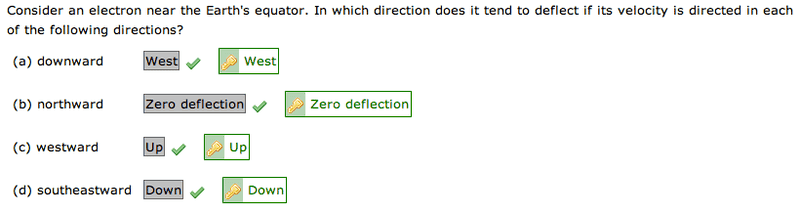
PHYSICSELECTRONS_zps4c2eb880.png


I DON'T get this!

I know they're basically saying this:

Velocity of electron (v) x Directuib if Earth's magnetic field (B) = direction ------> electron goes OPPOSITE this direction.

But my question is, HOW do I go about determining what South x North equal? or West x North equal? It makes NO sense!

I've tried using Fleming's Right Hand rule but I can only move my middle finger (which represents velocity v) in just a few directions -__-
 
Physics news on Phys.org
Consider question (a). You are given that the electron is moving vertically downward toward the ground.

Can you explain a little more why you are having trouble using the right hand rule? There are different conventions as to which finger should go with which vector, so it will help if you describe which finger you use for the B field and which you use for the force.

[Note that the "x" in v x B represents a "cross-product" of vectors and not just ordinary multiplication. So, "west x north" indicates a cross-product of a vector pointing west and a vector pointing north].
 
Last edited:
riseofphoenix said:
Consider an electron near the Earth's equator. In which direction does it tend to deflect if its velocity is directed in each of the following directions?

PHYSICSELECTRONS_zps4c2eb880.png


I DON'T get this!

I know they're basically saying this:

Velocity of electron (v) x Directuib if Earth's magnetic field (B) = direction ------> electron goes OPPOSITE this direction.

But my question is, HOW do I go about determining what South x North equal? or West x North equal? It makes NO sense!

I've tried using Fleming's Right Hand rule but I can only move my middle finger (which represents velocity v) in just a few directions -__-
Is Earth's geographic north pole a magnetic north pole, or is it a magnetic south pole ?
 
TSny said:
Consider question (a). You are given that the electron is moving vertically downward toward the ground.

Can you explain a little more why you are having trouble using the right hand rule? There are different conventions as to which finger should go with which vector, so it will help if you describe which finger you use for the B field and which you use for the force.

[Note that the "x" in v x B represents a "cross-product" of vectors and not just ordinary multiplication. So, "west x north" indicates a cross-product of a vector pointing west and a vector pointing north].

OHHHHHHHH
OMG, i swear I am so stupid sometimes -.-

Ok ok so I DO using Fleming's right hand rule where the index finger is ALWAYS pointing NORTH (horizontally), and the directions they give me for the velocity of the electron is where the middle finger should be pointing. And the thumb basically indirections the direction of the force that deflects it.
 
riseofphoenix said:
Ok ok so I DO using Fleming's right hand rule where the index finger is ALWAYS pointing NORTH (horizontally), and the directions they give me for the velocity of the electron is where the middle finger should be pointing. And the thumb basically indirections the direction of the force that deflects it.

If the index finger points in the direction of the field and the middle finger in the direction of the velocity, then the thumb will point in the direction of the force on a negative charge (electron). So, you will not take the opposite direction of the thumb (unless you wanted the force on a positive charge!)

You should probably double check the rule as explained in your text or in class. Usually the rule is designed to give the force on a positive charge rather than a negative charge.
 

Similar threads

  • · Replies 8 ·
Replies
8
Views
4K
  • · Replies 2 ·
Replies
2
Views
2K
Replies
5
Views
2K
  • · Replies 2 ·
Replies
2
Views
2K
Replies
1
Views
2K
  • · Replies 4 ·
Replies
4
Views
3K
  • · Replies 9 ·
Replies
9
Views
3K
  • · Replies 3 ·
Replies
3
Views
2K
  • · Replies 1 ·
Replies
1
Views
2K
  • · Replies 18 ·
Replies
18
Views
13K