Rocket in Deep Space: Momentum Maximization

  • Thread starter Thread starter Sekonda
  • Start date Start date
  • Tags Tags
    Rocket Space
Click For Summary

Homework Help Overview

The discussion revolves around a problem related to maximizing the momentum of a rocket in deep space, where external forces are negligible. The original poster is attempting to differentiate the momentum equation to find the mass that maximizes momentum.

Discussion Character

  • Exploratory, Mathematical reasoning, Assumption checking

Approaches and Questions Raised

  • The original poster presents their differentiation of the momentum equation and questions the validity of their result, suspecting an error. Some participants raise concerns about whether the condition for a maximum has been met, while others discuss the implications of assuming initial velocity is zero.

Discussion Status

The discussion is ongoing, with participants providing insights into the conditions for maximizing momentum and clarifying the assumptions involved. There is acknowledgment of the original poster's approach, but also a caution regarding the interpretation of the results.

Contextual Notes

Participants are considering the implications of the initial velocity and the assumptions made in the problem setup, particularly regarding the conditions under which momentum is maximized.

Sekonda
Messages
201
Reaction score
0
Hey,

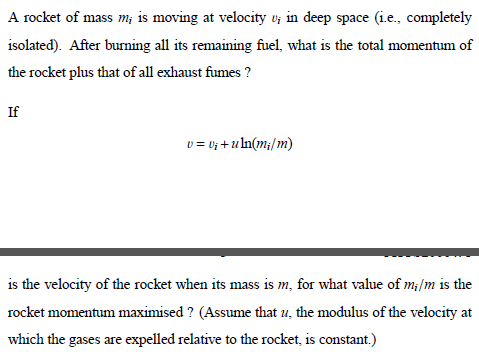
I have a question on a rocket in deep space (all external forces negligible), basically I'm doing something wrong the latter part of the question - maximizing the momentum via differentiation, here's the question:
Rocket.png


So the momentum at a given mass 'm' is :

p=mv_{i}+muln(\frac{m_{i}}{m})

I attained a derivative of respects to 'm' as:

\frac{\partial p}{\partial m}=v_{i}+u(ln\frac{m_{i}}{m}-1)=0

Giving 'm' as :

\LARGE m=m_{i}e^{\frac{v_{i}}{u}-1}

Which is wrong according to the solutions unless I assume v(i)=0 which I don't think I should.

Where am I going wrong?

Thanks guys,
SK
 
Physics news on Phys.org
Remember that momentum is a vector not a scalar.
 
Are you sure that is a maximum? (hint: ∂p/∂m = 0 is a necessary but not sufficient condition for a maximum).
 
Sekonda said:
Giving 'm' as :

m=m_{i}\,e^{\frac{v_{i}}{u}-1}
That's correct.

Which is wrong according to the solutions unless I assume v(i)=0 which I don't think I should.
That is a reasonable assumption for this problem.
 
Filip Larsen said:
Are you sure that is a maximum? (hint: ∂p/∂m = 0 is a necessary but not sufficient condition for a maximum).

I can see that my earlier comment, made on the assumption that you did have an error somewhere, could be read to imply that your solution is not a maximum, when in fact it is. I apologize for any confusion my comment may have caused.

After doing the actual calculation I too concur that your solution gives maximum momentum in the interval 0 ≤ m ≤ mi or, equivalently, when vi ≤ u.
 

Similar threads

  • · Replies 2 ·
Replies
2
Views
1K
  • · Replies 27 ·
Replies
27
Views
2K
  • · Replies 10 ·
Replies
10
Views
2K
Replies
15
Views
2K
  • · Replies 2 ·
Replies
2
Views
1K
  • · Replies 3 ·
Replies
3
Views
1K
  • · Replies 1 ·
Replies
1
Views
2K
  • · Replies 2 ·
Replies
2
Views
2K
  • · Replies 2 ·
Replies
2
Views
1K
Replies
5
Views
2K