Can Rogowski Coils Be Used Without an Integrator for HOKA Applications?

  • Thread starter Thread starter Glenn Emmers
  • Start date Start date
  • Tags Tags
    Coil Design
Click For Summary
SUMMARY

Rogowski coils can be effectively utilized in HOKA applications without an integrator by employing a low pass filter and subsequent amplification. The coil discussed features 152 windings with a mutual inductance of 40nH, resistance of 10.141 Ω, inductance of 8.019 μH, and capacitance of 40.7nF, designed for current measurements up to 100A. Sensitivity in this setup is determined by the coil's mutual inductance divided by the time constant (M/τ), and the parameters for the low pass filter should be derived from the Hall sensor's datasheet. Additionally, parallel configurations of Rogowski coils can reduce noise interference.

PREREQUISITES
  • Understanding of Rogowski coil design and operation
  • Familiarity with low pass filter design principles
  • Knowledge of Hall effect sensors and their applications
  • Basic concepts of electrical impedance and sensitivity calculations
NEXT STEPS
  • Research the design specifications for Hall effect sensors suitable for HOKA applications
  • Study low pass filter design techniques and their impact on signal processing
  • Explore sensitivity calculations for Rogowski coils in non-integrator configurations
  • Investigate methods for minimizing noise in parallel Rogowski coil setups
USEFUL FOR

Electrical engineers, researchers in non-intrusive current measurement, and professionals working with HOKA applications will benefit from this discussion.

Glenn Emmers
Messages
5
Reaction score
0
Dear all,

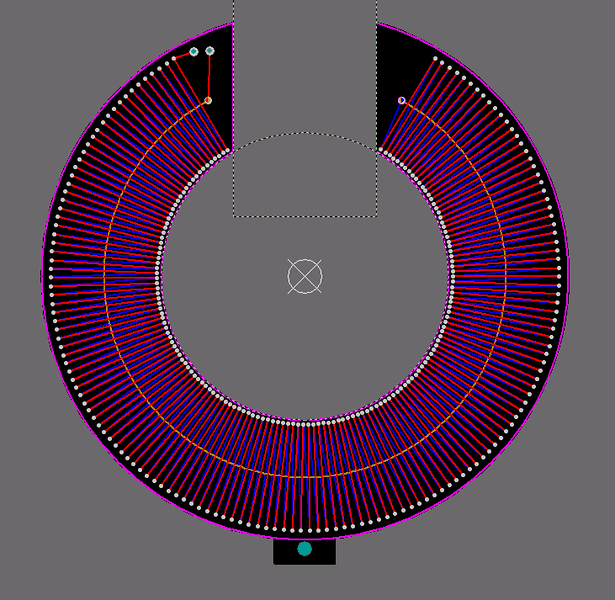
I'm currently working on an open core PCB rogowski coil and came up with the following design:
F61p2Ac.png

93y9h

I concluded that the asymmetry wouldn't be a problem if the coil is centered precisely around the conductor and cause it's mainly supposed to operate around 50 Hz. Is this a good assumption?
The coil has 152 windings with the following approximated properties:
- Mutual inductance (M) = 40nH
- Resistance = 10.141 Ω
- Inductance = 8.019 μH
- Capacitance = 40.7nF
I'm supposed to measure currents up to 100A under normal conditions (higher in extraordinary cases)

For a HOKA, the integrator is replaced by a low pass filter and a gain is added afterwards. (Here is link with a bit of explanation).

So I have a couple of questions:
I thought the sensitivity of the Rogowski was also determined by the integration constant, with the sensitivity being: M/τ. But since I won't have an integrator, how will I be able to determine the sensitivity?
Also what is the best way to determine the parameters of this low pass filter and amplifier?
Can I put 2 rogowski coils in parallel to have less relative noise disturbance?
What Hall-sensors would be useful in this application?

I thank you in advance,

Glenn
 

Attachments

  • F61p2Ac.png
    F61p2Ac.png
    57.6 KB · Views: 2,788
Engineering news on Phys.org
Welcome to the PF.

So HOKA is a new term? I wasn't able to find it via Google, but do see it mentioned in the paper you linked. What does HOKA stand for?
 
berkeman said:
Welcome to the PF.

So HOKA is a new term? I wasn't able to find it via Google, but do see it mentioned in the paper you linked. What does HOKA stand for?
Thank you!

HOKA stands for the names of the two people who came up with it: Verkoppelungsschaltung nach Hofer-Noser und Karrer (Source: Hudoffsky, Boris, (2014),Berührungslose Messung schnell veränderlicher Ströme)
 
Your HOKA link describes not a low pass but a Hall effect sensor element to extend frequency response down to DC. That device is inherently low pass.

Glenn Emmers said:
Also what is the best way to determine the parameters of this low pass filter and amplifier?
I'd say from the datasheet of your Hall sensor.

here's the instruction manual for an early Tektronix combination Hall efect/Faraday effect current probe that describes how they did it in mid 1960's. Its bandwidth was DC to 50mhz. . While their Faraday element had a core the working principle is identical to your HOKA paper.
http://materias.fi.uba.ar/6644/info/puntas/manuales/p6042 current probe.pdf
I used one of those in early 1970's . It was a Godsend for non-intrusively checking AC relay drivers, which as you can imagine is REALLY handy in a nuke plant.

old jim
 
Last edited:
Glenn Emmers said:
I concluded that the asymmetry wouldn't be a problem if the coil is centered precisely around the conductor and cause it's mainly supposed to operate around 50 Hz. Is this a good assumption?
Define precise.
If you remove the turns component below as you have in the rectangular area above then symmetry will be restored. Sensitivity to current will fall slightly, but eccentricity of mounting about the current conductor will no longer be a problem. The undefined precision will not be required.
 

Similar threads

  • · Replies 30 ·
2
Replies
30
Views
4K
  • · Replies 7 ·
Replies
7
Views
6K
  • · Replies 7 ·
Replies
7
Views
3K
  • · Replies 2 ·
Replies
2
Views
3K