Calculating Stiffness of Springs/Suspensions for Inclined Suspension

Click For Summary
SUMMARY

This discussion focuses on calculating the stiffness of springs and suspensions in inclined suspension systems. The key formula derived is the roll stiffness, represented as Kφ = 0.5 Ks s2, where Ks is the spring rate and s is the lever arm length. For independent suspensions, the same calculation applies, substituting Ks with the appropriate spring rate and s with the track width. Additionally, for straight axles with inclined springs, the roll rate must be multiplied by the cosine of the inclination angle.

PREREQUISITES
  • Understanding of spring mechanics and stiffness calculations
  • Familiarity with independent suspension systems
  • Knowledge of torque and lever arm principles
  • Basic trigonometry for calculating angles in inclined systems
NEXT STEPS
  • Research the derivation of spring rate formulas in automotive engineering
  • Explore the impact of track width on suspension performance
  • Learn about the effects of inclination angles on roll stiffness
  • Study advanced topics in suspension geometry and dynamics
USEFUL FOR

Automotive engineers, suspension designers, and mechanics involved in the analysis and optimization of vehicle suspension systems.

Vincent Mazzo
Messages
5
Reaction score
0
Hello guys

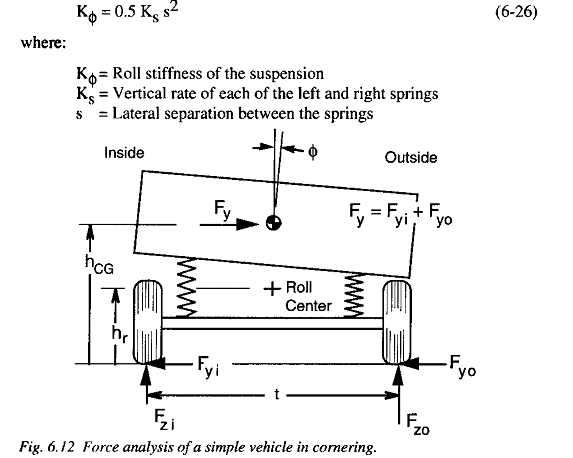
How can I calculate the following stiffness of the springs/suspensions in the case of inclined suspension (angle between suspension and axle)?

I know that the lateral separation of the springs causes them to develop a roll resisting moment proporcional to the difference roll angle between the body and the axle.

And in the case of independent suspension? How substitute the rate at the wheel for K_s and use the tread as the separation distance?
attachment.php?attachmentid=36293&stc=1&d=1307671722.png
 

Attachments

  • fig.png
    fig.png
    12.7 KB · Views: 14,894
Engineering news on Phys.org
Derivation of the roll stiffness:

The reaction torque (T_{\phi}) can be found with the spring force (F_{s}) times the lever arm length (s/2) for both springs:

T_{\phi} = 2 \times F_{s} \frac{s}{2} = F_{s} s

The spring force is equal to the spring rate times the spring compression (or extension) based on the roll angle (\phi) and lever arm length (s/2):

F_{s} = K_{s} \phi \frac{s}{2}

Which leads to:

T_{\phi} = 0.5 K_{s} s^{2} \phi

Since roll stiffness is defined as the amount of torque per roll angle:

K_{\phi} = \frac{T_{\phi}}{\phi} = 0.5 K_{s} s^{2}

So for independent suspensions, the same procedure applies. All you have to do is to replace K_{s} with the http://enderw88.wordpress.com/automotive-theory/spring-rate-theory/" and s with the track width (where the wheel rates are acting).

For the straight axle with inclined springs, multiply the roll rate by the cosine of the inclination angle (see the wheel rate link above, same concept).
 
Last edited by a moderator:

Similar threads

Replies
1
Views
2K
  • · Replies 4 ·
Replies
4
Views
3K
  • · Replies 7 ·
Replies
7
Views
9K
Replies
4
Views
8K
Replies
25
Views
13K
  • · Replies 23 ·
Replies
23
Views
10K
  • · Replies 3 ·
Replies
3
Views
4K
  • · Replies 9 ·
Replies
9
Views
8K
  • Sticky
  • · Replies 2K ·
60
Replies
2K
Views
853K
  • · Replies 7 ·
Replies
7
Views
2K