How Can I Measure Kinetic Energy in a Non-Inertial Reference Frame?

  • Thread starter Thread starter xkcda
  • Start date Start date
Click For Summary
SUMMARY

The discussion focuses on measuring kinetic energy in a non-inertial reference frame, specifically point A. The formula presented for kinetic energy is K = (Moment of Inertia about A * Angular Velocity^2)/2 + (Mass * Velocity^2)/2, yielding a value of K = 9.5. However, there is contention regarding the inclusion of both linear and rotational kinetic energy terms, as it may lead to double counting. The conversation emphasizes the importance of clarifying whether the reference frame is rotating and understanding the motion of the rigid body as a combination of linear motion and rotation about its mass center.

PREREQUISITES
  • Understanding of kinetic energy concepts in physics
  • Familiarity with moment of inertia calculations
  • Knowledge of angular velocity and its implications
  • Basic principles of non-inertial reference frames
NEXT STEPS
  • Study the derivation of the kinetic energy formula in non-inertial frames
  • Learn about the principles of rigid body dynamics
  • Explore the concept of moment of inertia about different axes
  • Investigate the effects of rotation in non-inertial reference frames
USEFUL FOR

Physics students, educators, and professionals interested in classical mechanics, particularly those studying non-inertial reference frames and kinetic energy calculations.

xkcda
Messages
7
Reaction score
0
TL;DR Summary: I think A is an non inertial reference frame.So how can I measure kinetic energy about it?

I found a solution to the problem which states that Kinetic Energy about A= (Moment of Inertia about an axis passing through A*Angular Velocity^2)/2+(Mass*Velocity^2)/2 .Thus K=9.5.Can anyone please show me the derivation of this formula?
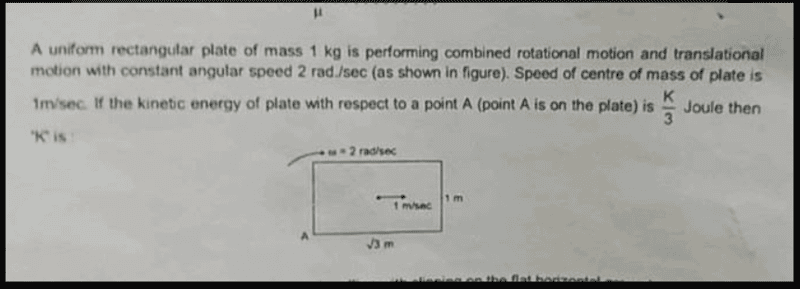
Screenshot from 2023-06-16 00-03-00.png
 
Last edited:
Physics news on Phys.org
No attempt shown.
 
Please show some effort, so we can help you learn.
 
Moved to homework help.
 
The first difficulty is that "with respect to point A" is ambiguous.
It is reasonable to assume, as you have, that it does not mean the fixed point in space where that corner happens to be at some instant; rather, it moves with that corner of the plate. But that still does not answer whether the reference frame is also rotating with the plate. Consider both cases.
In each case, think of what an observer in the frame would see the plate as doing.
xkcda said:
Kinetic Energy about A= (Moment of Inertia about an axis passing through A*Angular Velocity^2)/2+(Mass*Velocity^2)/2
That seems very unlikely to be right. If you take the moment of inertia about the axis of rotation then you should not need to be adding a linear KE term: that would be double counting. Generally speaking, you can consider the instantaneous motion of a rigid body as the sum of the linear motion of its mass centre and its rotation about its mass centre. So if you have an ##mv^2## term for the linear component then the moment of inertia should be about the mass centre.
 

Similar threads

  • · Replies 3 ·
Replies
3
Views
2K
  • · Replies 3 ·
Replies
3
Views
2K
  • · Replies 33 ·
2
Replies
33
Views
3K
  • · Replies 8 ·
Replies
8
Views
1K
  • · Replies 44 ·
2
Replies
44
Views
2K
Replies
3
Views
2K
  • · Replies 3 ·
Replies
3
Views
2K
  • · Replies 21 ·
Replies
21
Views
5K
  • · Replies 12 ·
Replies
12
Views
3K
  • · Replies 5 ·
Replies
5
Views
3K