Discussion Overview
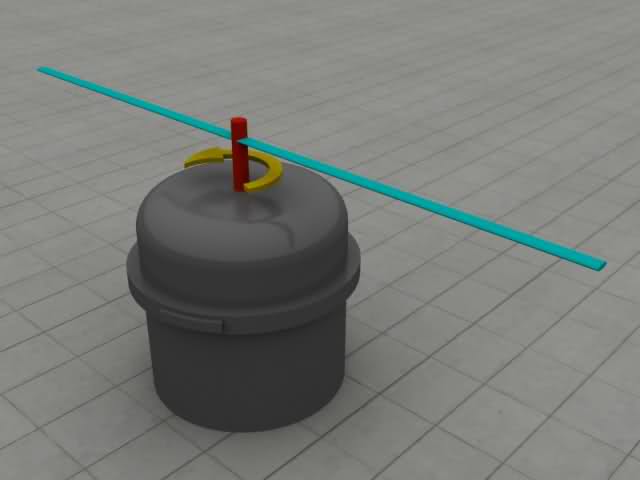
The discussion revolves around the effects of air resistance on rotating blades, specifically focusing on how to calculate whether a rod can withstand the forces exerted by air drag during rotation. Participants explore the relevant physical principles, mathematical formulations, and material properties that should be considered in these calculations.
Discussion Character
- Technical explanation
- Mathematical reasoning
- Debate/contested
Main Points Raised
- One participant inquires about how to calculate if a rod can withstand air resistance, asking which material properties, such as specific strength or tensile strength, should be considered.
- Another participant provides the drag force equation and suggests using specific values for drag coefficient and air density, while also prompting for clarification on the equation's components.
- Several participants discuss the integration of drag force over the length of the rod to determine total torque, with one participant detailing the steps involved in the integration process.
- Questions arise regarding the meaning of variables in the equations, such as the definition of dr and how to apply it in calculations.
- Participants express confusion about whether to use the full length of the rod or half when calculating torque for a single blade.
- There is a discussion about unit consistency, particularly regarding the conversion of air density from g/cm³ to kg/m³.
- One participant expresses a preference for a simplified formula derived from the integration process, while another participant presents a specific calculation scenario involving multiple blades and their parameters.
- Finally, there is a request for guidance on how to relate the calculated torque to the material strength of the rod to determine if it will break or bend under the conditions described.
Areas of Agreement / Disagreement
Participants generally agree on the need to calculate torque and consider material properties, but there is no consensus on the specific methods or interpretations of the equations involved. Multiple competing views on the application of the formulas and the definitions of variables remain evident throughout the discussion.
Contextual Notes
Limitations include potential misunderstandings of the integration process, variable definitions, and unit conversions. The discussion does not resolve these ambiguities.
Who May Find This Useful
This discussion may be useful for individuals interested in the mechanics of rotating systems, fluid dynamics, and material science, particularly in contexts involving engineering applications or theoretical physics.