fab13
- 300
- 7
I am exercising on Stellar Physics topics and in particular the questions below:
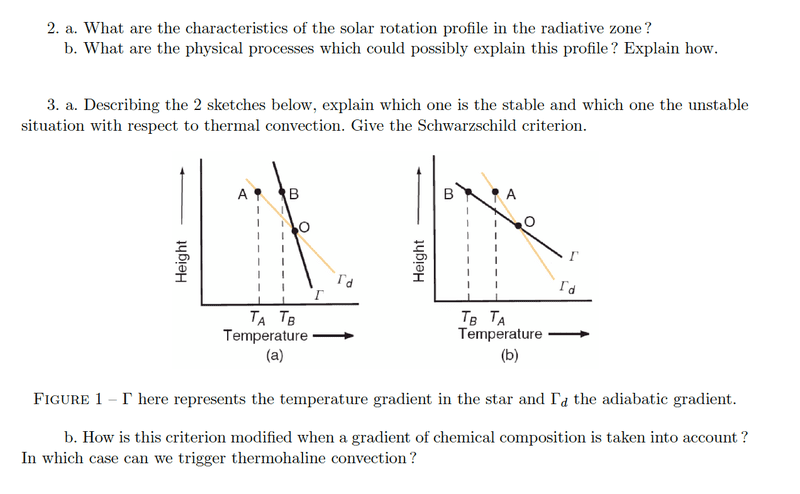
1) First of all on the rotation profile for the radiative zone: I know that unlike the convective zone, where the rotation varies mainly in latitude (faster at the equator than at the poles), the radiative zone has a solid rotation, that is to say that it rotates in a single block.
What is the shape rotation profile for the radiative area?
Is it flat ? , "Keplerian" (I mean velocity equals ##V = \sqrt{\dfrac {GM}{R}}## ) ?, or just circular (##V = R \Omega## and thus the profile would be linearly increasing according to the radius ##R##)?
From what I have seen on web, it seems to be a flat profile but I am not sure.
2) Then, what physical processes occur to keep this profile with this form?
3) Regarding the question with the 2 schemes: I know that convection occurs when the temperature gradient is greater than the adiabatic gradient. So there is instability for the scheme a) and stability for scheme b) towards the convection: is this correct?
The Schwarzschild criterion would be on the adiabatic gradient ?
for example, if ##\bigg(\dfrac{\text{d}\,\text{ln} T}{\text{d}\,\text{ln} P}\bigg)_{m}> 2/5##, Then there is convection?
3) For question 3.b), how does a molecular weight gradient change this criterion?
I would say a priori that the molecular weight prevents the penetration of the radiative zone in the convective zone because the archimedes thrust would be counter-balanced by gravity but I'm not sure?
or would its effect be in the other direction, that is, a penetration of the convective zone into the radiative zone?
4) Finally, does thermohaline convection correspond to a penetration of convection in the radiative zone (perhaps because of this molecular weight gradient) or the opposite (penetration of the radiative zone into the convective zone)?
In what case then does it occur?
Thank you in advance for your help, it will be precious
1) First of all on the rotation profile for the radiative zone: I know that unlike the convective zone, where the rotation varies mainly in latitude (faster at the equator than at the poles), the radiative zone has a solid rotation, that is to say that it rotates in a single block.
What is the shape rotation profile for the radiative area?
Is it flat ? , "Keplerian" (I mean velocity equals ##V = \sqrt{\dfrac {GM}{R}}## ) ?, or just circular (##V = R \Omega## and thus the profile would be linearly increasing according to the radius ##R##)?
From what I have seen on web, it seems to be a flat profile but I am not sure.
2) Then, what physical processes occur to keep this profile with this form?
3) Regarding the question with the 2 schemes: I know that convection occurs when the temperature gradient is greater than the adiabatic gradient. So there is instability for the scheme a) and stability for scheme b) towards the convection: is this correct?
The Schwarzschild criterion would be on the adiabatic gradient ?
for example, if ##\bigg(\dfrac{\text{d}\,\text{ln} T}{\text{d}\,\text{ln} P}\bigg)_{m}> 2/5##, Then there is convection?
3) For question 3.b), how does a molecular weight gradient change this criterion?
I would say a priori that the molecular weight prevents the penetration of the radiative zone in the convective zone because the archimedes thrust would be counter-balanced by gravity but I'm not sure?
or would its effect be in the other direction, that is, a penetration of the convective zone into the radiative zone?
4) Finally, does thermohaline convection correspond to a penetration of convection in the radiative zone (perhaps because of this molecular weight gradient) or the opposite (penetration of the radiative zone into the convective zone)?
In what case then does it occur?
Thank you in advance for your help, it will be precious
