Rotational motion and finding the moment of inertia

Bolter
Messages
262
Reaction score
31
Homework Statement
Find the moment of inertia
Relevant Equations
PE = mgh
KE tran = 1/2mv^2
Here is the problem that I am finding difficult to answer

Screenshot 2019-12-19 at 16.13.02.png

I had tried using conservation of energy to do this question

Where I know that the gravitational potential energy at the top of the slope equals to the sum of both the linear and rotational kinetic energy at the bottom of the slope.

Hence which is why I written down this, in where I then rearrange for I (moment of inertia). However upon doing this, I realize I have an unknown which is omega (angular velocity). How would I work out omega so I then find the moment of inertia of the ball?
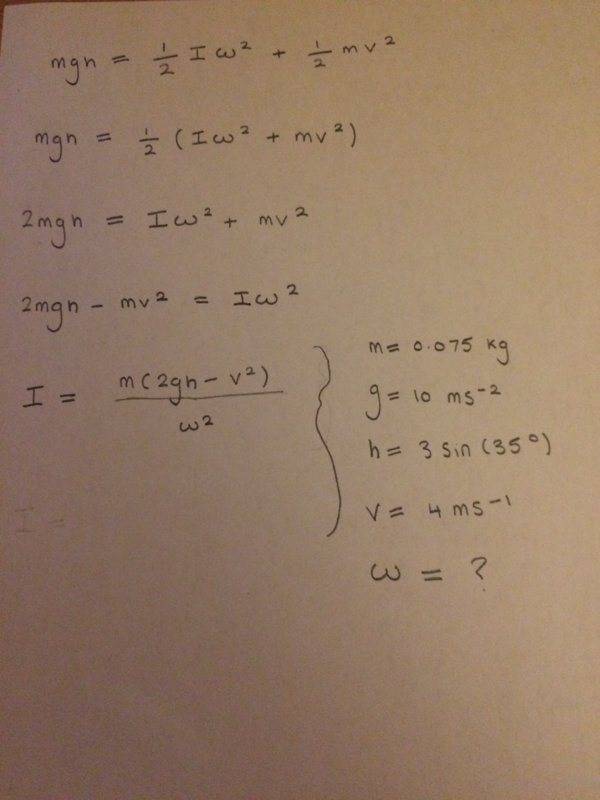
IMG_3506.JPG


Thank you!
 
Physics news on Phys.org
You make use of the given that 'the ball rolled' (i.e. it did not slip) !
 
BvU said:
You make use of the given that 'the ball rolled' (i.e. it did not slip) !

So is finding angular velocity as simple as dividing the linear velocity by the ball's radius
I have done that to get my angular velocity to be 266.667 rad/s

Then plugging in all the values I need from before, I get I = 1.94 x 10^-5 kg/m^2 (3 sig figs)

IMG_3508.JPG


Is this alright?
 
Bolter said:
So is finding angular velocity as simple as dividing the linear velocity by the ball's radius
I have done that to get my angular velocity to be 266.667 rad/s

Then plugging in all the values I need from before, I get I = 1.94 x 10^-5 kg/m^2 (3 sig figs)

View attachment 254367

Is this alright?
Looks right.
 
haruspex said:
Looks right.

Thanks for checking. Appreciate it!
 
I agree with your result. There is one snag, however:
For a massive sphere, ##I = {2\over 5}\,mr^2##; for a hollow sphere, ##I = {2\over 3}\,mr^2##. Most you can have is ##I = mr^2## (all the mass at distance ##r##, like for a ring).

Our ##I = 1.94 \ 10^{-5}## kg m2 would be 1.15 ##mr^2\qquad## o0)

I suspect an error by the exercise composer ...
 
  • Like
Likes Bolter
BvU said:
I agree with your result. There is one snag, however:
For a massive sphere, ##I = {2\over 5}\,mr^2##; for a hollow sphere, ##I = {2\over 3}\,mr^2##. Most you can have is ##I = mr^2## (all the mass at distance ##r##, like for a ring).

Our ##I = 1.94 \ 10^{-5}## kg m2 would be 1.15 ##mr^2\qquad## o0)

I suspect an error by the exercise composer ...

Ah yes that is true. I’ll definitely take note of that :)
 

Similar threads

  • · Replies 13 ·
Replies
13
Views
3K
  • · Replies 40 ·
2
Replies
40
Views
6K
  • · Replies 8 ·
Replies
8
Views
1K
  • · Replies 28 ·
Replies
28
Views
2K
Replies
11
Views
3K
  • · Replies 16 ·
Replies
16
Views
2K
  • · Replies 9 ·
Replies
9
Views
2K
  • · Replies 1 ·
Replies
1
Views
1K
Replies
2
Views
2K
Replies
8
Views
14K