How Do Mass and Windings Affect Disc Rotation Dynamics?

Click For Summary
SUMMARY

The discussion focuses on the relationships between angular velocity, displacement, acceleration, and kinetic energy of a disc in motion, influenced by falling masses and the number of winds. Key variables include moment of inertia and potential energy, which significantly affect the rotational dynamics of the system. The poster is encouraged to formulate hypotheses and equations to explore these relationships further. Calibration of parameters, such as determining the constant 'k' in the equation for displacement, is essential for accurate modeling.

PREREQUISITES
  • Understanding of angular velocity and its calculations
  • Familiarity with moment of inertia concepts
  • Knowledge of potential energy in mechanical systems
  • Basic principles of rotational dynamics
NEXT STEPS
  • Research the equations governing angular velocity and acceleration in rotational systems
  • Explore the concept of moment of inertia and its impact on rotational motion
  • Investigate the relationship between potential energy and kinetic energy in mechanical systems
  • Learn about damping factors and their effects on motion in physical systems
USEFUL FOR

Students and researchers in physics, mechanical engineers, and anyone involved in projects related to rotational dynamics and energy systems.

oshin
Messages
1
Reaction score
0
Moved from a technical forum, so homework template missing
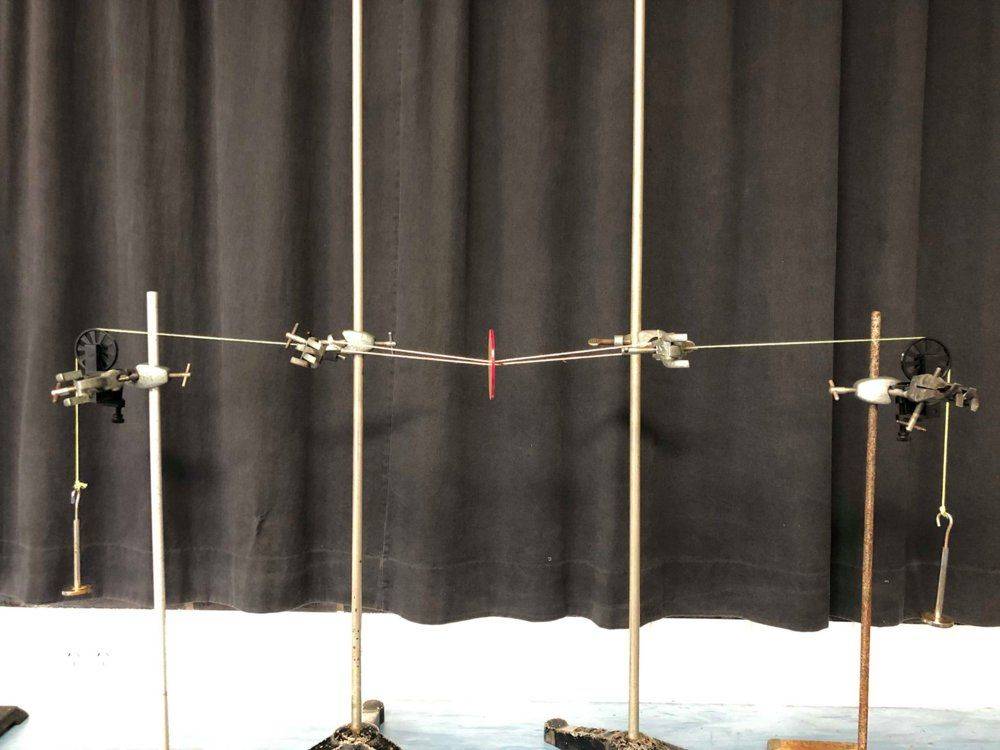
I am doing a project, but am struggling to find relationships of proportionality or formulae between my dependent variables (angular velocity, displacement, acceleration of the disc and kinetic energy of the system) and my independent variables (falling masses and then the number of winds) or any other relationships that can occur such as how the moment of inertia of the disc may effect the rotational movement. Below is a picture of my setup. It works by winding the disc, and then releasing it to unwind. The disc has two holes which the strings go through and the strings are attached to masses that go over the pulley.
241150
 
Physics news on Phys.org
Hello oshin, ##\qquad## :welcome: ##\qquad## !

Here at PF we encourage posters to give it a try and then ask for assistance.
You have a nice setup and mention a bunch of variables; give them a name and make some hypotheses about their relationship in the form of equations.
oshin said:
angular velocity, displacement, acceleration of the disc and kinetic energy of the system, falling masses and the number of winds
You may also need the potential energy of the system and perhaps a damping factor
Next would be to calibrate some parameters, for example: if you assume displacement = ##k## x number of turns, you need to determine ##k##
 

Similar threads

  • · Replies 9 ·
Replies
9
Views
2K
Replies
7
Views
2K
Replies
13
Views
2K
  • · Replies 9 ·
Replies
9
Views
2K
Replies
15
Views
2K
  • · Replies 13 ·
Replies
13
Views
2K
Replies
11
Views
3K
Replies
3
Views
2K
  • · Replies 10 ·
Replies
10
Views
7K
