ago01
- 46
- 8
- Homework Statement
- A uniform cylindrical spool of string has radius R=3 cm, and mass M=500g. You accelerate the spool along a table by applying a constant force F=2N to the string. The spool rolls along the table without slipping and you can ignore the mass of the string. What is the acceleration of the center of mass of the spool? What is the magnitude of the static friction?
- Relevant Equations
- Torque, angular acceleration, force
I started out by drawing a diagram:
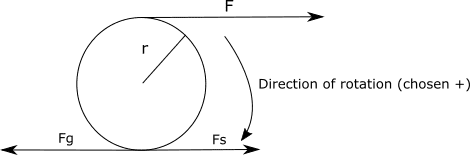
So I thought I would try torque with the axis of rotation in the center:
##T_1R = \frac{Mr^2}{2}\alpha##
and given that ##T_1## is equal to ##F## in the positive direction.
##\alpha = 266.6 \frac{rad}{s^2}##
Then knowing the relationship between angular acceleration and tangential acceleration:
##\alpha = \frac{a_t}{r}##
##a_t = \alpha*r##
##a_t = 7.998 \frac{m}{s^2}##
But this is not correct. The center of mass is translating and the rest of the object is rotating around it. ##a_t## would be the acceleration of a particle on the edge of the spool. Without this I cannot solve the second part so I am stuck.
So what if instead I just consider the translational portion?
##F_x = Ma##
##T_1 = Ma##
##T_1/M = a##
## a = 4 \frac{m}{s^2}##
But this is also incorrect. This would be like dragging the cylinder with slipping. It seems I am missing the connecting equations for rotational and translational motion.
So I thought I would try torque with the axis of rotation in the center:
##T_1R = \frac{Mr^2}{2}\alpha##
and given that ##T_1## is equal to ##F## in the positive direction.
##\alpha = 266.6 \frac{rad}{s^2}##
Then knowing the relationship between angular acceleration and tangential acceleration:
##\alpha = \frac{a_t}{r}##
##a_t = \alpha*r##
##a_t = 7.998 \frac{m}{s^2}##
But this is not correct. The center of mass is translating and the rest of the object is rotating around it. ##a_t## would be the acceleration of a particle on the edge of the spool. Without this I cannot solve the second part so I am stuck.
So what if instead I just consider the translational portion?
##F_x = Ma##
##T_1 = Ma##
##T_1/M = a##
## a = 4 \frac{m}{s^2}##
But this is also incorrect. This would be like dragging the cylinder with slipping. It seems I am missing the connecting equations for rotational and translational motion.