Running princess and spider - time problem

  • Thread starter Thread starter Lotto
  • Start date Start date
  • Tags Tags
    problem Time
Click For Summary

Homework Help Overview

The discussion revolves around a problem involving a princess running while a spider attempts to catch her on a stretching veil. The problem touches on concepts of relative motion and the dynamics of stretching materials, raising questions about the implications of constant speed and acceleration.

Discussion Character

  • Mixed

Approaches and Questions Raised

  • Participants explore the relationship between the movements of the princess and the spider, questioning the assumptions about their respective speeds and the effects of the stretching veil. There are discussions about the definition of the variable ##p## and its implications in the context of the problem.

Discussion Status

Some participants express confusion about the problem's setup and the physical assumptions involved, particularly regarding the princess's speed and the spider's ability to catch her. Others provide insights into the mathematical relationships and suggest further exploration of the problem's dynamics.

Contextual Notes

There are mentions of potential ambiguities in the assignment, particularly regarding the princess's speed and the physical forces at play. Participants note that the problem may be more mathematical than physical, and some express concerns about the clarity of the problem statement.

Lotto
Messages
253
Reaction score
16
Homework Statement
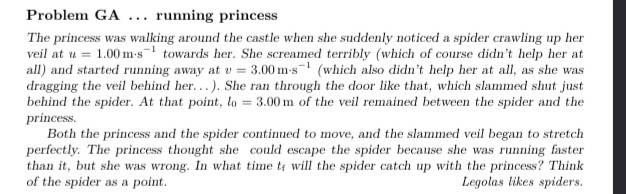
I have a problem whose description is below. I also add a solution of the problem.
Relevant Equations
I do not understand the ##p## number in the solution.
If the veil stretches prefectly, then when the princess moves by ##\Delta x##, then if the spider was not moving, he would also move by ##\Delta x## from the door, so he would be in the same distance from the princess. So assuming it, the time would be ##t_f=\frac {l_0}{u}## but that is no obviously correct.

Why? How is it then possible for the spider to catch her?
Screenshot_20230817-003600_Firefox.jpg

Screenshot_20230817-003556_Firefox.jpg
 

Attachments

  • Screenshot_20230817-003556_Firefox.jpg
    Screenshot_20230817-003556_Firefox.jpg
    40.2 KB · Views: 96
Last edited:
Physics news on Phys.org
Google the “ant on a rubber band problem”.

You are mistaken about the distance the spider would move. If the spider were at the position of the princess, sure. But as a test, put it just beside the door at the pinch point. Does the spider move ##\Delta x##?
 
Last edited:
Lotto said:
I do not understand the ##p## number in the solution.
Take a look at the animation here. The symbol ##p## is the ratio of length of the stretching bar to the length that's behind the moving red dot. Initially ##p=0## and finally ##p=1## as the author of the solution claims. I suggest that you study this solution. It's the best I've seen on the web.
 
  • Informative
Likes   Reactions: phinds
Lotto said:
when the princess moves by ##\Delta x##, then if the spider was not moving, he would also move by ##\Delta x## from the door,
No. If the spider is not attempting to move then it gets further away from the princess. The length of veil between it and her increases. So the spider moves less than ##\Delta x##.

However, the spider is moving relative to the veil.

The solution defines ##p## as how far the spider is along the veil from its trapped end, as a fraction of the whole (instantaneous) length. At the start, this is 0. If the spider catches her, p will then be 1.
If that hurts the head too much, let the current length of the veil be ##L(t)=L_0+vt##.
Let the spider be at distance ##x=x(t)## from the princess. ##x(0)=L_0##. The part of the veil the spider is on is getting further from the princess at speed ##v\frac xL##. Relative to that, the spider is moving towards the princess at ##u##.
From these you can get a differential equation for x.

The relationship to the solution you posted is ##p=1-\frac xL##.
 
OK, I get it but the only thing that confuses me a bit is the fact that I cannot write the ##p## as ##\frac{ut}{l_0+vt}##.

I understand that at any time the spider moves by ##u\mathrm d t##, but I still do not know why I cannot write it like above.
 
Lotto said:
OK, I get it but the only thing that confuses me a bit is the fact that I cannot write the ##p## as ##\frac{ut}{l_0+vt}##.

I understand that at any time the spider moves by ##u\mathrm d t##, but I still do not know why I cannot write it like above.
You would need to write the position of the spider with respect to the door in the numerator. The denominator is the position of the princess w.r.t the door.

The idea is that ##u## is less than ##v##, that’s the seemingly paradoxical part. As long as ##u## is nonzero, the spider catches the princess…eventually. If ##p## was what you wrote, it would never have a chance of being 1.
 
Last edited:
Lotto said:
OK, I get it but the only thing that confuses me a bit is the fact that I cannot write the ##p## as ##\frac{ut}{l_0+vt}##.
That would be right if the spider were to have sat still while the veil stretched by ##vt##, then the princess stood still while the spider advanced ##ut##. But the spider moves while the veil is stretching, and traverses more of the veil's material in the early part than in the later.
 
OK, I get it now.

But don't you think that the assignment might be confusing? Because in real life, the princess would not move with a constant speed because she would have to use a bigger and bigger force to maintain the speed (##F=k\Delta x##). And she wouldn't probably react immediately on the changing force so an instantaneuous force would deaccelarate her for a time ##\mathrm d t##, she would increase her force as well, but she would lose a bit of her speed anyway until she moves at all.

Should't it be written in the assignment that her speed is still constant?
 
Lotto said:
OK, I get it now.

But don't you think that the assignment might be confusing? Because in real life, the princess would not move with a constant speed because she would have to use a bigger and bigger force to maintain the speed (##F=k\Delta x##). And she wouldn't probably react immediately on the changing force so an instantaneuous force would deaccelarate her for a time ##\mathrm d t##, she would increase her force as well, but she would lose a bit of her speed anyway until she moves at all.
It's more a math problem than a physics problem for sure.

The "ant on a rubber rope problem" specifies that the end of the band is moving with constant velocity. So yeah, they missed a detail if they didn't specify that in their re-write.

However, it did say they both keep moving, and you clearly don't have enough information to actually solve a mechanics problem with forces, etc... so I would say your objection is on thin ice IHMO.
 
Last edited:
  • #10
Lotto said:
OK, I get it now.

But don't you think that the assignment might be confusing? Because in real life, the princess would not ##\dots##
I think that in real life the princess would just remove her veil and keep running leaving the spider stranded. But you're right, the problem should have specified that she maintains her constant speed after the door is shut.
 
  • #11
Just for fun here is an alternative way to handle the math:

The velocity of the spider ##\dot x_s## with respect to the pinch point is given by:

$$ \dot x_s = u + \frac{x_s}{l + vt } v \tag{1}$$

Make the substitution that:

$$ \lambda = u + \frac{x_s}{l + vt } v $$

Now, differentiate ##\lambda## w.r.t. time ##t##:

$$ \dot \lambda = \frac{v \dot x_s}{l+vt} - \frac{v^2x_s}{(l+vt)^2} $$

Factor:

$$ \dot \lambda = \frac{v}{l+vt}\left( \dot x_s - \frac{vx_s}{(l+vt)} \right) $$

Notice that what is in parenthesis is identically ##u## by ##(1)##:

$$ \dot \lambda = \frac{v}{l+vt} u $$

Separate and integrate:

$$ \int_{\lambda_o}^{\lambda_f} d \lambda = u \int_0^t \frac{v}{l+vt} ~dt $$

$$ \implies \lambda_f - \lambda_o = u \ln \left( \frac{l+vt}{l}\right) $$

$$ \implies \left( \cancel{u} + \frac{x_s}{l + vt } v \right) - \cancel{u} = u \ln \left( \frac{l+vt}{l}\right) $$

Solving for ##x_s##:

$$ x_s = (l+vt) \frac{u}{v}\ln \left( \frac{l+vt}{l}\right) $$

To solve for the time ##t## when the spider reaches the princess note that ## x_s = l+ vt ##:

$$ \implies 1 = \frac{u}{v} \ln \left( \frac{l+vt}{l}\right) $$

finally solving for ##t## yields:

$$ t = \frac{l}{v}\left( e^\left( \frac{v}{u} \right) - 1 \right) $$
 
  • Like
Likes   Reactions: Lotto
  • #12
Interesting to note that regardless of the length of the veil or the constant speed at which the princess runs, the spider will get her in end (or in the head I guess).
If, however, she is continuously accelerating (via dark terror?), she can outrun it the spider is beyond the spidey-event-horizon.
 
  • #13
Halc said:
Interesting to note that regardless of the length of the veil or the constant speed at which the princess runs, the spider will get her in end (or in the head I guess).
Depends, on what she was veiling.
If, however, she is continuously accelerating (via dark terror?), she can outrun it the spider is beyond the spidey-event-horizon.
As luck would have it, the increasing force she's putting into flight is balanced by increasing tension on the veil.

At 1m/s, that's one fast spider.
 
  • #14
Halc said:
(via dark terror?),
:woot:
 

Similar threads

  • · Replies 15 ·
Replies
15
Views
2K
Replies
7
Views
2K
  • · Replies 36 ·
2
Replies
36
Views
3K
Replies
7
Views
1K
Replies
23
Views
2K
Replies
12
Views
1K
Replies
1
Views
2K
  • · Replies 7 ·
Replies
7
Views
1K
  • · Replies 17 ·
Replies
17
Views
3K
  • · Replies 6 ·
Replies
6
Views
2K