Schrodinger Equation as Flow Equation

Join the discussion
Ask a follow-up here, or get your own question answered by working scientists, mathematicians and engineers — people, not an autocomplete.
Real named experts · corrections over time · the nuance an AI answer skips
2 replies · 2K views
lagrangman
Messages
13
Reaction score
2
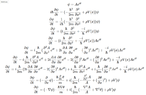
I was playing with the Schrödinger equation and realized that it can be interpreted as a flow equation.

If we set $$ \psi = A e^{i \theta} $$

We can put the Schrödinger in the form ∂ψ∂t=(−∇ψ)⋅v+iEψ

If v=ℏθm and E=ℏ2m(−∇2AA+∇2θ)+ρV

I find this intuitive personally as it shows that the wavefunction flows. Is there any book that mentions this?
 

Attachments
  • Thoughts.PNG
    Thoughts.PNG
    37.2 KB · Views: 246
Last edited:
Reply
  • Like
Likes   Reactions: Delta2
Physics news on Phys.org
lagrangman said:
I was playing with the Schrödinger equation and realized that it can be interpreted as a flow equation.

If we set $$ \psi = A e^{i \theta} $$

We can put the Schrödinger in the form ∂ψ∂t=(−∇ψ)⋅v+iEψ

If v=ℏθm and E=ℏ2m(−∇2AA+∇2θ)+ρV

I find this intuitive personally as it shows that the wavefunction flows. Is there any book that mentions this?
In my Mathematical Methods for Physics book by Wyld from 1976 it was referred to as a diffusion equation with an imaginary diffusion constant. Baym (1969) mentioned it in his Lectures on Quantum Mechanics assuming that is what you meant by a flow equation.

In his Lectures on Physics (Volume 3, chapter 16, section 1) Feynman speaking of the Schrödinger equation says;

In fact, the equation looks something like the diffusion equations which we have used in Volume I. But there is one main difference: the imaginary coefficient in front of the time derivative makes the behavior completely different from the ordinary diffusion such as you would have for a gas spreading out along a thin tube. Ordinary diffusion gives rise to real exponential solutions, whereas the solutions of Eq. (16.13) are complex waves.
 
Last edited:
Reply
  • Like
Likes   Reactions: vanhees71, PeterDonis and Delta2
lagrangman said:
I was playing with the Schrödinger equation and realized that it can be interpreted as a flow equation.
There is a more important presentation of the Schrödinger equation as a flow equation which goes back to Madelung. His variables are often misleadingly named "hydrodynamic variables". For the probability distribution in the configuration space ##\rho(q,t) = |\psi(q,t)|^2## the Schrödinger equation gives a probability flow equation
$$\partial_t \rho + \partial_i \left(\rho v^i\right) = 0.$$

The velocity is defined by the phase ##\phi(q) = \hbar \Im \ln \psi(q)## by ##m v^i(q,t)=\partial_i \phi(q,t) ##
The Schrödinger equation gives also a quantum generalization of the Hamilton-Jacobi equation:

$$\partial_t \phi + \frac{1}{2} (\nabla \phi)^2 + V -\frac{\hbar^2}{2} \frac{\Delta \sqrt{\rho}}{\sqrt{\rho}} = 0.$$

These variables are used in almost all realistic interpretations of quantum theory, in particular in de Brogllie-Bohm theory (also known as Bohmian mechanics), in Nelsonian stochastics, and (my favorite) Caticha's entropic dynamics. For the discussion of those interpretations there is a separate subforum.
 
Reply
  • Like
Likes   Reactions: dextercioby