Schrodinger equation for a free particle in 3d space

Click For Summary

Discussion Overview

The discussion revolves around the application of the Schrödinger equation for a free particle in three-dimensional space, specifically focusing on the mathematical steps involved in deriving certain terms, such as the factor of \((i/\hbar)^2\), from the differentiation of exponential functions. Participants are seeking clarification on the calculations and the underlying concepts.

Discussion Character

  • Technical explanation
  • Mathematical reasoning
  • Homework-related

Main Points Raised

  • One participant expresses confusion regarding the multiplication that leads to the term \((i/\hbar)^2\) in the solution process.
  • Another participant seeks clarification on whether the confusion pertains to the appearance of \((i/\hbar)^2\) or its subsequent disappearance in the derivation.
  • It is noted that the term arises from the second derivative of an exponential function, specifically \(\frac{\partial^2}{\partial x^2} e^{ax} = a^2 e^{ax}\).
  • A participant requests further details on the exact steps leading to the second line of the derivation and inquires about the values of \(a\), \(e\), and \(x\).
  • Clarification is provided that \(e\) refers to Euler’s number and that \(a\) is a constant in the context of differentiation.
  • Another participant adds that \(a\) is a complex constant and \(x\) is the independent variable used in the differentiation process.

Areas of Agreement / Disagreement

Participants are engaged in clarifying the mathematical steps and definitions involved, but there is no consensus on the specific calculations or the interpretation of the terms, indicating that the discussion remains unresolved.

Contextual Notes

There are limitations in the discussion regarding the assumptions made about the variables and the definitions of terms, which have not been fully resolved.

GeolPhysics
Messages
3
Reaction score
3
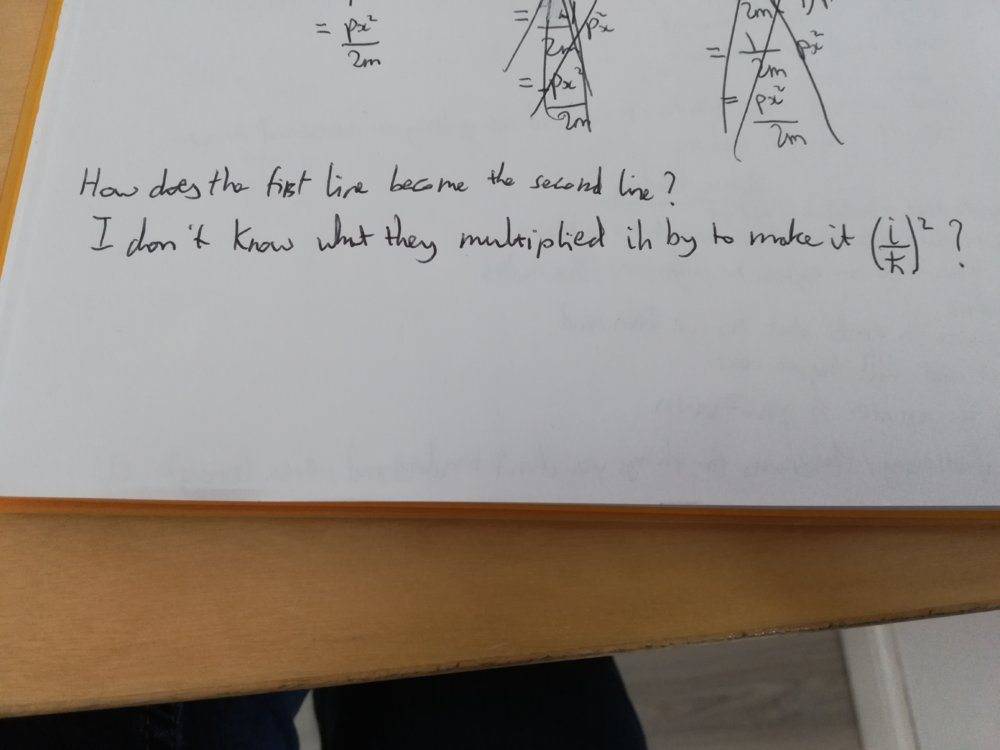
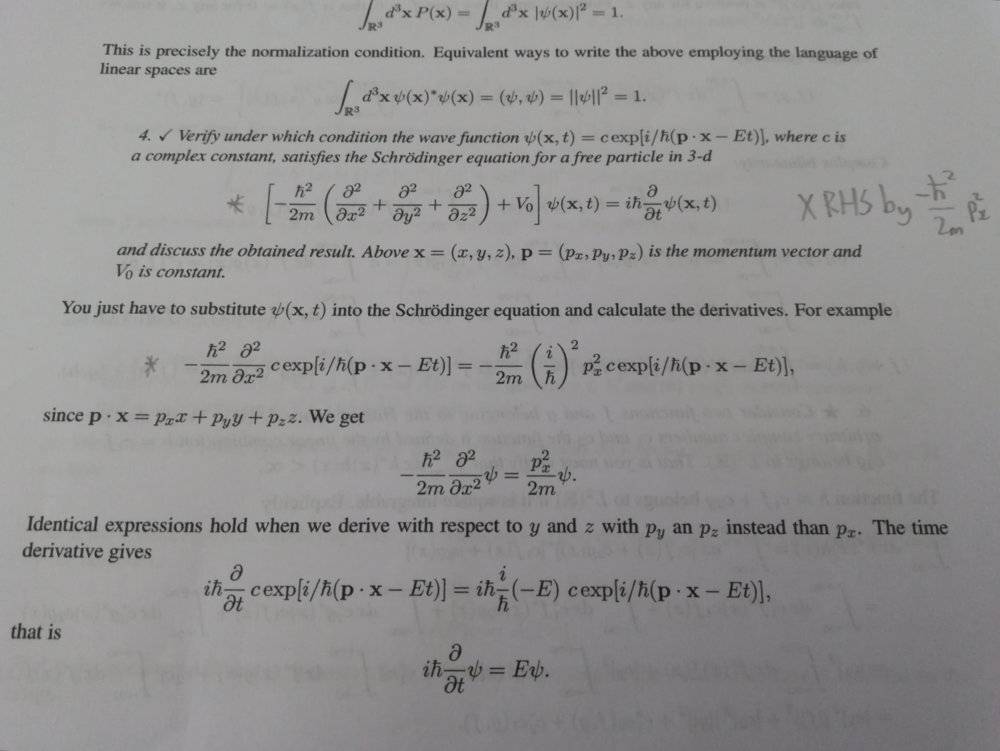
I've got the solution to the question but I just need more detail. I can't work out the first step of the solution to the second step.
IMG_20190903_092948.jpg


IMG_20190903_093320.jpg
That should read, I don't know what they multiplied ih-bar by to make it (i/h-bar)^2?
 
Physics news on Phys.org
I'm confused as to what you donate understand. Is it the appearance of ##(i/\hbar)^2## or it going away on the next line?
 
DrClaude said:
I'm confused as to what you donate understand. Is it the appearance of ##(i/\hbar)^2## or it going away on the next line?
Yeah, it's the appearance of ##(i/\hbar)^2##
 
It comes from the derivative of the exponential.

$$
\frac{\partial^2}{\partial x^2} e^{ax} = a^2 e^{ax}
$$
 
DrClaude said:
It comes from the derivative of the exponential.

$$
\frac{\partial^2}{\partial x^2} e^{ax} = a^2 e^{ax}
$$
I only managed to get this. Can you show me the exact steps on how you ended up with the second line?
IMG_20190907_174757.jpg
And what are the values of a, e and x?
 
GeolPhysics said:
And what are the values of a, e and x?
Did you intend to ask what ##e## is? It’s Euler’s number, and ##exp(a)## is another notation for ##e^a##. If you not already familiar with its properties you’re going to have to put some time into first-year differential and integral calculus before you can take on Schrödinger’s equation.

If that was just a slip of the typing fingers, go back to the ##\psi## suggested in the text, then rewrite the exponential of sums as a product of exponentials. Now you’ll be able to take the second derivative with respect to ##x## to get the ##(i/\hbar)^2## factor.
 
To add to what @Nugatory said, ##a \in \mathbb{C}## is a constant and ##x## is the independent variable, as in the differentiation.
 

Similar threads

  • · Replies 39 ·
2
Replies
39
Views
4K
  • · Replies 3 ·
Replies
3
Views
1K
  • · Replies 3 ·
Replies
3
Views
2K
  • · Replies 6 ·
Replies
6
Views
2K
  • · Replies 2 ·
Replies
2
Views
1K
  • · Replies 11 ·
Replies
11
Views
2K
  • · Replies 1 ·
Replies
1
Views
2K
  • · Replies 32 ·
2
Replies
32
Views
3K
  • · Replies 17 ·
Replies
17
Views
3K
  • · Replies 4 ·
Replies
4
Views
2K