Discussion Overview
The discussion revolves around the conditions under which energy levels of particles in potential fields are quantized, specifically focusing on the One-Dimensional Time-Independent Schrödinger equation and potential fields that may allow for non-quantized energy states. Participants explore various potential functions and scenarios, including scattering states and the continuous spectrum of hydrogen atoms.
Discussion Character
- Exploratory
- Debate/contested
- Technical explanation
Main Points Raised
- Some participants note that the solution to the Schrödinger equation for a constant electric potential results in non-quantized energy eigenvalues.
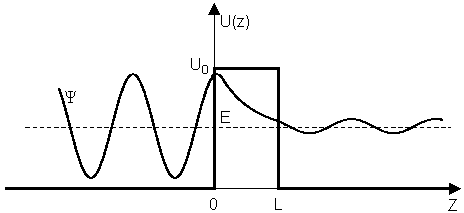
- Others mention the scattering case where a particle's energy exceeds the potential, referencing the continuous solution of the hydrogen atom.
- A participant expresses surprise at the existence of a continuous spectrum in hydrogen and questions why it is not commonly observed.
- Another participant cites historical observations of continuous spectra in white dwarfs, suggesting that extreme conditions can lead to such phenomena.
- Concerns are raised about the stability of quasi-isolated hydrogen atoms and the potential for ionization affecting observations of continuum states.
- Some participants discuss the implications of continuum states being non-normalizable and not corresponding to physically realizable states.
- There is a debate about whether additional factors beyond the Schrödinger equation might exclude the possibility of continuum states.
- Questions arise regarding the mechanisms by which electrons lose energy and the nature of interactions that can lead to photon emission.
Areas of Agreement / Disagreement
Participants express a range of views on the existence and implications of non-quantized energy states, with no clear consensus on the conditions under which these states can be realized or observed. The discussion remains unresolved regarding the specific mechanisms and conditions affecting continuum states.
Contextual Notes
Participants highlight limitations in understanding the physical realizability of continuum states and the role of wavefunction behavior at infinity. There is also uncertainty regarding the observational aspects of continuum states in various experimental setups.