SUMMARY
The Schwarzschild radius can be calculated using the formula V(esc.)=(2GM/R)^(1/2), leading to R=2GM/c^2 when escape velocity is set to the speed of light (c). This results in a Schwarzschild radius of approximately 1.46*10^-27 m/kg. While this calculation is valid, it is crucial to understand that a black hole's nature differs significantly from classical bodies. A deeper comprehension requires studying the Schwarzschild solution to the Einstein field equations, which provides essential insights into black hole physics.
PREREQUISITES
- Understanding of escape velocity and its formula
- Familiarity with gravitational constant (G) and speed of light (c)
- Knowledge of Einstein's field equations
- Basic concepts of black hole physics
NEXT STEPS
- Study the Schwarzschild solution to the Einstein field equations
- Research the implications of black hole escape velocity
- Examine Insight articles on Schwarzschild geometry
- Compare Schwarzschild radius calculations for different masses, such as the sun and protons
USEFUL FOR
Physicists, astrophysicists, and students interested in black hole mechanics and general relativity will benefit from this discussion.
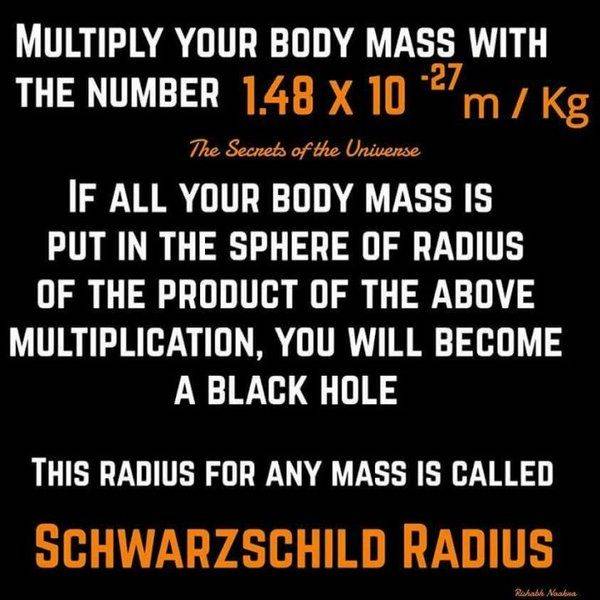 V(esc.)=(2GM/R)^1/2 that is equal to R=2GM/V^2 putting v=c,we get R=2GM/c^2 by putting the value of G,M,C we get schwarzschild radius=1.46*10^-27 m/kg